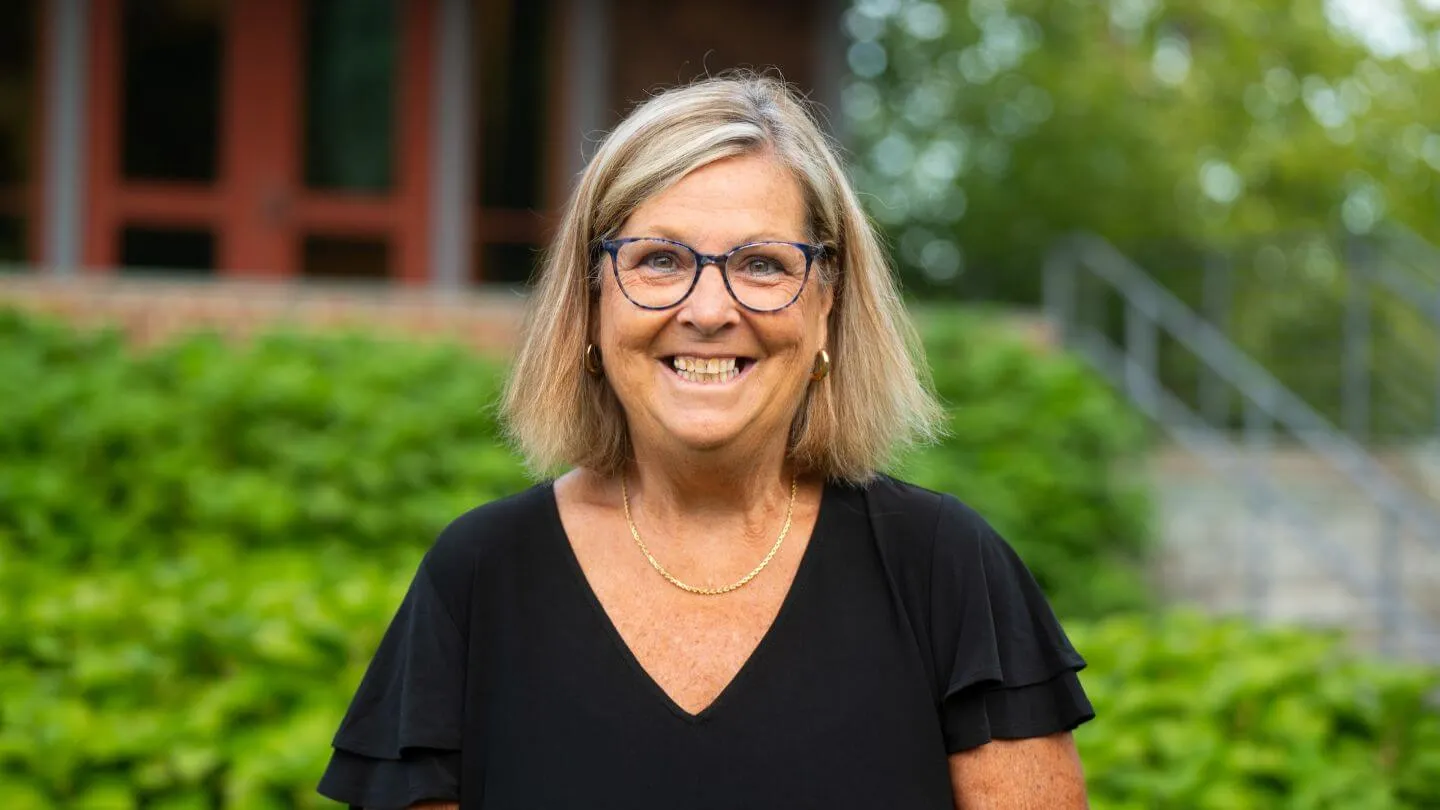
When the director of UVM’s newly formed Office of Accessibility Services (OAS) Sharon Mone talks about accessibility, she doesn’t start with compliance or checklists. She starts with people.
For nearly 18 years, Mone has helped move UVM from a decentralized approach to accommodations to an industry-leading, centralized, campus-wide model that addresses accessibility systemically and holistically. Anchored in the belief that accessibility is a shared responsibility, the Director of OAS and UVM’s ADA Coordinator is leading a values-driven roadmap that shifts campus culture from reactive accommodation to proactive design.
“Accessibility is how we turn our values into action,” Mone says. “It shouldn’t be something we do after the fact…it’s something we intentionally design from the beginning.”
That philosophy is at the heart of OAS. Formed in January of 2025, OAS realized a longstanding vision of bringing access and accommodations services under one roof, uniting student and employee accommodations, ASL interpretation and live captioning for public events, and university-wide compliance with the Americans with Disabilities Act.
According to nominator Jen Papillo, Associate General Counsel, the shift reflects both vision and persistence. “Sharon was a key voice in making this happen,” Papillo wrote. “It ensures that accessibility is woven into the framework of all we do rather than serving as an afterthought.”
Building capacity and trust
Mone started looking for work at the university after her son showed interest in attending UVM and she heard about the tuition remission benefit. Within a month, she had five interviews, but she was drawn to the office manager position in Student Accessibility Services.
“My daughter has a disability, and I thought, let’s just start here,” she recalls. “If I want to spread my wings, I can probably do that.”
She did—while also enhancing UVM’s capacity to support its community. When she started in 2008, the team was serving barely 500 students a year.
“Everything was paper-based, and the scope was narrow,” she recalls.
Today, OAS supports close to 3,000 students annually. Mone leads a team of more than 15 staff members and approximately 60 student employees, whom she describes as her strongest ambassadors for accessibility.
Centralization has also transformed access for employees. During the first year of taking on employee accommodation requests, Mone personally managed every case to fully understand the work before delegating it. In that time, employee accommodation requests tripled.
“That told us two things,” Mone says. “People were finding us, and people trusted us.”
That foundation of trust became especially important as OAS began tackling its first major, campus-wide priority, the development of an accessibility roadmap to achieve compliance with revised federal mandates for UVM's digital content by April 2027. Mone has been adamant this project will lead to action, not collect dust. “Let’s not turn this work into a binder that goes on somebody’s shelf,” she recalls.
Instead, Mone insisted the roadmap pair clear compliance requirements with practical support. “You will need to do this,” she says with a smile, “and we can help you.”
Leading with care
This cooperative approach matters in a field where conversations are often difficult and emotionally charged. When navigating questions of access, compliance, or impact, Mone leads in ways that create space for candor and trust. That trust opens the door to better outcomes, such as her collaboration with the Disabled Student Union to address potential campus barriers like transportation challenges and elevator outages. It is also how she first helped a single student continue training a service dog while attending UVM and then transformed that one instance into a thriving student group, known as UPRAWR. And on an even bigger stage, this approach makes it possible for UVM Commencement to be the gold standard for accessible campus events.
“That’s how you know you made it,” Mone says. “When families say, ‘We didn’t have to worry. It was taken care of.’”
Her care extends inward, as well. Mone emphasizes cross-training, flexibility in balance for her team, and she is known to regularly send handwritten notes of gratitude to them, as well.
“People need to know they’re seen,” she says simply.
Why it matters
Mone believes accessibility work directly reflects Our Common Ground values.
“It’s about respect, in recognizing the dignity of every individual,” she says. “Innovation, in how we design inclusive solutions. And responsibility, in ensuring equitable access to education and employment.”
And just like upholding Our Common Ground, accessibility builds a better world for everyone.
“When we remove barriers, we create more flexible, usable, welcoming environments,” she says. “It improves the experience for the entire community.”
Mone now splits her time between Vermont and Virginia, close to family in both states. Yet after years of transformation, her commitment to UVM remains grounded in one simple truth.
“It matters,” she says. “When you see a student go across the stage at commencement, and they look for you, and they bring their family over and tell them who you are and why it mattered—that’s everything.”