Farmers in the Northeast seek ways to increase on-farm feed production and to diversify their operations to increase farm profitability and climate resilience. One promising crop is soybeans because it can be grown for human consumption, animal feed, and/or biodiesel. However, growing it in the relatively short northern growing season can be challenging, and there has been limited research-based guidance for farmers. In addition, when growing soybeans and many other crops, farmers seek management practices that reduce harmful impacts on water quality. In some instances, farmers are now growing cover crops to improve soil health, thereby protecting waterways. Many farmers are also exploring reduced and no-till practices to decrease nutrient loading in waterways due to soil erosion.
In the 2022 to 2023 season, Dr. Heather Darby and the NWCS team conducted trials to: 1) evaluate soybean yield and quality under conventional growing conditions, 2) determine cover cropping management practices that enhance soil health and support high soybean yields, and 3) assess the impacts of reduced and no-till practices on soybean crops. They conducted the research at Borderview Research Farm in Alburgh, VT.
This article offers highlights from the results. Note that weather anomalies from May through October 2023 may have affected the outcomes. There were cooler-than-average temperatures in many months, low rainfall in May, and higher-than-average rainfall from June through October, much of which fell in several large storms. In July and August—key months for soybean growth—it was unseasonably cold and wet.
Highlights: Soybean Variety Evaluation Trial
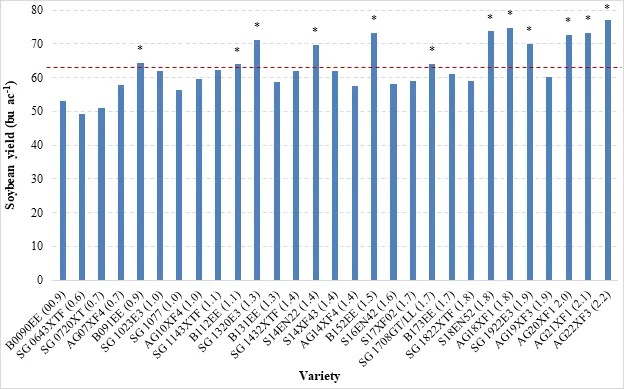
The trial evaluated 29 soybean varieties from four different seed companies spanning maturity groups 0.6 to 2.0. Even with poor weather conditions, overall soybean yields were good, with a trial average of 3,801 lbs or 63.4 bu ac-1. The average moisture at harvest was 14.6%, so minimal additional drying was needed to attain a safe storage temperature. The average test weight was 56 lbs bu-1, which is less than the industry standard of 60 lbs bu-1.
The results suggest that good soybean yields can be achieved from varieties within a range of relative maturities (0, 1, and 2) in the Champlain Valley. Figure 1 summarizes soybean yields by variety compared to the trial average, and data are organized in order of relative maturity.
Highlights: Cover Crop Termination and Nitrogen Fertility
Winter rye is a common cover crop in the Northeast. As soybean production increases, it’s important to understand the potential benefits, consequences, and risks associated with growing winter rye in soybean systems. One risk can be that the cover crop ties up nitrogen such that there isn’t enough for the subsequent soybean crop. The research team wondered whether low rates of nitrogen applied as starter fertilizer could solve that problem.
On September 29, 2022, the team planted winter rye as a cover crop, and in spring 2023 they terminated it with five different methods (Table 1 and Figure 2). On June 1, 2023, they planted soybean variety SG 0720XT into 30-inch rows at a rate of 180,000 seeds ac-1.
Table 1. Cover crop termination treatments - Alburgh, VT, 2023.
Method | Details |
Plow | Winter rye plowed under 3 weeks before planting soybeans |
Spray Early | Winter rye sprayed with herbicide 3 weeks before planting soybeans |
Spray Late | Winter rye sprayed with herbicide 1 week before planting soybeans |
Roll & Plant | Winter rye rolled and crimped just before planting soybeans |
Plant & Roll | Soybeans planted and then winter rye rolled and crimped after soybean emergence |
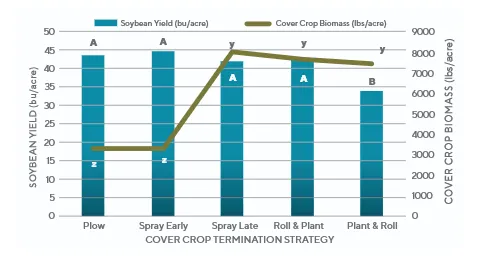
The late-terminated winter rye had twice as much biomass as the earlier-terminated winter rye. There were no statistical differences in biomass among any of the late termination methods (Spray Late, Roll & Plant, and Plant then Roll), suggesting that any difference in soybean yield among the late termination treatments was not due to differences in cover crop biomass.
Soybean yields were not statistically different in the Plow, Spray Early, Spray Late, or Roll & Plant treatments. The Plant & Roll treatment had significantly reduced soybean yields and higher seed moisture at harvest. The team did not statistically analyze soybean emergence but observed that it was 5 to 7 days later in the Plant then Roll treatment than in other termination methods. Cooler soils, late germination, and possibly lower plant populations may have contributed to yield reductions.
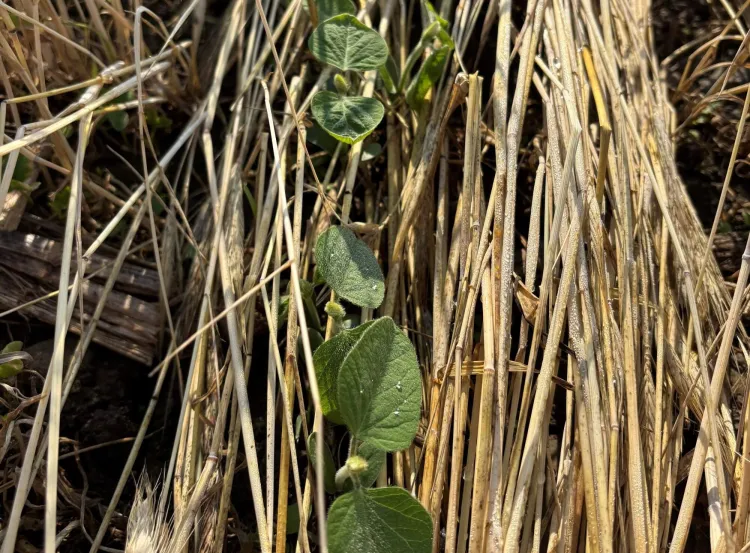
Credit: UVM Extension Northwest Crops and Soils
Highlights: Interseeding Cover Crops into Soybeans
Incorporating cover crops into soybeans can be challenging because soybeans are generally harvested in October and November. In the Northeast, the last planting window for winter rye is mid-September to mid-October. Exploring pre-harvest establishment strategies such as interseeding could provide Northeast farmers opportunities to integrate cover crops into soybean fields. Compared to post-harvest seeding, interseeding presents additional challenges related to equipment and timing to avoid damaging the soybean crop while getting good cover crop establishment. When interseeding too early, soybean plants that are young and bushy may be damaged by equipment pushing them over. When interseeding too late, pod shattering damage may occur, resulting in yield loss.
The research team was able to successfully interseed winter rye into an early soybean variety (0.7) when it reached growth stage R7 (as leaves started to die back and drop) on September 21, and a late maturity soybean variety (1.7) when it reached R7 on September 28. There was no impact on soybean yield or quality when soybeans were interseeded. Average yield was 59.6 bu ac-1, which was comparable to conventional soybean varieties grown at Borderview Research Farm that year.
Fall ground cover and rye biomass after the soybean harvest was highest when the rye was planted on September 21 but was not statistically different when planted on September 28 (Figure 3).
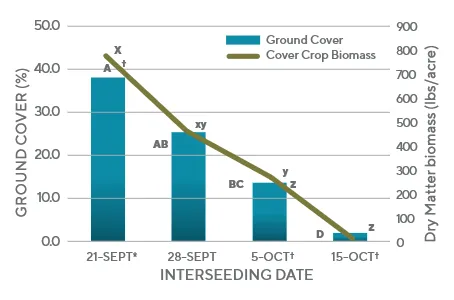
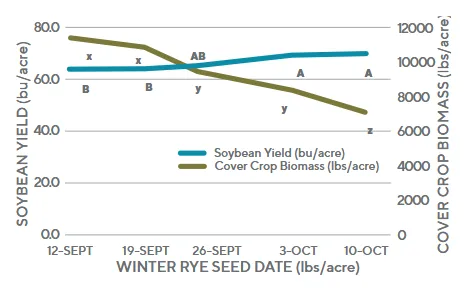
Winter rye ground cover and biomass were reduced on average 73% when planted in early to mid-October. These data suggest that winter rye planted in mid- to late September will establish better in the fall, provide more spring ground cover, and produce higher biomass the following year than winter rye planted in October (Figure 4).
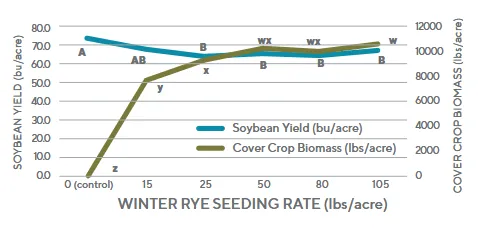
Increasing seeding rates will also increase fall establishment, spring ground cover, and spring biomass production for winter rye (Figure 5).
More Information and Resources
To learn more about soybean production in Vermont and the Northeast, see these NWCS annual research reports.
Impact of Winter Rye Planting Date and Seeding Rate on No-Till Soybeans (PDF)
Soybean Cover Crop Termination X Nitrogen Fertility Trial (PDF)
The Corn-Soybean Field Guide, published by the Eastern Region Soybean Board, is also a handy resource. The board’s 2023 Annual Report explains some of the research findings on cover cropping in soybeans in more detail.
On the website of the Soybean Research & Information Network, a search for “Vermont” brings up numerous articles about Dr. Darby’s soybean research, including the following.