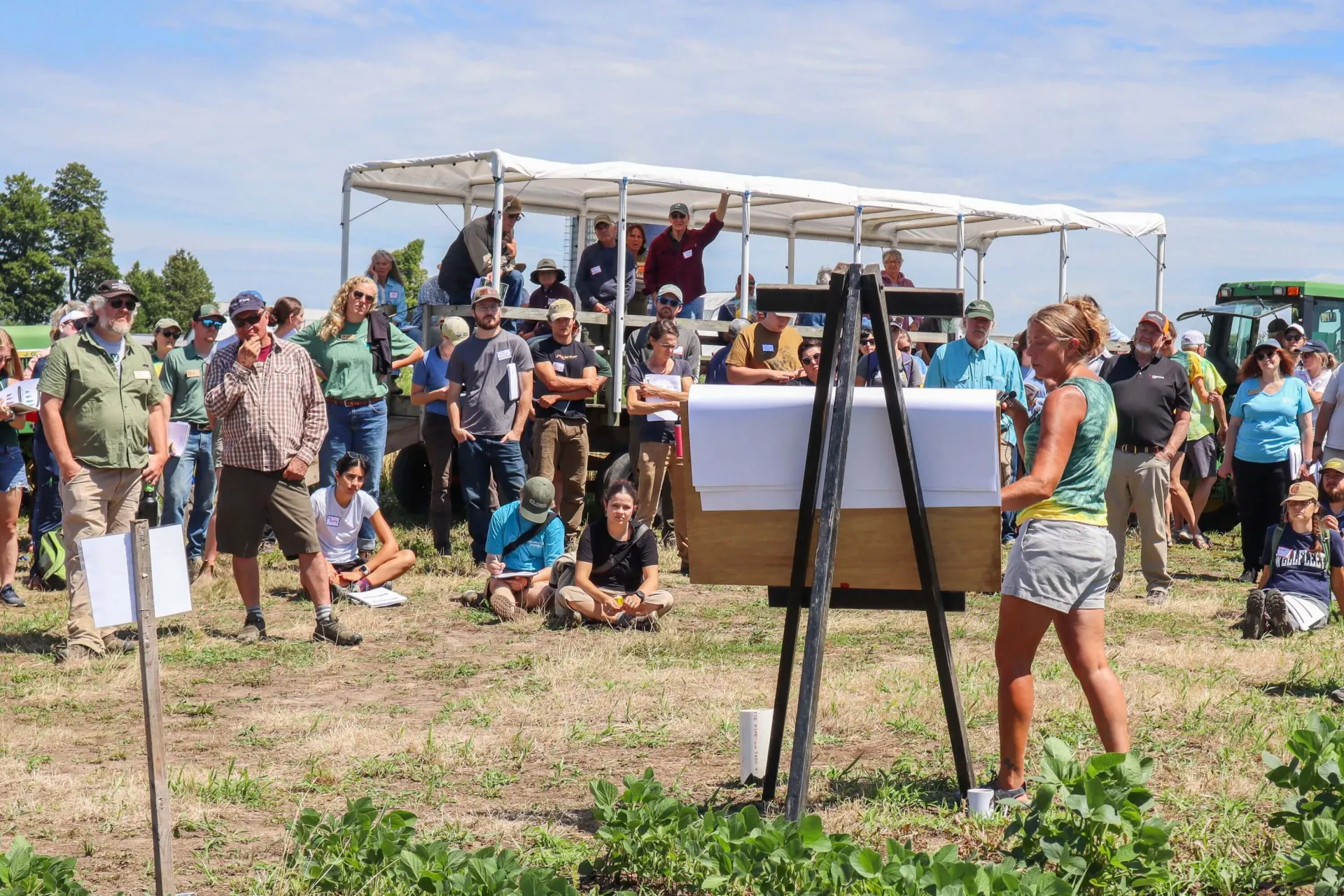
The UVM Extension Northwest Crops and Soils Program (NWCS) team holds the annual event to showcase their innovative agricultural research and connect with the local community. Led by agronomist and UVM Extension Professor Dr. Heather Darby, the NWCS team conducts research to answer farmers’ questions and provide timely, useful information to the agricultural community.
More than 200 farmers, researchers, students, service providers, legislators, and community members attended the event, dubbed “The Demonstration Derby” this year. It featured more live demonstrations and hands-on activities than previous field days. Some guests, such as Sloane Selenis of the USDA-ARS Food Systems Research Unit, arrive knowing exactly what they want to learn. “I’m excited for one of the afternoon workshops on forage species and species identification.”
Others come ready to soak up whatever the day has to offer. “I always pick up one or two new things. Often, I don’t know what those are going to be. I’ll be surprised by one of the presentations or pick up something that I didn’t think I’d learn,” said Farmers Watershed Alliance Chair and farmer Scott Magnan.
The event always begins with welcome remarks from Dr. Darby and a prompt to “follow the folks in the green and yellow tie-dyed T-shirts!” Instead of a traditional uniform, the NWCS team sports tie-dyed attire created by the Alburgh business New Dye.
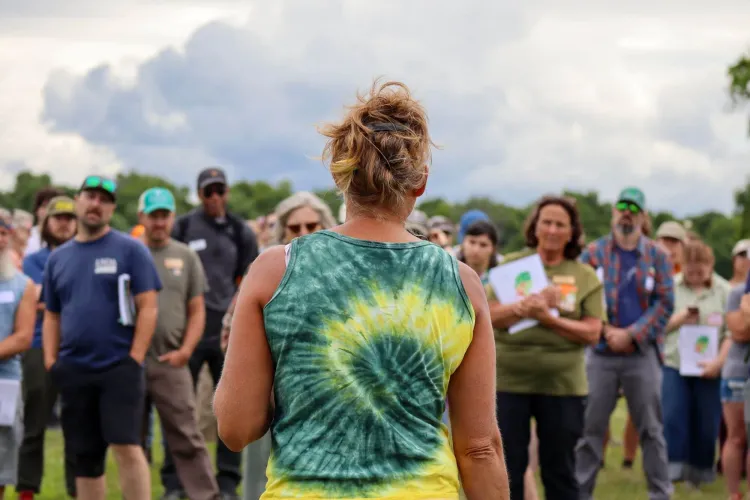
Next on the agenda was a guided farm tour inviting guests to learn about local research directly from the researchers while viewing the fields where data was gathered. At nine tour stops, Dr. Darby and her team gave overviews of their diverse research work on strawberries, vegetable seeds, cover crops, corn, dry beans, seed treatments, and more.
Tour Highlights
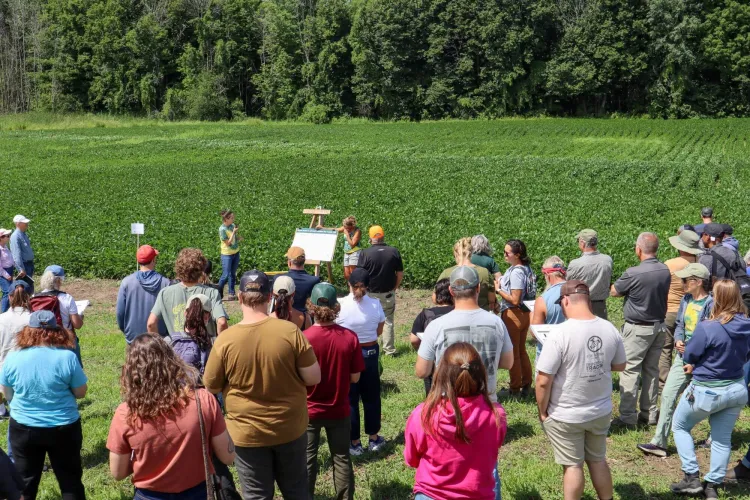
NWCS Research Specialist Lindsey Ruhl described the program’s biochar research. Biochar is made by burning feedstock (e.g., manure, biosolids, wood, straw, or other plant residue) at high temperatures in low oxygen conditions. This procedure chars the materials and converts them into a stable carbon-rich soil amendment. Biochar can provide many benefits, including increased soil fertility, higher yields, improved soil health, and a reduction of carbon dioxide emissions. However, biochar’s unique properties are influenced by factors such as its feedstock, burn temperature, and burn time. Furthermore, the extent of its beneficial impacts depends on its properties, application rate, existing soil properties, residence time in soil, and crop needs. The NWCS team has conducted field trials over three years to explore how biochar can impact corn silage yield, soil health, and greenhouse gases. The team is still working to understand the effects of biochar, but preliminary results are promising, showing that when manure and biochar are applied to corn silage, yields may increase. Stay tuned for biochar research updates on our website!
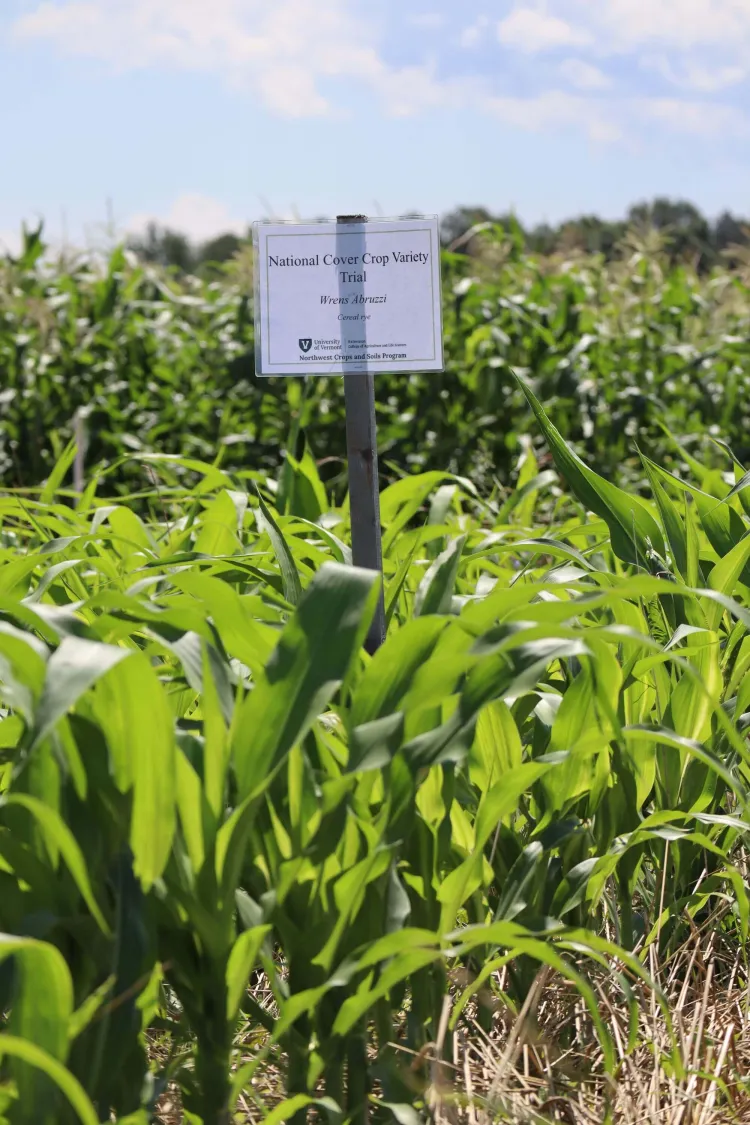
“Shout out for the cover crops!” said Dr. Heather Darby, highlighting the program’s research into double cropping cover crops--using them as cover crops and forage crops. “What has made cover cropping more desirable by many operations," she said, “is the fact that somebody looked at it one day in the spring and said, ‘Wow, that looks like good feed for my cows.’”
At a later tour stop, Daniel Bliss, NWCS precision agriculture specialist, described the program’s research on neonicotinoid seed treatments. Neonics are a systemic, broad-spectrum seed treatment, meaning they kill a wide range of pests that harm crop seeds and reduce yields. Neonicotinoids are effective at controlling pests, but they can also pose a threat to beneficial insects and pollinators. Vermont is enacting a ban on all neonicotinoid seed treatments beginning in 2029. In preparation, NWCS has developed research projects to understand how the ban may affect crops and soil health and to help farmers identify safe, effective alternatives. Currently, the team is focused on understanding whether neonics are effective against early-season pests such as wireworm and seedcorn maggot.
Breakout Session Highlights
Interested in soil health? Precision agriculture? Fiber arts? This year’s five breakout sessions had something for everyone! Here are a few highlights from the afternoon.
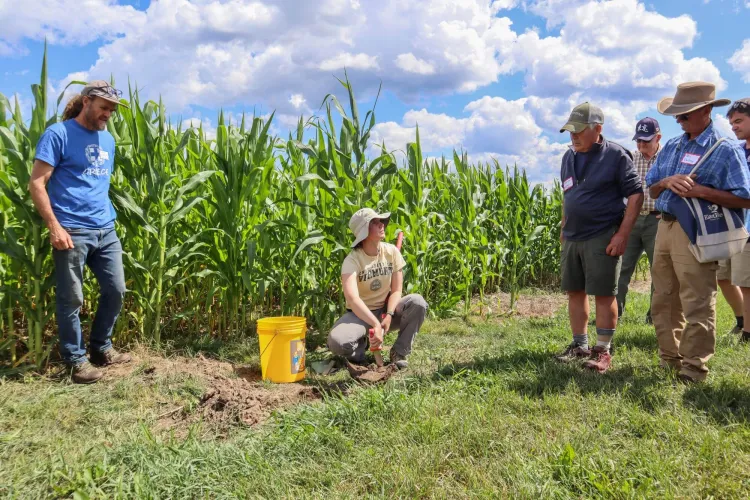
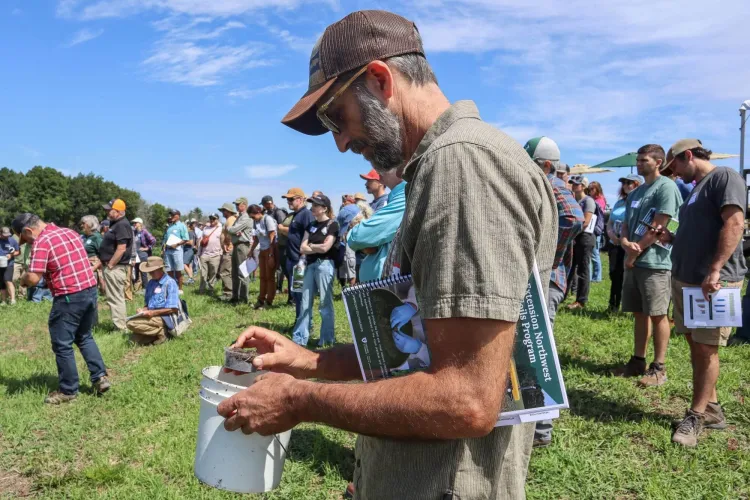
The Soil Health Research and Extension Center (SHREC) team hosted a session on how they test the physical properties of soil in their lab. Marie English, SHREC lab manager, demonstrated the correct procedure for taking a soil sample for analysis by the SHREC lab. Rather than take soil samples with a probe, she explained that it’s best to take slices of soil with a shovel. This method preserves the soil’s aggregate structure, allowing researchers to better analyze its physical characteristics, making it the ideal strategy, especially for CEMA 216 soil testing for the USDA Natural Resource Conservation Service.
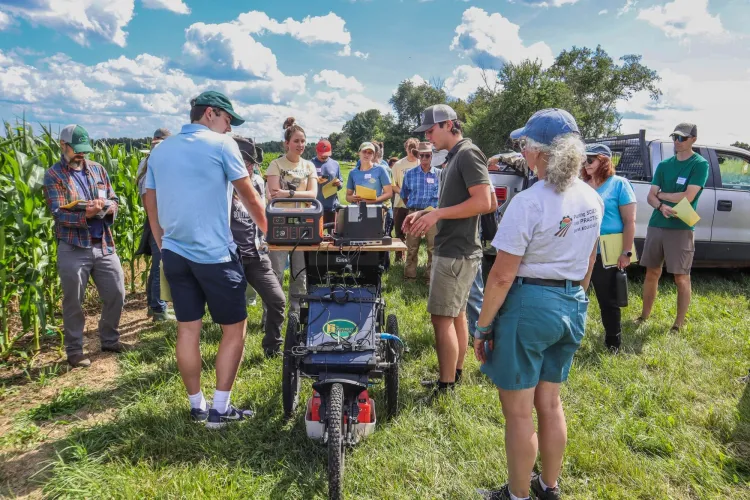
Alex Hoefer and Luke Ste. Marie, mechanical engineering students at the University of Vermont, exhibited Ground Penetrating Radar (GPR) at the SHREC breakout session. The GPR creates imaging of underground infrastructure, freeing humans from the drudgery of shovels. It can help farmers by mapping soil compaction and moisture levels in fields.
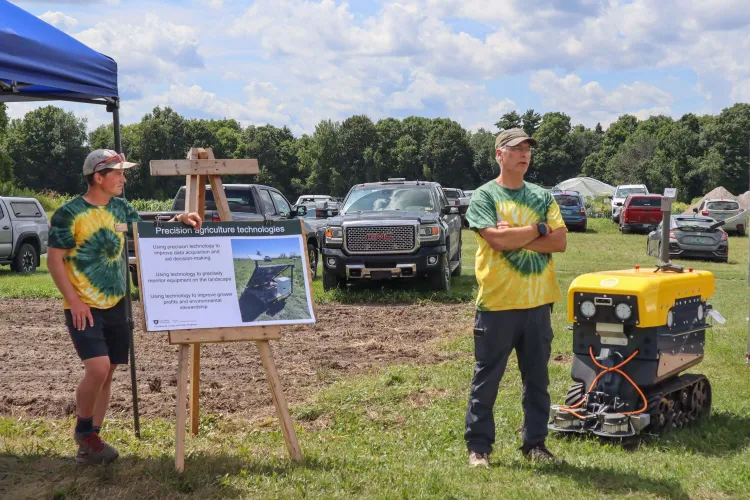
Bliss and Jeff Sanders, NWCS agronomy specialist, provided updates on their precision ag research, including their project on autonomous weeding robots. “The robots seem useful,” said Jacob LeDuc, Research Technician at the Willian H. Miner Agricultural Research Institute in Chazy, NY. “Probably challenging at first, but super exciting for the future as the technology improves.” This summer, Bliss and Sanders were assisted by NWCS intern Addison Gates, who will begin studying engineering at North Carolina State University this fall. Learn more about her experience in our recent article.
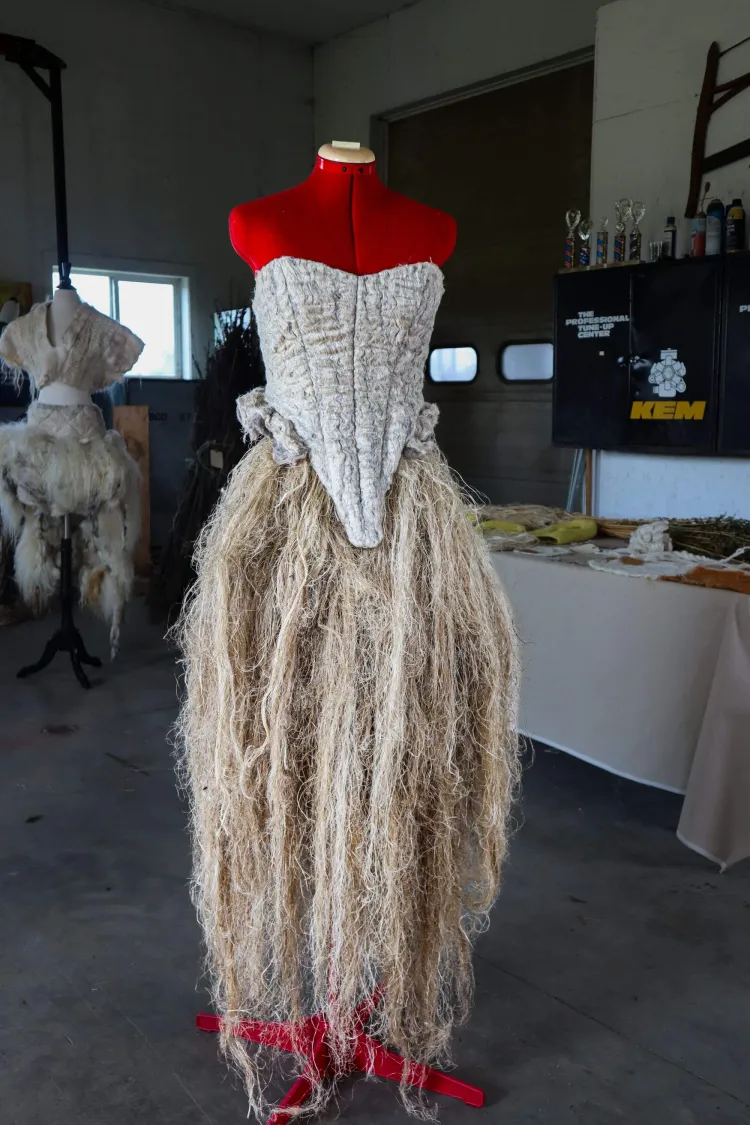
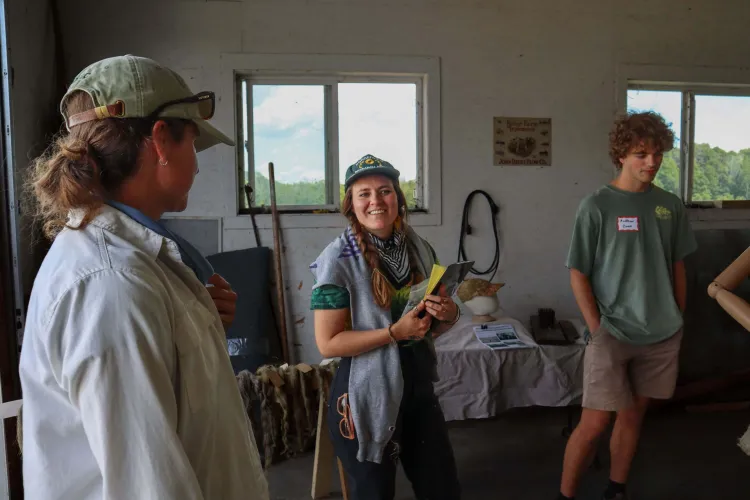
Another breakout session, hosted by Laura Sullivan, NWCS hemp research specialist, offered a retrospective art exhibition featuring clothing and fiber art she designed and created using locally sourced hemp, flax, wool, dyes, and other natural materials. Some of this artwork will be on display at the National Industrial Hemp Council's Global Hemp Fiber Summit in New York City, September 16-18. After six productive years with NWCS, Laura has moved on to complete an artist’s residency in Ireland focused on fiber art and clothing design. Thank you for all your amazing work, Laura!
It was a day full of local research, connecting with the community, a delicious catered lunch by Cold Hollow Catering, and many, many Ben and Jerry’s ice cream bars. What more could we want? A huge thank you to all our partners, sponsors, and presenters who helped make this year's event such a success! Shoutout to ReMarket in St. Albans for helping us with our program banner. Last, but not least, a very special thank you to Roger and Claire Rainville, owners of Borderview Research Farm, for hosting our program and Annual Field Day and for their dedication to agriculture.
We can’t wait to see everyone next year for the 20th Annual Crops and Soils Field Day! Sign up for our monthly email newsletter to receive event information and the latest research updates.
Check out our social media channels to see more content from the 19th Annual Crops and Soils Field Day.