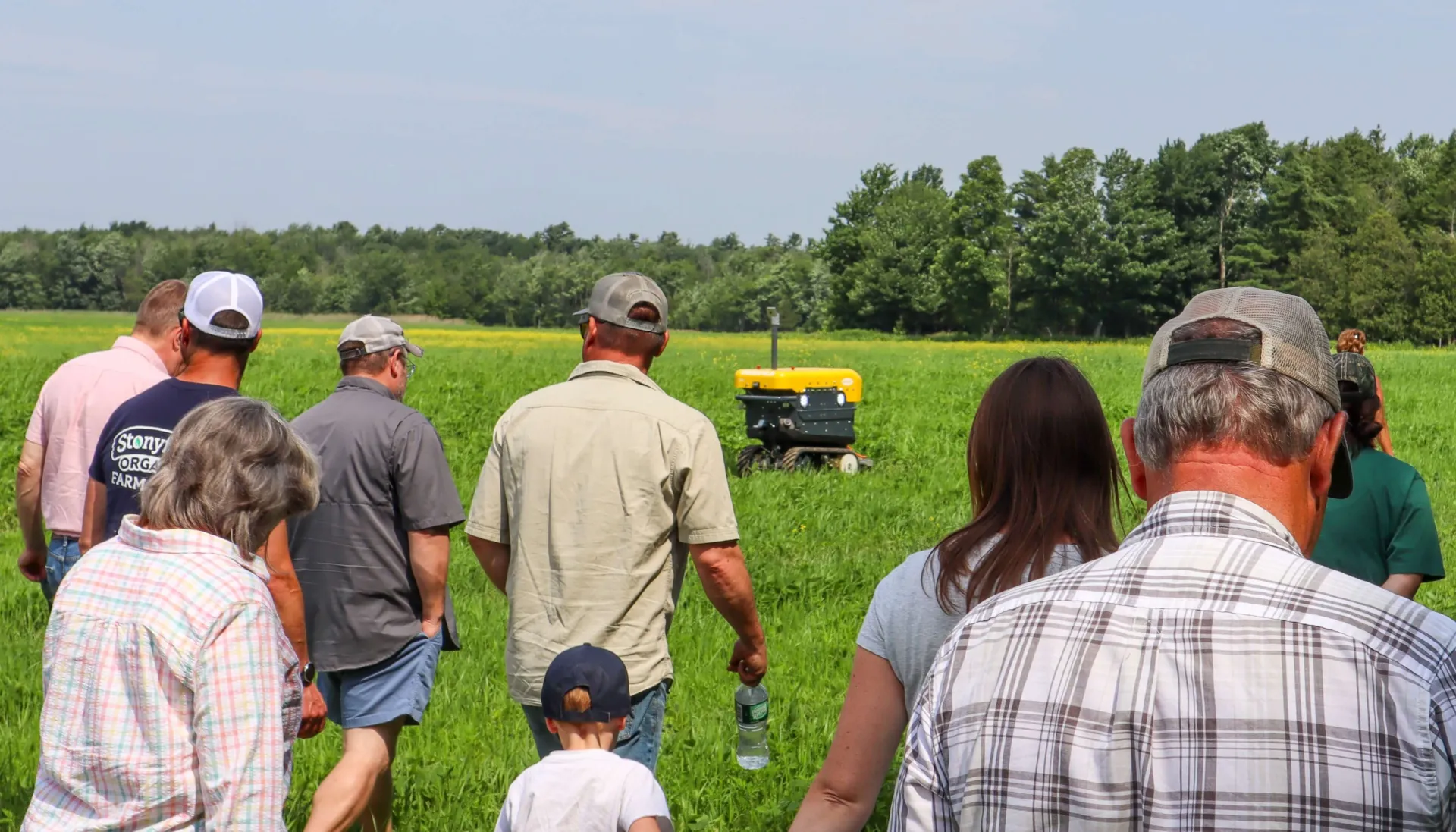
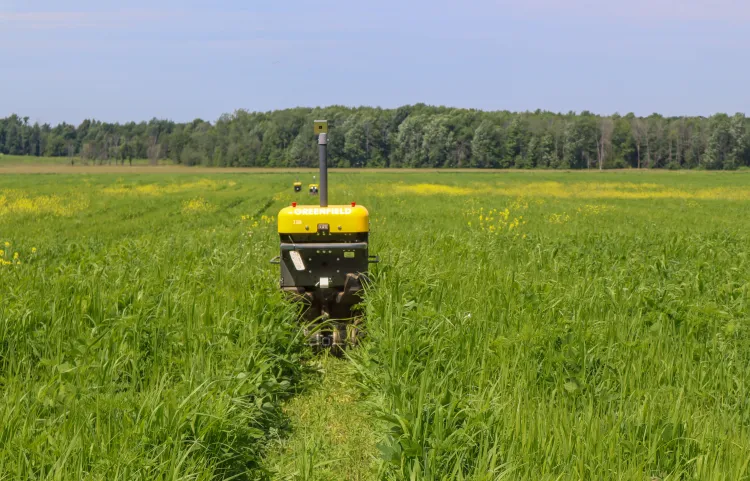
On June 30, more than 45 farmers, researchers, government agencies, and community members gathered at Henry Bros. Wolfridge Dairy in Alburgh to watch the robots autonomously mow weeds between rows of soybean plants.
The project began with a simple question. Could this technology become a practical and worthwhile investment for Vermont farmers? UVM Extension Professor Dr. Heather Darby wanted to know whether autonomous weeding robots could perform effectively in Vermont's rocky fields, diverse soils, and varied growing conditions. Through on-farm research and demonstrations like the June 30 event, the team is working to find the answer.
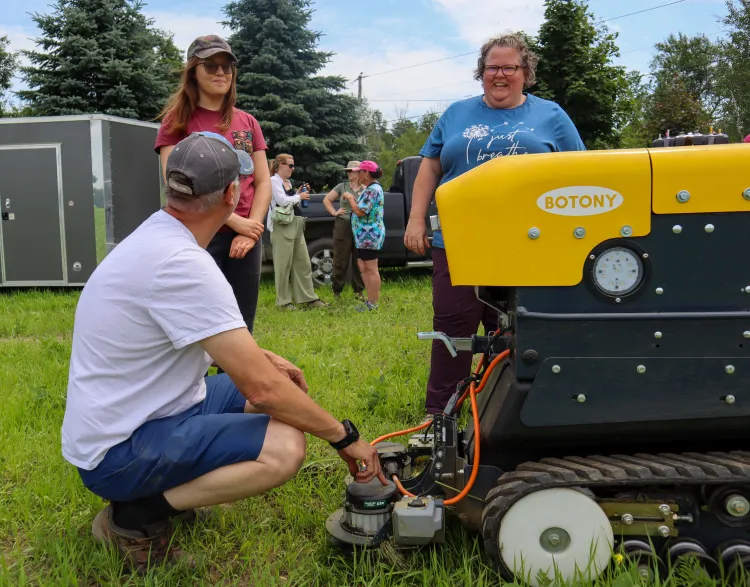
Jeff Sanders, UVM Extension agronomy specialist, and Daniel Bliss, UVM Extension precision ag specialist, are leading the project, equipped with six of the robots.
At the field day, Darby, Sanders, and Bliss fielded questions and curiosity about the robots and shared their impressions of them so far.
The robots are designed to mow in 30-inch crop rows. So far, the team has tested them in corn and soybean fields.
“I see pumpkin being an option, or anything like that on a 30-inch row” said Darby in response to a question about the robots’ capabilities. The team plans to test the robots in black beans and sweet corn later in the season.
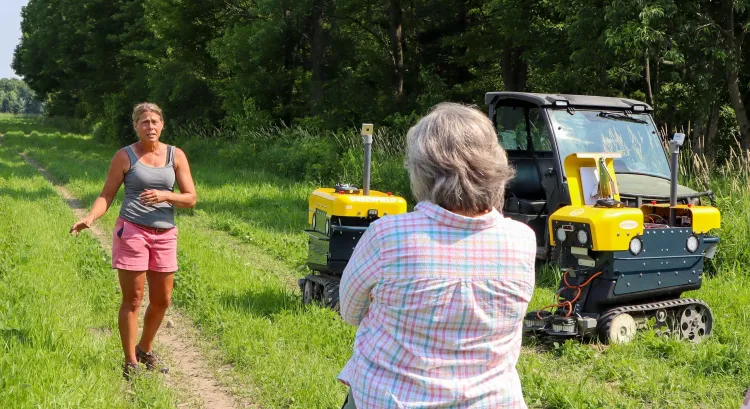
To operate autonomously, each weeding robot requires a virtual field map. To create these maps, Adam Reck, Greenfield Robotics northeast territory leader, flies a rigid-wing drone 350 feet over a field when the crop is 4 to 6 inches tall. It collects photos and data to create a very high-contrast map that determines precise paths the robots will follow. Guided by the map, a robot can cover about 7 acres per day.
Each robot is powered by two lithium-ion rechargeable batteries stored under its yellow hood. One guest asked whether the batteries must be removed to be recharged.
“There are two ways to do this,” Reck responded. “You can remove the rechargeable batteries and replace them with fully charged ones.” The second option is, “On the machine, there is a port that can charge the battery while it’s still in the bot.” The NWCS team typically uses the latter option. We transport and store the robots in a custom trailer with chargers mounted on a wall.
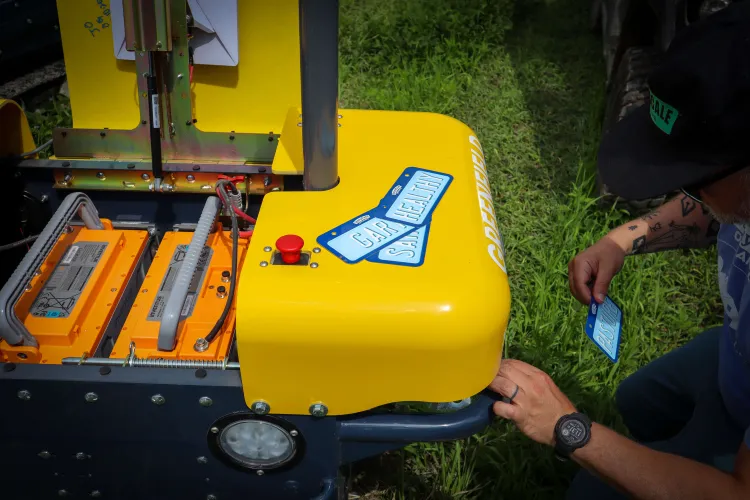
How long do the batteries last? Each robot operates for approximately 3–3.5 hours on a single charge, and recharging to full capacity takes about the same amount of time. For most farming operations, a single robot would not provide enough field capacity to complete weeding in a timely manner. Instead, multiple robots working simultaneously would likely be needed to cover enough acreage efficiently.
To launch the robots, users open the Greenfield Robotics app and issue the command, "Start Robot [robot's assigned number]." Once activated, the robot begins navigating the field autonomously using its preloaded field map.
Sanders described one challenge they have faced so far: cell phone service.
“You need to have cell service to turn the bots on. Our team uses Starlink to get service in rural areas where there is typically no cell service.” This solution has worked OK so far, but the service can be spotty and has caused delays in the project.
Darby joked that Greenfield should create snowplow attachments to make the robots useful throughout the whole year. She envisions another potential use for the robots along fence lines. “Fence lines are easy to map. I can see farmers using them to mow there in addition to in between crop rows.”
Sylvia Jensen, a water quality specialist with the Vermont Agency of Agriculture, Food and Markets, was impressed with the robots’ performance. “This is just amazing to watch all three robots interacting with themselves, no duplication.”
When asked whether they could be useful for Vermont farmers, Jensen said, “Yes. I spoke with one other farmer, and we are hoping the cost comes down, but I think that [will happen]... in time. But I think in an organic situation, this could be a game changer.”
Our research with these robots is just beginning.
Do you have questions about the robots? Want to see a live demonstration? Take a trip up to Alburgh for the 2026 Annual Field Day on Thursday, July 23, at 10:00 a.m., where Sanders and Bliss will conduct a demonstration the autonomous weeding robots and provide an update on precision agriculture technology.