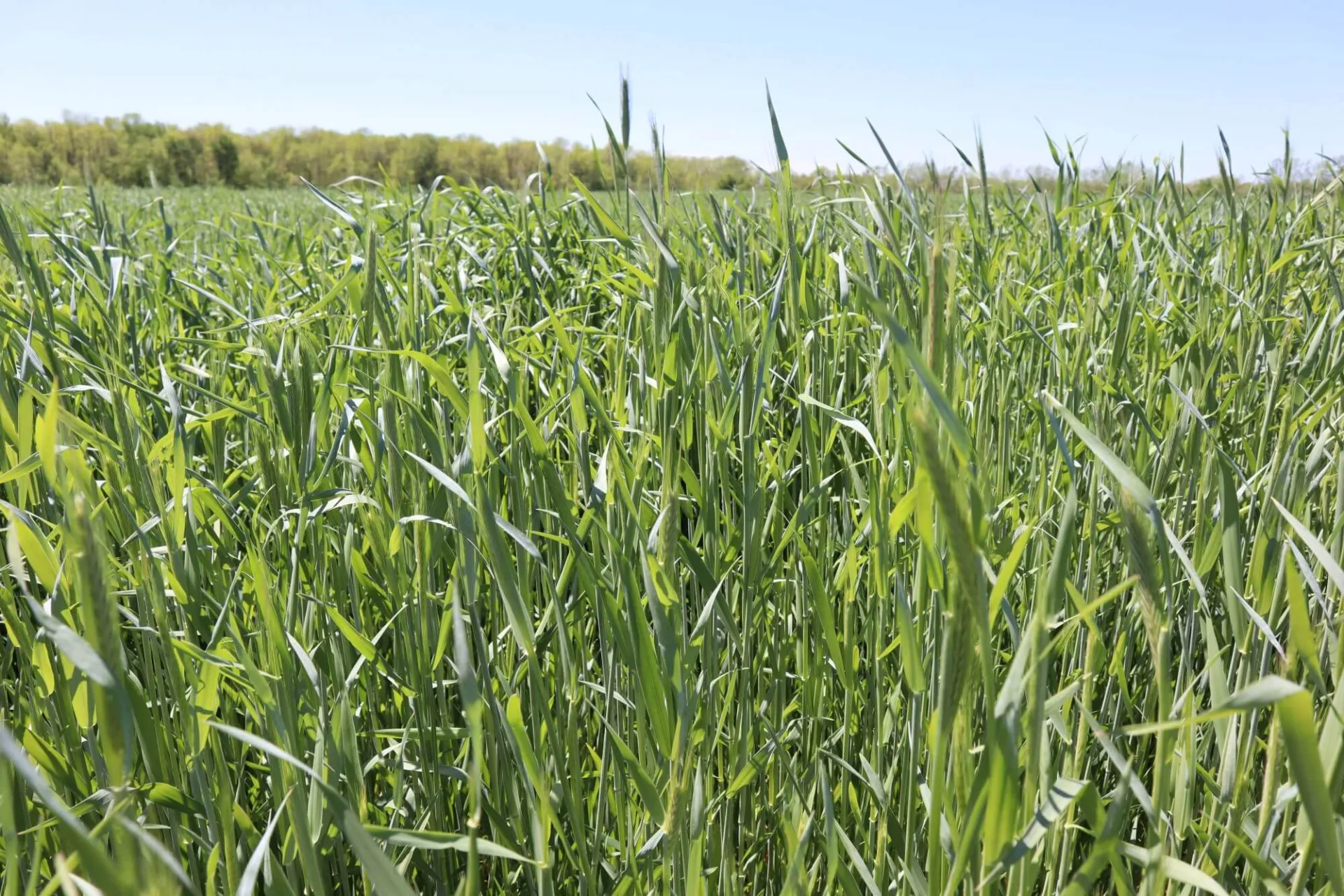
Cereal rye (aka winter rye) is the most frequently used cover crop in Vermont and the U.S. It is cold hardy and provides many ecosystem services, including erosion control, weed suppression, and reduced nitrate leaching into groundwater and waterways. To achieve these ecosystem services a cover crop must be well established and have adequate shoot and root growth—it must have good biomass. Cereal rye’s biomass declines as sowing dates get later in the fall. When exactly is the optimal time to plant cereal rye? Can we compensate for lower biomass due to late planting dates by increasing seeding rates?
Researchers in seven Northeast states collaborated to find out. They explored whether increasing cereal rye (Secale cereale L.) seeding rates could compensate for lost growing degree days when sowing is delayed, and whether early spring ground cover could predict late spring biomass to guide grower decision making on termination strategy. Their methods and findings were recently published in “Sowing date and seeding rate influence cereal rye productivity across the Northeastern United States” (Agronomy Journal, 2026, https://doi.org/10.1002/agj2.70376).
UVM Extension Professor Heather Darby and Research Specialist Ivy Krezinski were two of the collaborators, conducting trials at Borderview Research Farm in Alburgh, VT. The other researchers’ trials were in South Deerfield, MA; Freeville, NY; Rock Springs, PA; Georgetown, DE: Beltsville and Queenstown, MD; and Storrs, CT.
From fall 2021 through spring 2023, the researchers studied: a) the effects of sowing date relative to the historic first frost date of each location; and b) seeding rate (0, 15, 30, 60, 90, and 120 lbs ac−1) on productivity and weed suppression.
Across all sites, they found that the optimal window for sowing cereal rye is during the four-week window around the historic first frost date for that location. (In Alburgh, VT, that window was two weeks before and two weeks after October 1.) At all sites, sowing after that window decreased ground cover by 57% and biomass by 44%. Increasing the seeding rate could not fully compensate for the loss of growing degree days.
However, in Alburgh, VT, there was a clear trend: Ground cover increased with increasing seeding rates at the late sowing date. Increasing the seeding rate to 100 lbs ac−1 when seeding late in the fall may be warranted when overwinter ecosystem services are a priority. However, these planting dates and seeding rates were only established for one site in Vermont. Future research should evaluate a larger range of Vermont environments.
The researchers also found that increasing cereal rye seeding rates up to 55 lbs ac−1 maximized ground cover, biomass, and weed suppression at most sites. This rate is lower than existing regional recommendations and could save farmers money on seed costs for comparable ecosystem services. However, when overwinter ecosystem services such as nitrogen retention and erosion control are primary goals, seeding rates up to 80 lbs ac−1 may be warranted to maximize winter and early spring ground cover.
Finally, the researchers found that, independent of sowing date, cereal rye’s ground cover in early spring was a good predictor of its biomass at anthesis—the transition from vegetative growth to grain and seed production and the ideal time to terminate by roller crimping. Technology being developed will use early spring ground cover satellite imagery to help growers predict maximum cereal rye biomass accumulation.
For more information about the study and its findings, contact Dr. Darby at Heather.Darby@uvm.edu or see “Sowing date and seeding rate influence cereal rye productivity across the Northeastern United States.”