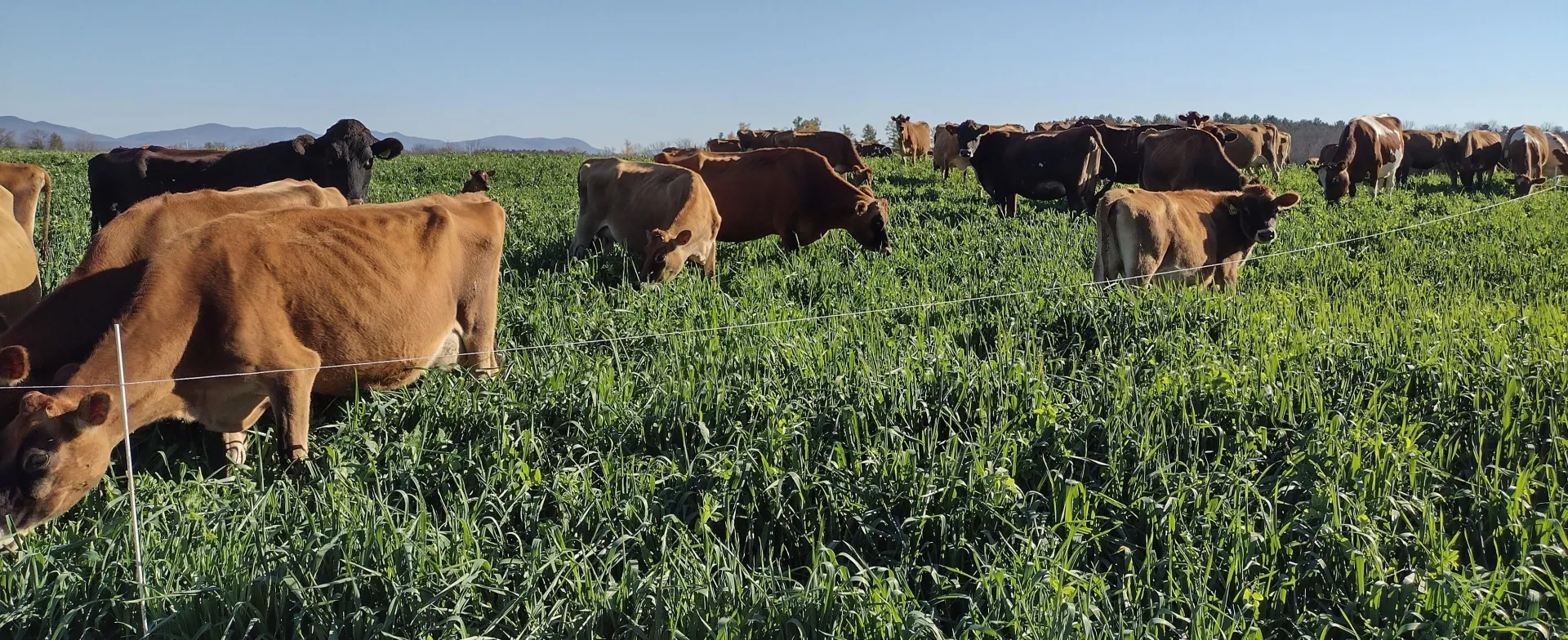
Vermont has one of the highest cover crop adoption rates in the country. In 2022, approximately 12% of Vermont cropland was cover cropped, but the national average was 4.7%. Cover crops provide multiple ecosystem services that benefit the environment and farm economics. Planting annuals as dual-purpose crops—as cover crops and forage crops—may increase their direct economic value to farms and, in turn, expand cover crop adoption.
Dr. Heather Darby and her team at UVM Extension’s Northwest Crops and Soils Program wrote on this topic for the book Cover Crops for Sustainable Soil Management (Burleigh Dodds Science Publishing, 2026). Chapter 6, titled “The Role of Cover Crops in Forge Production,” describes dual-purpose cover cropping (aka double cropping) and associated management practices such as species selection, nutrient management, harvesting, storage, and feeding. The chapter also explores examples of double cropping on Vermont farms.
“Using cover crops as forage has helped to expand the adoption of cover crops because they can be multipurpose,” Darby says. “They can help protect the soil over the winter and then serve as a valuable feed in the spring.”
The book chapter focuses on production practices for harvesting cover crops both as stored feed and in grazing systems. Here are some highlights from the chapter.
How Dual-Purpose Cover Cropping Works
In Vermont and other northern states, when fall corn silage harvesting is complete livestock farmers plant cover crops—grasses such as winter rye or legumes such as clover. The plants establish in the fall, overwinter, regrow in the spring, and are terminated before the cash crop is planted. Though the short window between summer cash crops in the Northeast can make it challenging for farms to incorporate cover cropping, state and federal cost-share programs often require it for soil conservation, water quality protection, and other benefits.
As livestock farmers started growing cover crops, they realized that the lush green cover in early spring looked like an excellent source of forage. Some farmers short on feed began to use it as emergency feed. When cover crops grew too rapidly in the spring to handle with common tillage tools, others harvested and stored it as feed. How livestock farmers viewed cover crops and their benefits began to shift, and cover crops for many are now part of a double-cropping system.
For cover crops to produce maximum output, farmers must grow them as they would a cash crop—carefully selecting the species, using proper seeding methods and rates, planting on-time, and fertilizing. Many factors influence whether a cover crop harvested for forage provides an economic benefit to the farm, including proximity to livestock; cost of growing a high-yield, high-quality cover crop; and overall demand for forage in any given location. Economic analyses of double-cropping are limited, and the economic impacts are variable, depending on several factors. But increasing numbers of livestock farmers are focusing their cover crop goals on both soil conservation (soil health and protection from erosion in winter) and valuable, nutritious feedstuff for their herds.
Species Selection
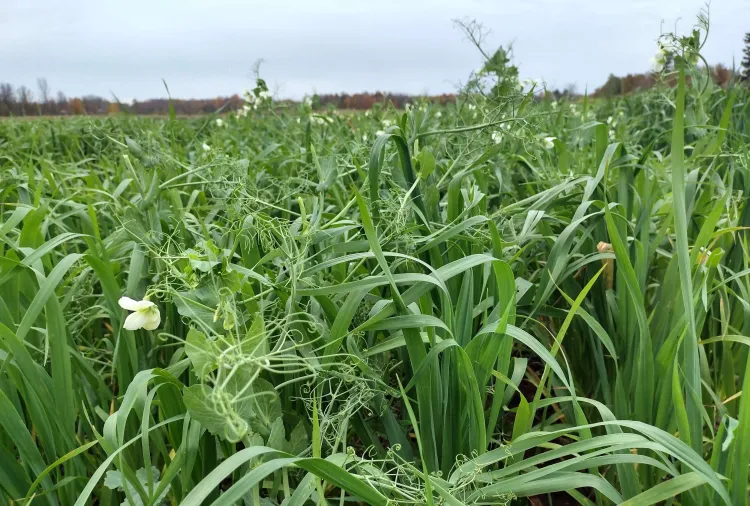
Goals driving species selection for double cropping may include early vigor, winter hardiness, maturation timing, high nutrient quality, high yield potential, palatability, and grazing adaptability. Species that meet these criteria are primarily cool-season forages, including annual ryegrass; cereal grains (wheat, barley, rye, triticale, and oats); brassicas (turnips, radishes, kales, and hybrids); and legumes (clovers, peas, and vetches).
Farmers often use cover crop mixtures to achieve multiple agroecosystem benefits simultaneously, particularly in beef, sheep, and some dairy systems. But selecting species that perform well both as a cover crop and as forage is tricky, and research on mixes for forage production is limited.
Nutrient Management of Cover Crops Grown for Forage
Though it is generally not common practice to fertilize a cover crop, if it is to be harvested as a forage, it should be managed as if it were a cash crop. As with any other crop, a farmer must know what nutrients are available in the soil and what additional nutrients may be required to meet the crop’s yield and quality goals. Forage yields of cover crops will vary by species, planting date, and harvest date, in addition to weather conditions and residual soil fertility. Furthermore, removal of the cover crop biomass as a forage crop will remove soil nutrients, impacting fertility requirements for the subsequent cash crop.
Harvest of Cover Crops Grown for Forage
In the Northeast cover crops can produce significant biomass rapidly in the spring. Farms must have a planned strategy for limiting this growth early in the season so it doesn’t compromise establishment of the cash crop. Harvesting the cover crop for forage is one of the most effective ways to remove that biomass in preparation for the cash crop and provides additional benefit to the farm while preserving many of the cover crop ecosystem services. Cover crops can be removed through livestock grazing or mechanical harvest.
Examples from Northern Vermont
Double cropping cereal rye on dairy farms
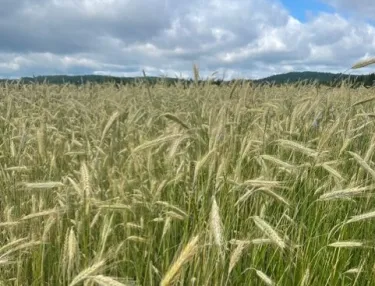
To increase milk production and components, some northern Vermont dairy farms that grow corn silage have begun double cropping to supplement feedstocks. Triticale and cereal rye are common winter grain choices. Cereal rye is much less expensive (roughly half the price) and, when harvested properly, produces excellent feed. Triticale, though more expensive, often matures later than cereal rye, providing a wider harvest window for excellent quality feed.
In northern Vermont, the second to third week of September is ideal for planting cover crops, and the recommended seeding rate for double cropping is substantially higher than for cover cropping because the goal is to harvest high biomass. For all cover crops, seed should be planted with a grain drill or broadcast and then lightly harrowed in.
When double cropping and applying manure in the fall, adjust spring fertilizer rates. Fertilize the field when the plants come out of dormancy. For cereal rye that’s typically in April, when the temperature rises above 38 degrees Fahrenheit. Applying roughly 60 pounds of nitrogen per acre can increase yields and boost protein levels.
Harvest winter cereal grains at the first reasonable weather window. Though this practice may seem to sacrifice quantity for quality, high-quality forage for livestock far outweighs a higher quantity of low-quality dry matter. Ideally, harvest small grains in the boot stage prior to seed head emergence (mid- to late May in northern Vermont) to reap as much yield and quality as possible. Once the seed head has emerged, the quality will be too low to feed to lactating animals. Monitor fields and weather closely as cereal grains can progress through these growth stages quite rapidly depending on conditions.
Double-crop feed is comparable or better than high-quality first-cut grass silage. Protein levels of >15% are common, and fiber digestibility is in the 60s to low 70s. These qualities make it an excellent supplemental feed source for high-producing dairy cows. Research has shown that a 1% increase in forage fiber digestibility corresponds to a 0.40 pound/cow/day increase in dry matter intake and, subsequently, a 0.55 pound/cow/day increase in milk production. Increasing the inventory of exceptional-quality forage will pay off by maintaining high milk production throughout the season, especially during hot spells in the summer. Obtaining this forage from a cover crop is a win-win for the dairy farm’s land, animals, and economics.
The costs of double cropping vary widely depending on location, seeding timing, field conditions, access to equipment, and harvest goals. Seed costs will vary by winter grain species, but prices typically range from $0.22 to $0.45 per pound. Seeding rates will range from 120 to 140 pounds per acre, depending on the planting date. Additional fieldwork could include picking stones, and fields are often rolled after planting to improve seed-to-soil contact and smooth the field surface to facilitate mechanical harvest. Such time and work are added expenses. Table 1 outlines approximate expenses for double cropping beyond that of managing a regular cover crop.
Table 1. Average costs for double cropping management beyond traditional cover cropping
Expense type | Cost per acre |
Seed | +$18 |
Planting | +$0 |
Post-seeding rolling | +$15 |
Mowing | +$18 |
Merging | +$15 |
Fertilizer | +$40 |
Total | +$106 |
The degree of benefit farms receive from this system is highly dependent on how well it is managed, from planting through feed out. Although results can vary from year to year and additional planning and management are required, Vermont farmers who have adopted this practice stick with it because of the valuable benefits to their farm and the environment.
Grazing Cover Crops on Organic Dairy Farms
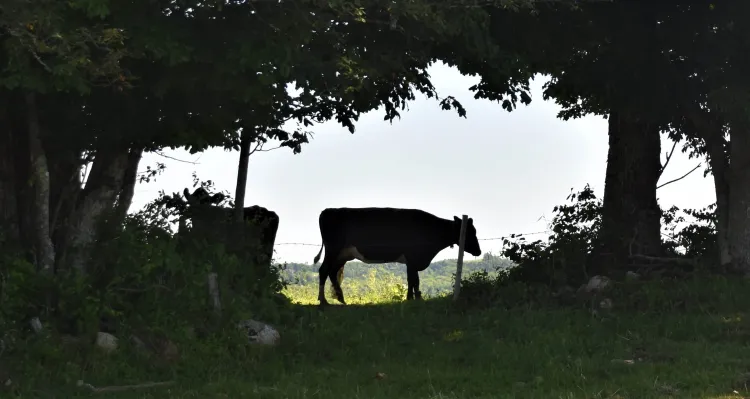
At a farm in Cornwall, Vermont, annual cover crops often grow in every season. The farm manages a herd of about 60 milking cows that calves year-round and has been grass fed for four years. While the farmers don’t use a typical double-cropping system with corn silage, which is prohibited by the grass-fed standards, they are finding ways to incorporate a wide range of cover crops into their forage program. The farm produces approximately half of the herd’s dry matter needs and purchases the rest.
Since transitioning to grass-fed, the farm has been increasing its land base to provide the additional forage needed to replace the grain removed from the herd’s diet. The farmers currently manage about 285 acres of land, and approximately 100 acres are permanent pasture. The farm’s soil varies from heavy clay to loamy sand. In the heat of summer, growth of the perennial cool-season pastures often slows, and there is a very long recovery period before they can be grazed again. During this time, the farmers feed the cows summer annual cover crop species such as sorghum Sudangrass and pearl millet.
Each year, the farm chooses a three- to six-acre area of perennial forage that would benefit from reseeding. The farmers graze the herd on those acres early in the spring, then till the field and plant the summer annual cover crop, usually in June. By mid-summer when the heat sets in, the field is ready to graze. The cows have access to the annual cover crop pasture for a few hours at a time—just long enough to stimulate them to eat more, fill up, and go back to the perennial pasture. The farmers will strip graze the field, giving the cows a small new section of the annuals daily. They are careful to move the cows through the annuals quickly so they don’t graze the plants too short, which would inhibit regrowth. After the cows have strip grazed the entire field once, it is ready for grazing again in as little as three weeks, depending on weather conditions. Typically, the herd will graze the annuals twice in a season.
The farm has mainly used sorghum Sudangrass, pearl millet, and Japanese millet. These species often provide very good weed suppression and leave a clean, well-primed seedbed where a perennial pasture mix or fall annual can be planted. The farm often plants a fall annuals mixture of oats and peas that can either be harvested and stored as baleage or grazed to further extend the grazing season. Because these cover crops will winterkill, the ground is well-prepared for seeding a perennial pasture mixture the following spring.
The quality of these small grain crops can be very high and make great supplemental forage for a grass-fed herd for which getting ample metabolizable energy is a constant struggle. The metabolizable energy content of both the oat/pea (1.18 Mcal/lb) and triticale baleage (1.12 Mcal/lb) is equal to or higher than the earliest lush spring pasture on the farm (1.15 Mcal/lb). The post-harvest seedbed after winter grains is ideally suited to no-tilling in a perennial pasture mix. If planted at the right time in the spring, small grains tiller prolifically, filling in the spaces between the rows to provide good weed suppression. These examples show the flexibility a farm can gain by integrating cover crops that can be used as forage crops.
See Chapter 6 in Cover Crops for Sustainable Soil Management for a second example of an organic grass-fed dairy experimenting with diverse cover crop mixtures grown during the hot summer months to feed the herd.
Looking Ahead
Farmers know how to grow high-yielding cash crops. For cover crops to produce maximum forage output, farmers should treat them like cash crops, with proper seeding methods, seeding rates, and fertilization. In the Northeast, variable weather and soil conditions can significantly impact cover crop success and are out of farmers’ control. Creating an added economic benefit by harvesting cover crops for forage may, in turn, produce cover crops that provide more consistent environmental benefit to farms and communities.
There is still much to learn about how best to optimize the conservation and forage benefits of cover crops. Sacrificing cover crop environmental benefits for forage production is not an acceptable compromise. Current research suggests that both benefits can be achieved, but more research is needed to capture region-specific situations and garner local farmer support.
For the entire chapter on cover crops in forage production, see Cover Crops for Sustainable Soil Management (Burleigh Dodds Science Publishing, 2026).