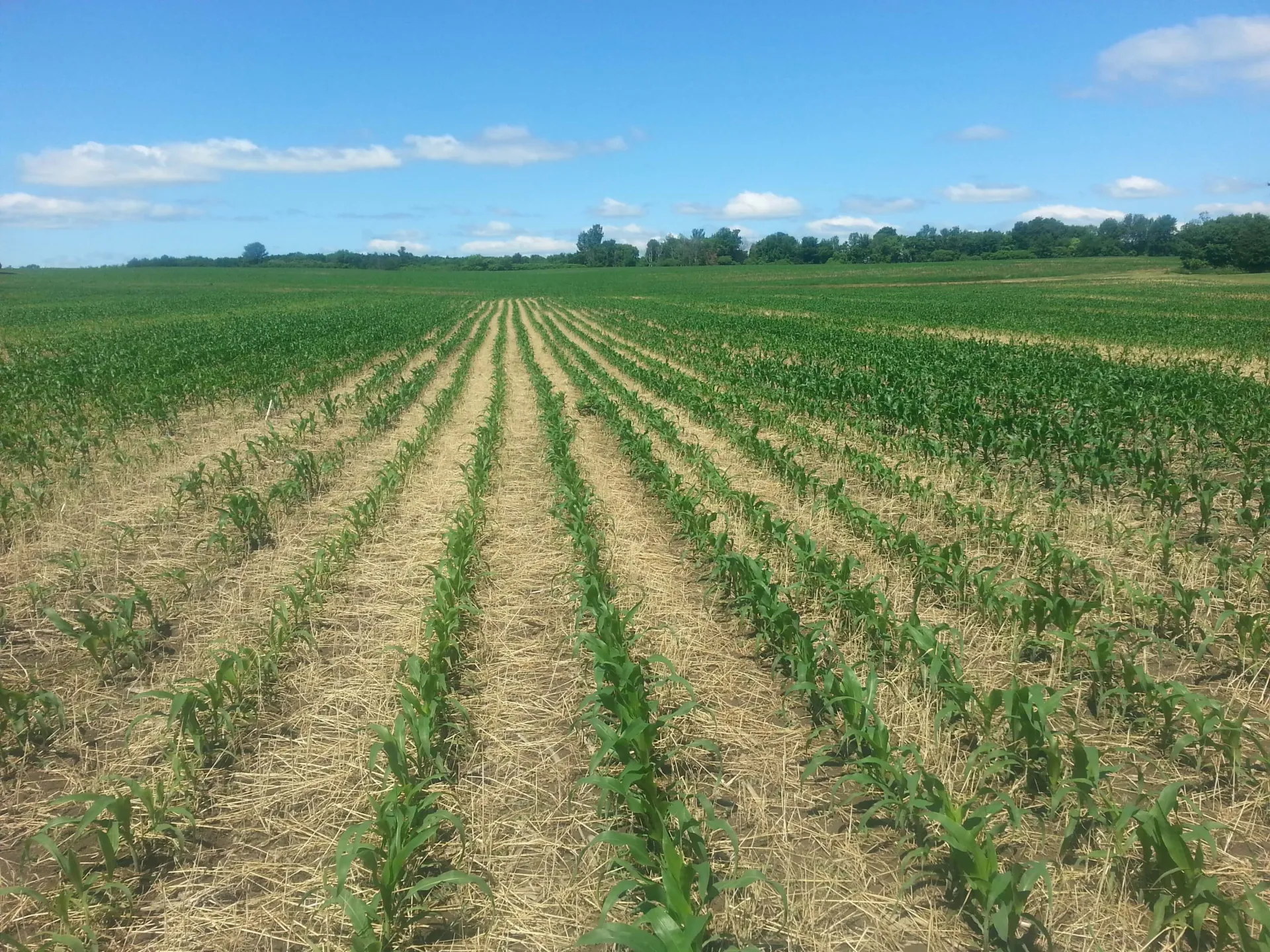
If your corn is 8” to 12” tall (the V5 to V6 growth stage), it’s time to give it a boost of nitrogen (N). Before you do, be sure to conduct the Pre-Sidedress Nitrate Test (PSNT)! The results will tell you how much more N the crop requires to reach your target yields. Applying the right amount of N avoids unnecessary fertilizer costs and decreases the risk of losses into the environment.
Why Test Just for Nitrogen?
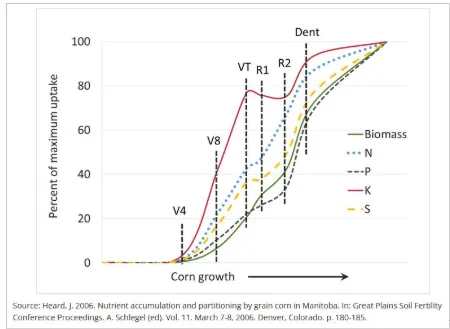
Although N is one of the most important macronutrients for crop growth, you won’t find its levels on a standard soil test report. Unlike other macro- and micronutrients, N is both highly volatile and constantly changes from one form to another, so soil N availability can change rapidly according to the weather, soil type, moisture, temperature, and other factors. Soil microorganisms break down organic materials such as manure, organic matter, and crop residue and release plant-useable forms of N (called nitrate) into the soil. Just like livestock, soil microbes are limited by resources such as air, water, and food and are sensitive to their environment. Because the amount of available soil N can fluctuate, it’s important to take a nitrate-specific soil test and apply nitrate at the optimal time—when corn nutrient uptake is highest (Figure 1). We topdress corn around the V6 stage because it becomes difficult to apply fertilizer when the crop is taller. Farms are often limited to using fertilizer spreaders that tractors pull through the field to broadcast the fertilizer. High boy applicators are another option, which allows farmers to apply nitrate a bit later. The goal is to apply nitrogen as corn approaches the rapid growth phase and requires the most nutrients. To support timely application, labs generally provide nitrate results within 24 hours.
What Is the Pre-Sidedress Nitrate Test?
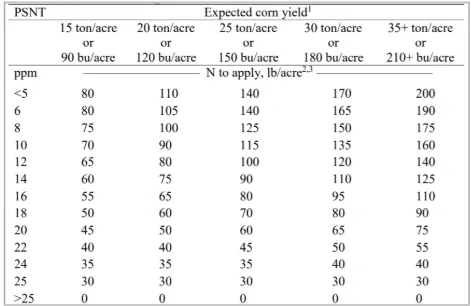
The Pre-Sidedress Nitrate Test (PSNT) helps farmers predict crop N needs by measuring soil nitrate. For corn crops, the available nitrate is then compared to a Vermont model of corn growth and response to nitrate, which indicates the amount of additional N required for the desired yield (Table 1).
How Do I Conduct the PSNT?
1. Gather Materials
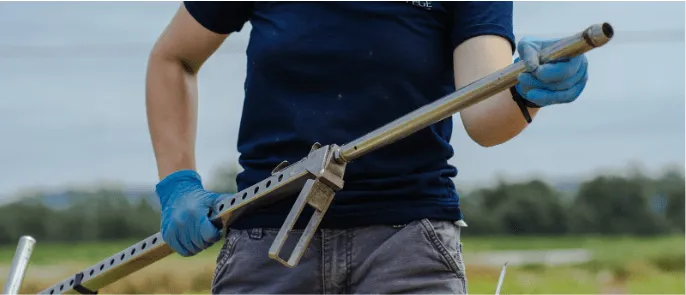
Gather these materials to create soil samples: a clean soil probe (Image 2) or auger (available at garden and farm supply stores and online); a bucket; one labeled, sealable plastic bag (e.g., Ziplock) for each field (or sample area); a cooler with ice (samples must be kept at less than 50° F); and one PSNT submission form for each field (or sample area) (see #4 below for links to UVM Extension forms). On the plastic bag label, be sure to include your farm name and a field name you’ll remember easily. You’ll put the field name on the PSNT submission form, and it will be on the lab report. Keeping the soil cool is critical because microbial activity and, therefore, soil nitrate levels can change at room temperature or spike quickly in warm, moist conditions.
2. Collect Soil Samples
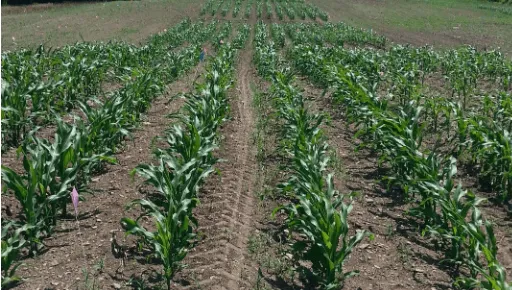
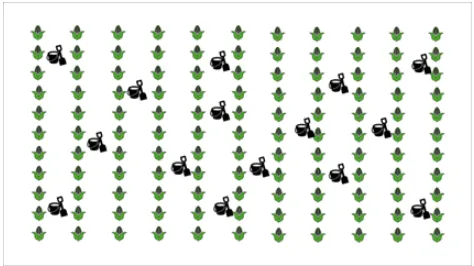
When the corn is 8 to 12 inches high, just before its major vegetative growth, collect 15 to 20 soil cores per field of 20 acres or less at a depth of 12 inches using a probe or auger. Take cores as evenly distributed throughout the field as possible to create a representative sample; using a W or X pattern can help ensure good coverage, or a pattern as shown in Image 3. Take cores from midway between rows to avoid the starter fertilizer bands. Avoid areas that are not representative of the field, such as low, wet spots.
For each field (or sample area), mix the soil cores together in a bucket to create your sample. Put 1 cup of the sample into your labeled plastic bag and put it in a cooler with ice. If you’re creating samples for another field, dump the leftover soil and reuse the bucket for the next field.
If you’re growing corn on fields that differ in soil type, drainage, and microclimate, all of which can impact N availability, create a sample for each field. Similarly, if you plan to apply fertilizer on portions of a field on different days, create a soil sample for each field portion as close to your application date as possible.
Though written for the home gardener, How to Take a Soil Sample by UVM Extension’s Agricultural and Environmental Testing Lab (AETL) offers helpful information.
3. Prepare a Sample for Testing
There are two options: a) deliver it to the lab yourself within 24 hours of sampling, or b) prepare it yourself and send it overnight mail.
a) Prepare It Yourself: Keep the sample below 50° F in a cooler with ice and/or in a refrigerator. Deliver it to a lab with your completed sample form within 24 hours of sampling.
b) Prepare It for Overnight Mail: After mixing your sample, remove one cup of soil and dry it. It must dry within a day to avoid changing the nitrate level. One way to dry it is to spread it thinly on a pie pan or cookie sheet and put it in the oven at very low heat (200° F) until dry. The other way is to spread it thinly on a cookie sheet and let it air dry. (Don’t place damp samples on absorbent material because it can absorb some of the nitrate.) Circulating air with a fan will reduce drying time. When it’s dry, place the sample in a labeled plastic bag.
4. Complete an AETL Form and Drop Off or Mail a Sample
If you are submitting a sample to AETL for the first time (you are new to the process), use the UVM Soil Nitrate Test for Corn (PSNT) (single-sample form). Read the instructions carefully. If you have created multiple samples, complete one form for each sample.
If you have submitted samples to AETL before (and know the process well), use the UVM Soil Nitrate Test for Corn (PSNT) (multiple sample form). It allows you to submit up to five samples per form.
Drop Off the Day Of: Bring the sample(s), form(s), and $10 per sample (check or money order only) to UVM AETL, 262 Jeffords Hall, 63 Carrigan Drive, Burlington.
Send by Overnight Mail: Place sample(s), form(s), and $10 per sample (check or money order only) in a pouch or box for overnight mail to UVM AETL, 262 Jeffords Hall, 63 Carrigan Drive, Burlington, VT 05405-1737.
Contact the lab with any questions at AgTesting@uvm.edu or 802-656-3030.
Using Test Results
PSNT lab results will include a recommendation for how much additional nitrate is needed to obtain your yield goal. The best time to apply nitrate is right after you receive the PSNT lab report and, ideally, before a light rain (0.25 to 0.50 inches), which can help dissolve surface nitrate, carrying it into the root zone and maximizing uptake. (Dry conditions, however, may allow nitrate to escape into the air, and excessive rainfall can wash it too deep in the soil or make it escape into the air.)
Any test or recommendation has limitations. PSNT results can’t account for weather anomalies such as heavy rain after soil sampling. If anomalies occur, consider resampling, or adjust the recommended N rate based on suspected nitrate loss.
The best way to use the PSNT test is to submit samples for several years and keep records of the results, as well as your fertilizer applications, growing conditions, and crop performance. Over time, you’ll gain experience to help you interpret the PSNT results.
Feel free to contact the NWCS office with any questions about PSNT and N application at 802-524-6501 or cropsoilvt@gmail.com.
Other Resources
Here are additional resources on nutrient management and PSNT. Note that some of the links within them no longer work.
Feeling the Squeeze: Manage Nutrients Efficiently to Offset High Fertilizer Prices is a short 2022 NWCS blog on soil sampling, manure nutrients, and side-dressing.
It’s Time to Topdress Your Corn is a short 2020 NWCS blog by Professor Heather Darby, UVM Extension agronomy and soil specialist, on the importance of the PSNT test.
Planning Your Mid-Season Corn Fertility Boost is a 2016 NWCS blog that describes how N becomes available to plants, explains the PSNT, and offers guidance on how to interpret PSNT results.
For crops other than corn, see Using the PSNT Test to Manage N Fertilization of Vegetable Crops by Professor Vern Grubinger, UVM Extension vegetable and berry specialist. Last updated in 2003, it explains mineralization, describes the history of the PSNT, and guides vegetable and berry growers on how to use the PSNT.