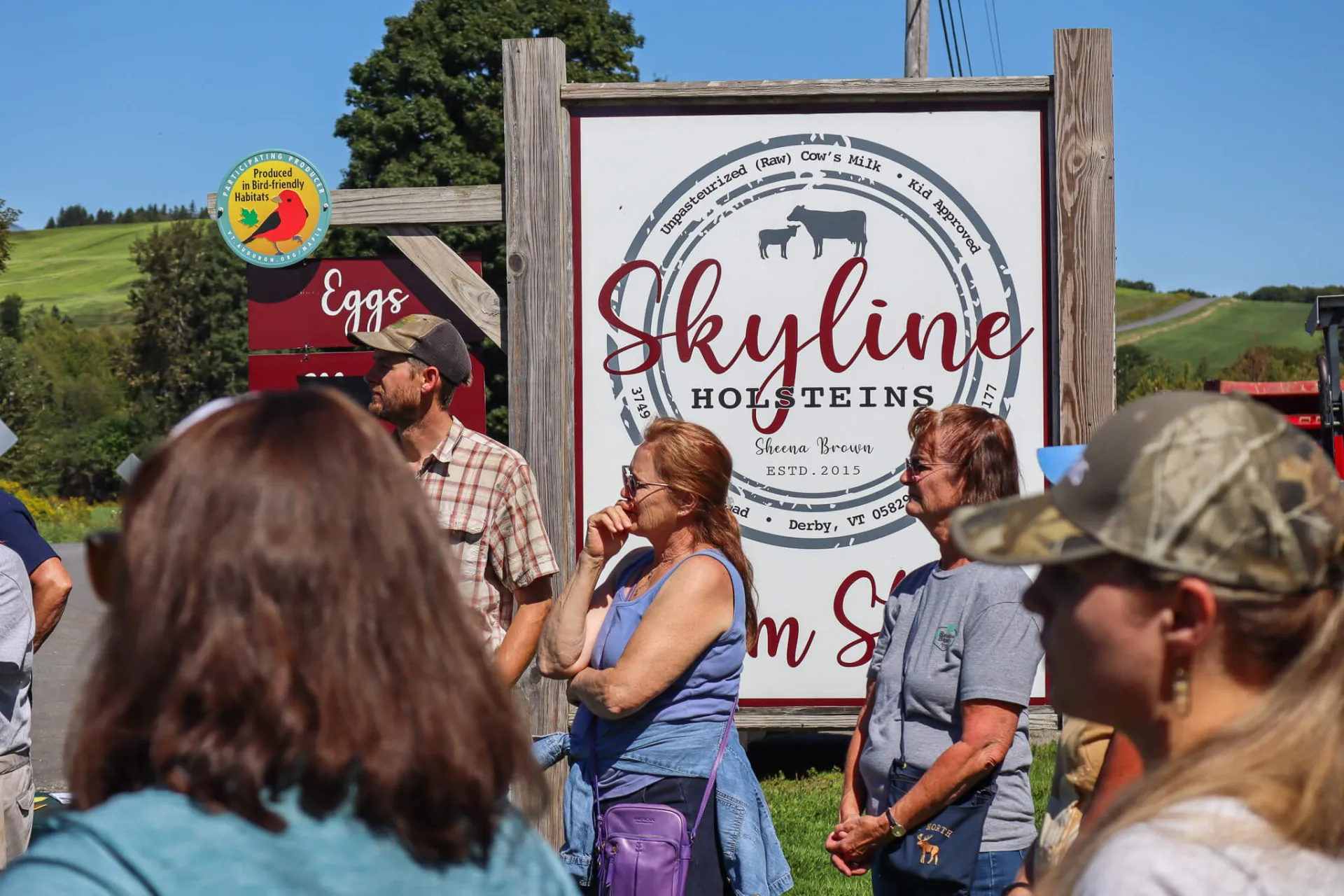
Throughout the summer, the UVM Extension Dairy team has hosted Future-Ready Dairy Farm Tours across Vermont. The tours highlight farms using innovative practices to adapt to the environmental and financial challenges of the modern dairy industry. Attendees have learned from farmers and celebrated their resiliency.
The Future-Ready Dairy Farm Tour on September 1 at Skyline Holsteins in Derby was no exception. Forty-five farmers, technical service providers, friends, and community members gathered at the farm to celebrate a major milestone for owner and fourth-generation dairy farmer, Sheena Brown, and her partner, Ben Farrow. After almost two years of planning, learning, and transitioning, the farm is now certified to sell their milk to Stonyfield Organic.
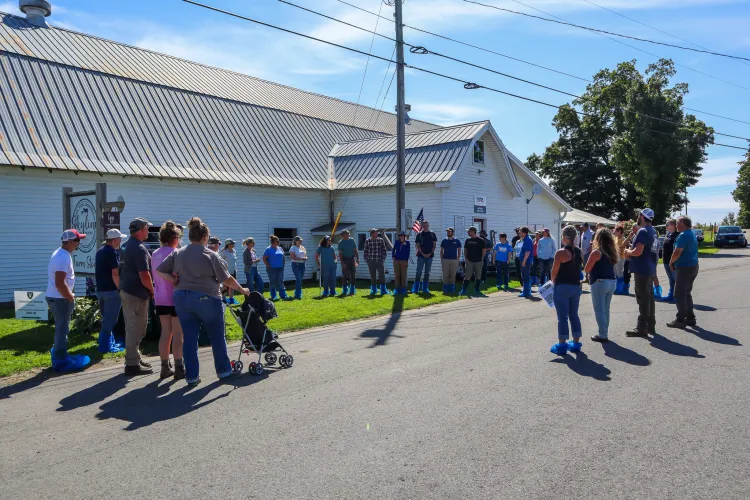
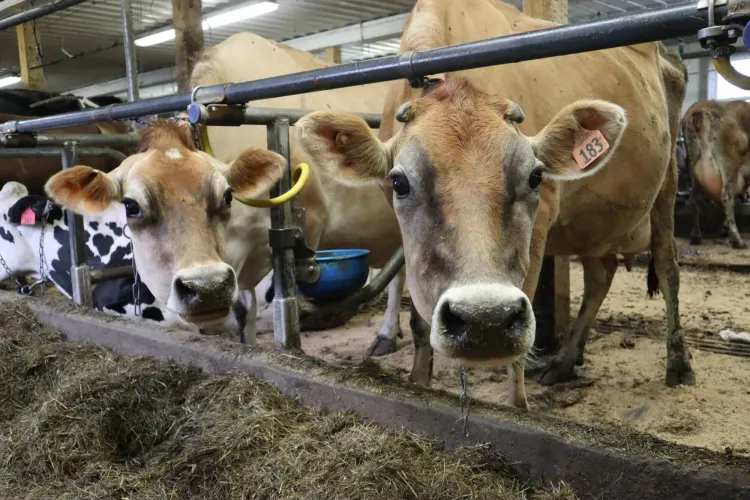
Skyline Holsteins is home to a 44-cow dairy herd of registered Holsteins, Jerseys, and Brown Swiss. Sheena bought the farm from her father in 2015. Shortly thereafter, she and Ben completely renovated the barn, keeping only the original milk pipeline and vacuum line..
Sheena and Ben also operate an on-farm store, where they sell their farm-raised beef and eggs, as well as maple syrup produced by Sheena’s father. But of all the products they sell, raw milk is the most popular. Skyline Holsteins became a certified raw milk producer in 2020.
“On a good day, we sell about ten gallons,” says Sheena. A major challenge is getting their customers to return the reusable glass milk bottles. But when they do, Sheena is particularly pleased. “We love seeing folks from the community come to our farm store week after week.”
Today, Skyline Holsteins is a family affair. Sheena and Ben live on the farm with their three young sons, who all help with barn chores. Seeing their sons helping in the barn makes them think of the future. Envisioning this future motivated them to do whatever they could to adapt and succeed, even if it meant doing something they had never considered.
Taking the Leap
For many conventional farmers, deciding to transition to organic production is not an easy decision. “We’ve always farmed conventionally, and we were always the type to say, ‘We’re never going organic’—until February of last year,” said Sheena.
“We came to a crossroads. We were working really hard but not getting anywhere. We were falling behind every day and thinking, ‘What are we doing?’” The farm was facing financial hardships due to several factors, including the high hauling and trucking fees deducted from their milk checks.
What happened next felt like it was “heaven sent,” Sheena said. A flyer from Stonyfield Organic arrived in their mailbox, recruiting farms for the certified organic milk market.
“We figured we should go out on a limb and give them a call, so we did,” said Sheena. She recalled how quickly the company followed up to discuss transitioning to organic management. “It seemed like the next day they sent reps here to talk to us and encourage us and tell us some pros and some cons.”
After considering all the options, the couple made their decision. “Along with lots of cheerleaders and our friends and family,” Sheena said, “if this is what we wanted to do, this size, and have our three boys involved, ...it just made sense for our farm to take the leap and transition to organic.” By making this transition and shipping milk to Stonyfield Organic, Sheena and Ben would save thousands of dollars a year in hauling and trucking fees, be able to maintain their herd size, and enter a lucrative market.
"Our number one goal in this business today, is to make our small farm sustainable enough and profitable enough for whomever may want to farm here after us. Whether that may be our boys or someone else too," said Sheena.
In 2022, the Census of Agriculture reported that cow dairies accounted for 58% of all agricultural sales in Vermont, demonstrating how important the dairy industry is to the overall agricultural and financial landscape in Vermont. According to data collected by UVM Extension, as of 2026, 114 of Vermont’s 400 dairy farms are organic.
What are the guidelines for certified organic milk production in Vermont? Dairy cattle must be fed 100% certified organic produced forages and feed ingredients, meet minimum dry matter intake requirements from pasture for at least 120 days per year, and have access to the outdoors year-round. The farm must also follow certified organic management practices for at least 12 months before milk can be sold with the USDA organic seal. Additional conditions apply.
The Road to Organic
The decision to transition wasn’t easy but that was only the beginning. For Sheena and her family, the hard work was just getting started.
Skyline Holsteins had always operated as a 100% purchased-feed operation, meaning the farmers didn’t grow the feed for their cows on their property. They purchased it from a nearby conventional farm that was unable to transition to organic. Sheena and Ben had to find a way to feed their dairy herd a 100% organic diet.
“That was another hurdle,” she recalled, but “Ben always put up feed for our beef cows, so we had some of the equipment we would need.”
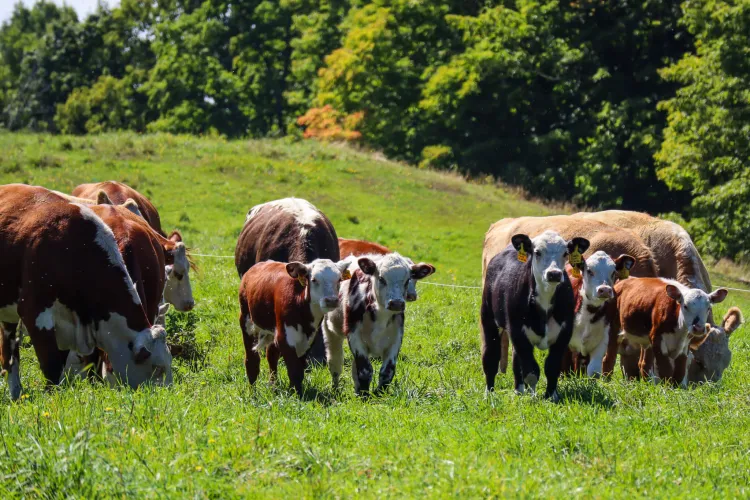
The couple worked with Sarah Flack Consulting to plan for transitioning their existing land base from conventionally managed hay and corn to certified organic high-quality forage acres for rotational grazing and stored feed production. That meant converting a large field that had previously grown only corn to productive pastureland, as well as installing grazing infrastructure such as fencing, laneways, and waterlines.
The farm received funding from the Vermont Agency of Agriculture, Food, and Markets (VAAFM) to make infrastructure investments that would protect water quality as they incorporated new grazing management practices into their operation. Sheena and Ben also began working with the national Dairy Grazing Alliance to implement new technologies for graziers, including Pasture.io, software that uses satellite imagery to help farmers determine when pastures are ready to be grazed. Innovations like these allow the family to make data-driven decisions that support herd health and nutrition while stewarding their land.
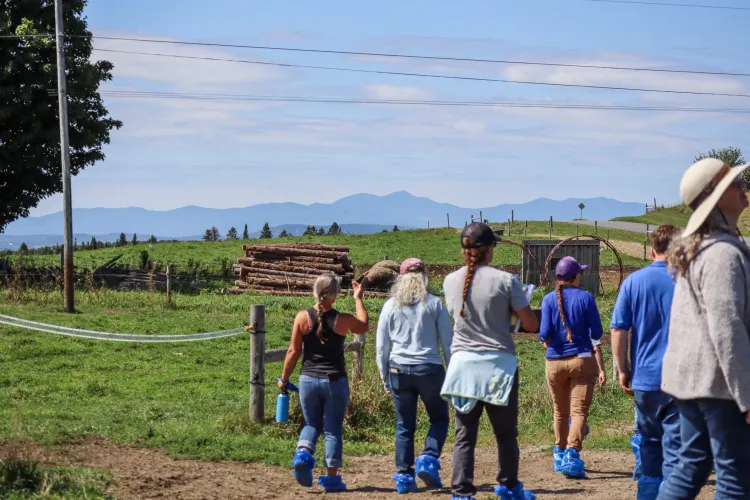
Sheena noted that integrating grazing into their operation was a worthwhile challenge for everyone involved. “Not only did we need to learn how to graze, but the cows had to learn how to graze, too. I think we all enjoy it.”
It Takes a Village
Throughout the farm tour, Sheena and Ben expressed gratitude to those who helped them through the transition, many of whom were in attendance, including members of Stonyfield Organic, UVM Extension, the Vermont Farm & Forest Viability Program, the Vermont Housing & Conservation Board, the Dairy Grazing Alliance, the VAAFM, the Vermont Natural Resources Conservation Service, and Sarah Flack Consulting.
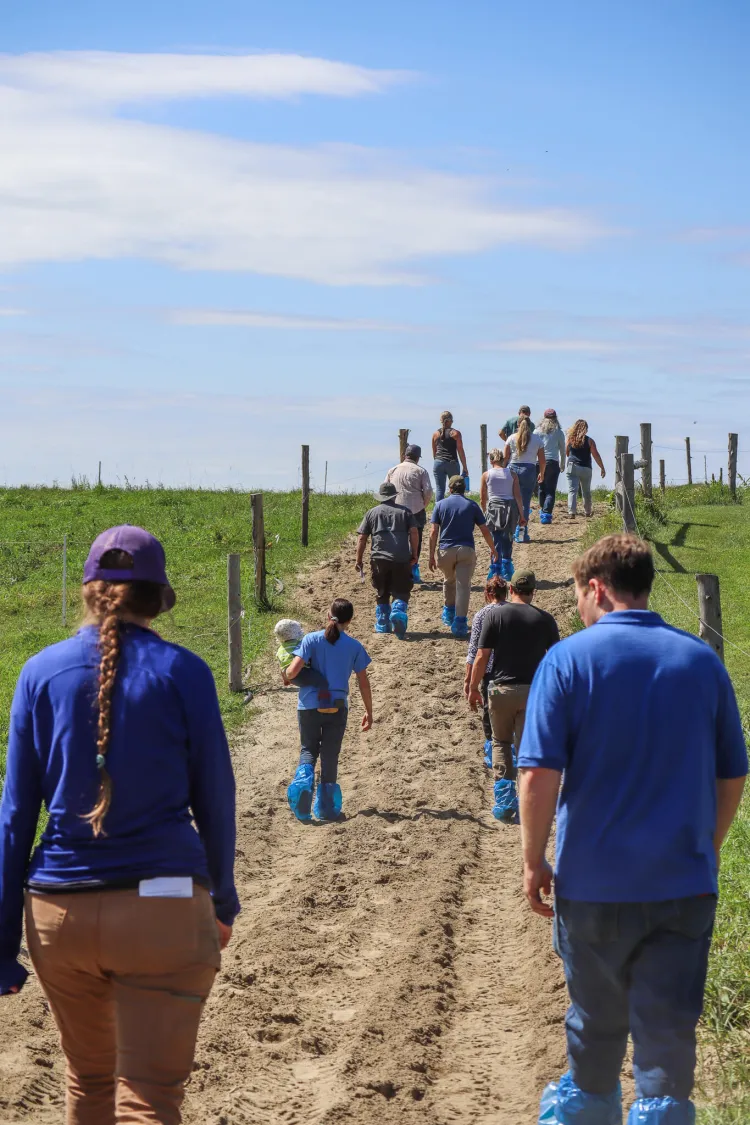
Ben Gabos of the VAAFM summed up the lesson of the farm tour when he said, “It takes a village.” That village included the family members, friends, and community members who gathered at the farm to learn from one another and celebrate a new chapter for Skyline Holsteins.
Linda Greg made the trek to Derby with both the past and present in mind. “I was born and brought up on a farm in Grand Isle, so farming always interests me. I like to go to these farm tours to see the new things that are going on. My father would be amazed if he were alive today.”
The UVM Extension Dairy team wholeheartedly thanks Sheena and Ben for welcoming everyone onto their farm and sharing their story.
Want to learn more about innovative practices on Vermont dairy farms? Join us for the next Future-Ready Dairy Farm Tour at Rockbottom Farm in Strafford on Tuesday, September 22. Click here to learn more and register.
In addition to farm tours, the Future-Ready Dairy event series includes workshops that aim to educate farmers about opportunities and programs to help fund on-farm projects that improve resiliency and reduce environmental risk. The UVM Extension Dairy team is hosting four of these workshops in November. Each workshop will cover the same content, so please register for the location that is most convenient for you. Click here to learn more and register.
Navigating Funding Opportunities for Vermont Dairy Producers
Tuesday, November 3, 10:00 a.m. - 12:00 p.m.,
People’s Trust Company, 59 Franklin Park West, St. Albans, VT 05478
Navigating Funding Opportunities for Vermont Dairy Producers
Thursday, November 5, 10:00 a.m. - 12:00 p.m.,
Middlebury Extension Office, 23 Pond Lane, Middlebury, VT 05753
Navigating Funding Opportunities for Vermont Dairy Producers
Tuesday, November 10, 10:00 a.m. - 12:00 p.m.,
Billings Farm, 69 Old River Road, Woodstock, VT 05091
Navigating Funding Opportunities for Vermont Dairy Producers
Thursday, November 12, 10:00 a.m. - 12:00 p.m.,
Poulin Grain, 3916 US Route 5, Derby, VT 05829