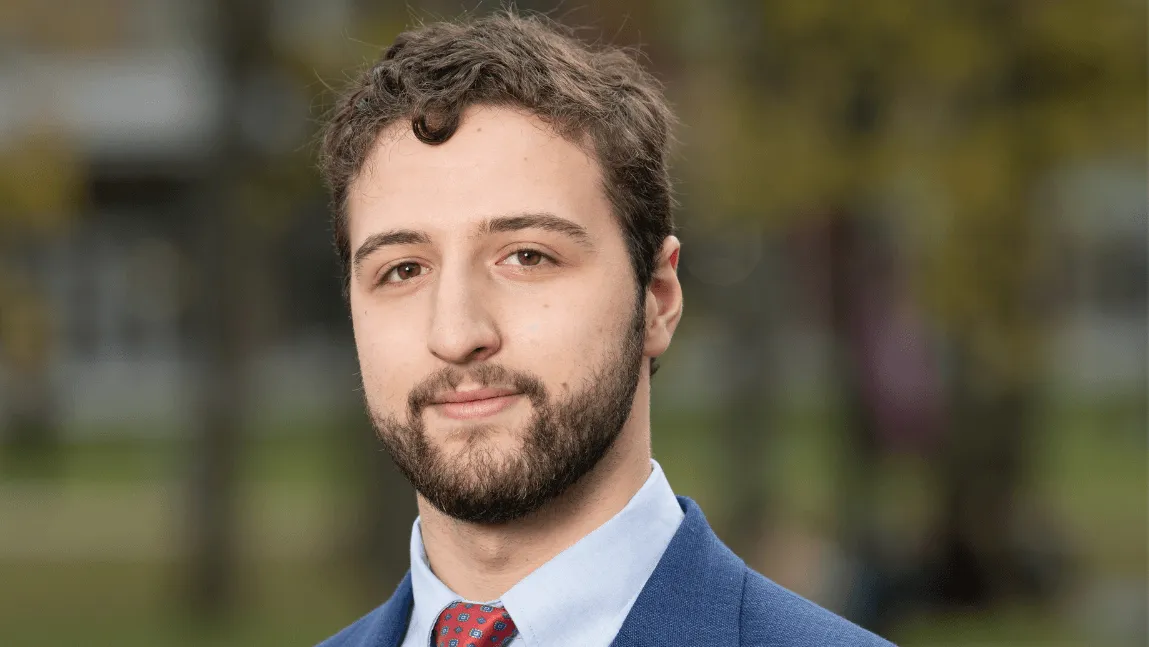
Mechanical Engineering senior Luc Capaldi recently was chosen as Engineer of the Year for 2022. We caught up with Luc, who has also just been inducted into Phi Beta Kappa, during his busy schedule to find out what his experiences at the University of Vermont have taught him.
What work/projects are you most proud of during your time here?
My research on silicon carbide fibers supports ongoing development efforts within NASA’s Hypersonics Project. Modern spacecraft routinely employ a rigid ablative heat shield to withstand the extreme environments encountered during atmospheric entry. However, the large mass of this shielding limits the maximum payload of a given mission, prompting NASA to develop lightweight alternatives. Such systems generally consist of a large inflatable structure that is deployed at the nose cone of the vehicle immediately prior to atmospheric entry. This requires a flexible thermal protection system composed of multi-layered materials sheathed by a thermally resistant fabric. Silicon carbide woven ceramics are desirable candidates due to their excellent thermal properties. However, extensive study is first required to fully understand the response of these materials in extreme environments. I am proud, therefore, that my work, although small against the broader backdrop of scientific inquiry, represents some tangible contribution to human progress.
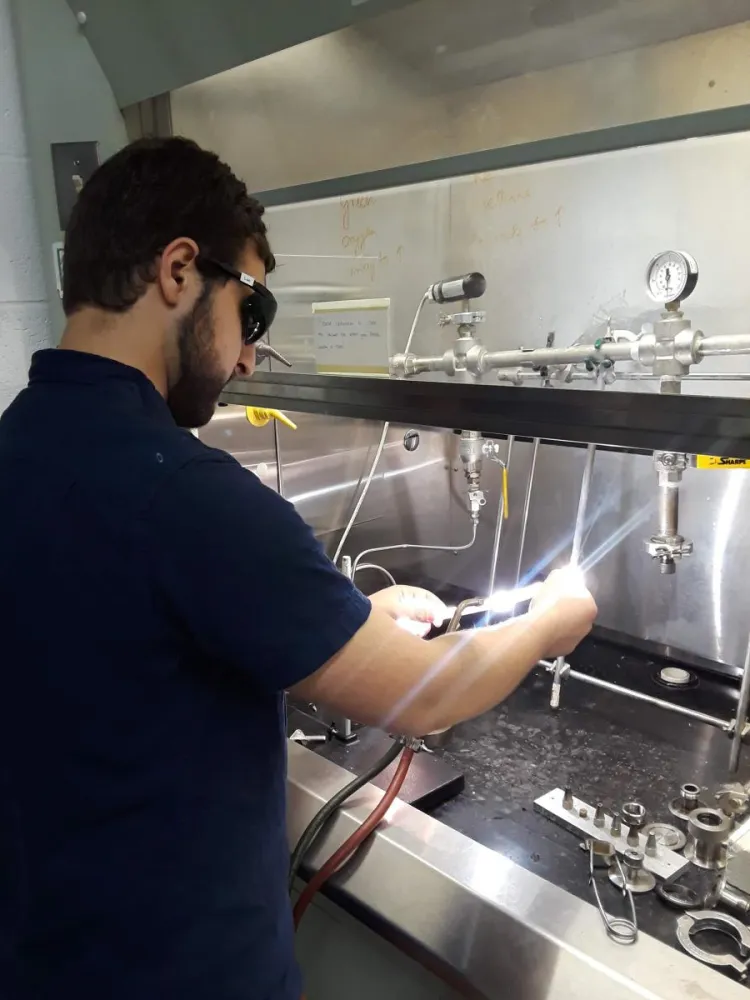
Growth Facility
How has the faculty supported you during your work here? Is there a particular faculty member with whom you have connected?
The faculty at UVM have consistently been supportive of both my research endeavors and general technical education. Notably, Dr. Frederic Sansoz within the Mechanical Engineering department has acted as both my academic and research advisor for most of my undergraduate career. His ongoing guidance in not only the technical, but also logistical, political, and ethical domains of engineering and research is invaluable. I am grateful for the substantial effort he has invested in my development both as an engineer and a junior researcher. Without a doubt, his tutelage has played a substantial role in my success at UVM.
Have you had any internships/employment while at UVM?
For the past 3 years, I’ve been an active member of the Sansoz Research Group where I use atomistic simulations to study the oxidation rate of silicon carbide fibers in extreme environments. In 2020, I received NASA funding through the Vermont Space Grant Consortium to support this work. I’ve also established independent collaborations with biophysics researchers at McGill University. Together, we conducted a study on macroscale knot formation which we subsequently published in Physical Review E. Last summer, I participated in an NSF-funded REU program in the Bulk Crystal Growth facility at Johns Hopkins University where I synthesized transition metal nitrides for application in renewable energy technologies, including photoelectrochemical cells. Most recently, I’ve been admitted to PhD programs in both Mechanical Engineering and Materials Science. I’m excited to build upon the excellent engineering and research foundation which I have obtained at UVM.
What do you see is the role of engineers in the world and how do you want to be a part of it?

chemicals in an Ar glovebox.
It is the role of engineers in the world to solve problems. In practice, this translates into an immense variety of technical activities for which any brief description is woefully inadequate. The main commonality is the ethical responsibility shared by all engineers to ensure public safety in the design and maintenance of engineered systems. Of course, there are those drawn to the biggest challenges – worldwide access to clean water, renewable energy production, space exploration, and more. The world faces plenty of interesting problems, and I’m not picky. However, I hope to work in a field where my efforts will have a significant positive impact on society.
What inspires you to do your best?
I perform best when I’m interested and excited about my work. I’m consistently drawn to research problems because the questions involved are varied, challenging and impossible to answer – at least at first. Consequently, my collaborators on these projects are often hardworking and knowledgeable individuals who are passionate about both technical and non-technical subjects. Their enthusiasm and competence inspires me to perform at my best.
What advice do you have for students entering UVM?
To incoming students: I suggest you find someone in your desired profession who enjoys mentoring students. Get that person invested in your success and rise to meet their expectations. Start pursuing professional opportunities immediately and be discriminating about how you spend your time. Exercise, eat and sleep regularly, and read Stoic philosophy.