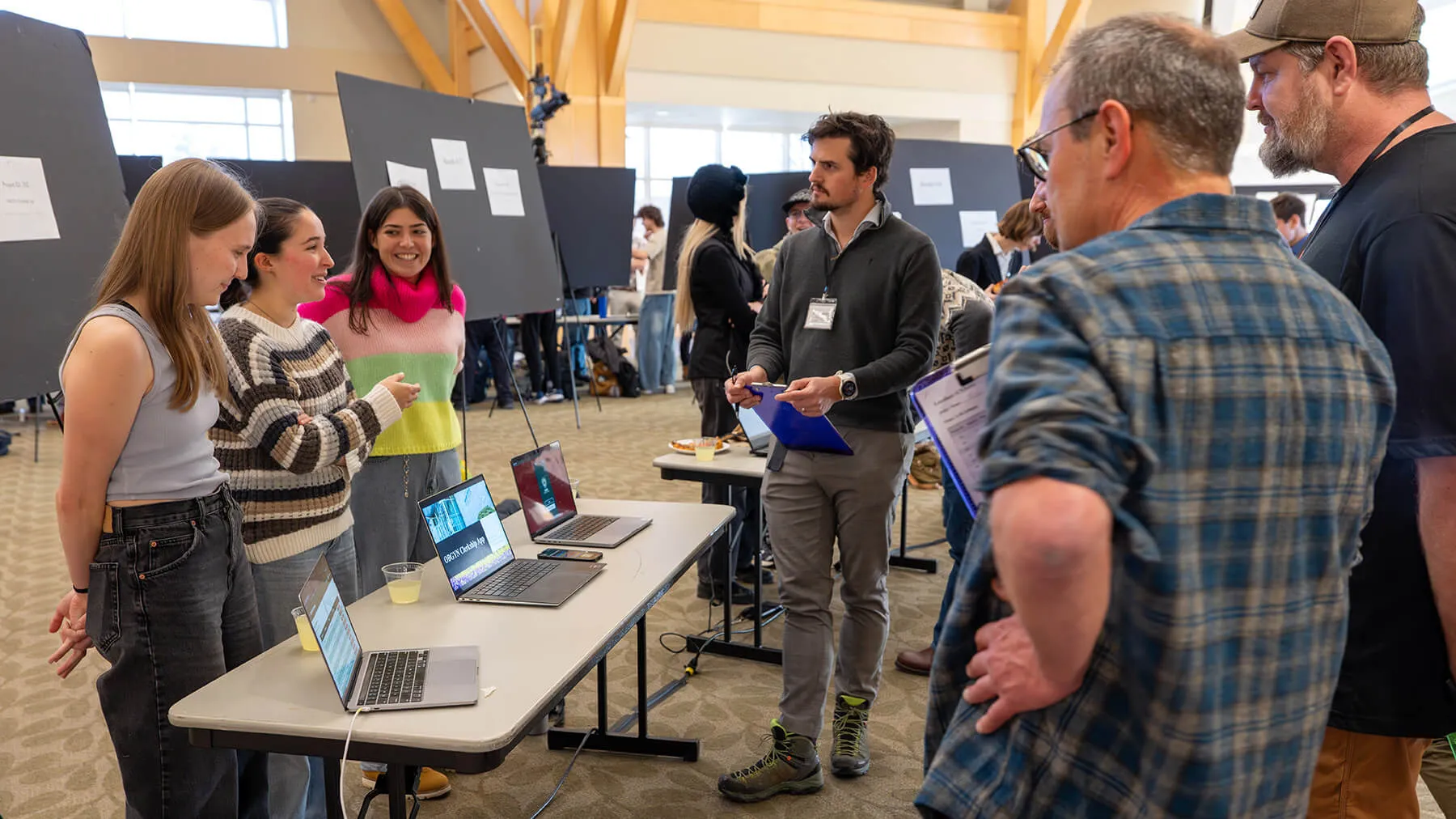
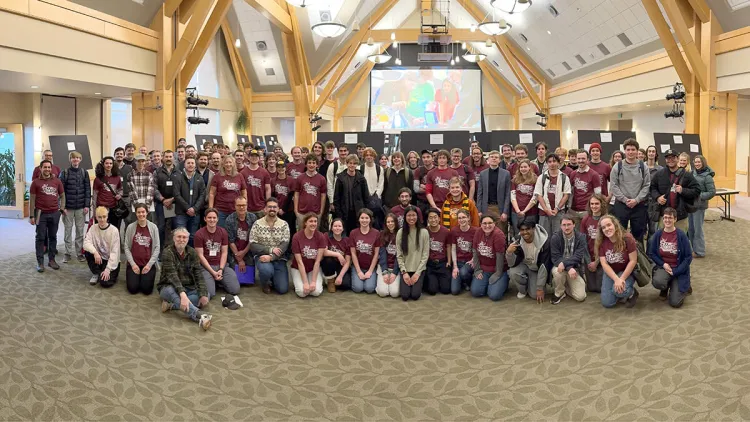
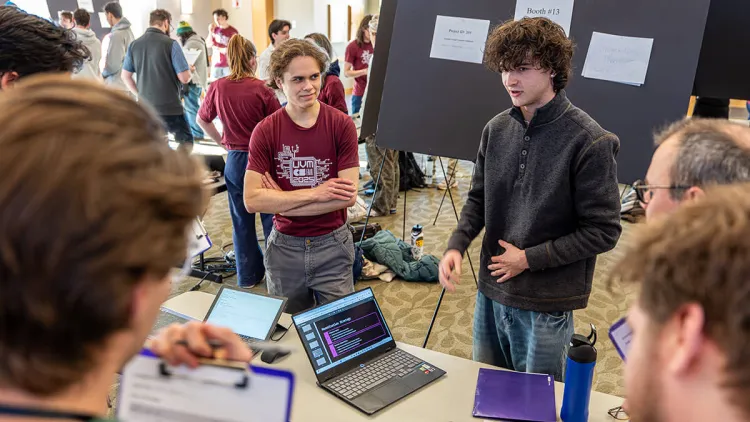
Coding prowess took center stage in the Davis Center’s grand Maple ballroom as the annual Computer Science Fair returned with over 90 unique projects competing for top honors in 4 different categories, along with two new prizes introduced this year. The scope and breadth of this year's innovative projects spanned a diverse and exciting range of applications, including wellness programs, game design, productivity trackers, music, research tools, and much more.
Participants were UVM students enrolled in a computer science (CS) course or active CS or Data Science majors. Each category was judged by a panel comprised of faculty and local industry representatives, with prizes up to $500 awarded in gift cards for first place, second place, and third place. In addition, event sponsor Beta Technologies selected two teams for a special prize that includes a curated lunch and a tour of their South Burlington headquarters, where the company is pioneering the future of electric flight. The exclusive experience includes an opportunity to take the controls in a virtual flight simulation of Beta’s advanced Alia aircraft.
In addition to faculty and staff from the computer science department, several local companies provided judges for the event, including Beta Technologies, Mascoma Bank, Fluency, WideWail, National Life Group, OnLogic, U32 High School, Gift Drive, and Marvell Technology.
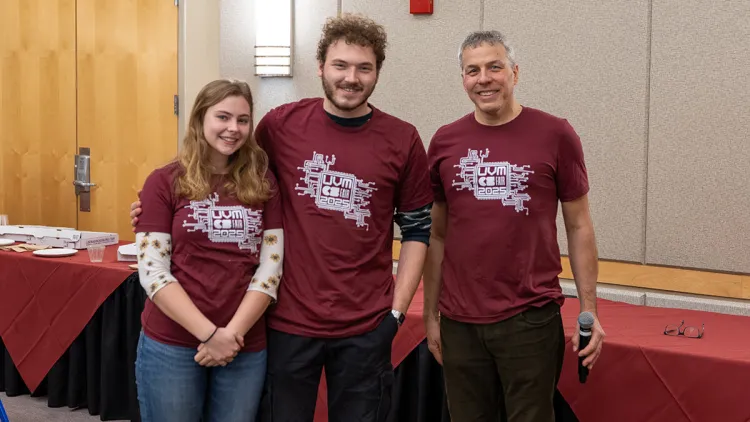
Continuing the tradition that Computer Science Professor Robert Erickson started before his retirement, this year’s fair was organized by Professor Jackie Horton with continuing support from the Society of Women in Computer Science (SWICS).
Congratulations to all the winners, and thank you to all of the participants, judges, and volunteers! For a complete listing of all of this year's projects, visit the UVM Computer Science Fair website.
View a slideshow of images from the 2025 Computer Science Fair
2025 CS Fair Award Winners
This year, organizers reframed the categories and named them after pioneering figures in computing history: Charles Babbage, Grace Hopper, Ada Lovelace, and Alan Turing.
In addition to the honors for first, second, and third place, a special award was provided to two teams selected by event sponsor Beta Technologies, as well as a "Peoples Choice" award chosen by participants.
BABBAGE:
Utilizes knowledge gained from the introductory level (CS1xxx) CS course sequence. (30 entries)
First Place: "A Bee-autiful Day"
by Benjamin Hood and Tekla Holm-Brown
This project features a game that follows a bee collecting pollen from flowers for its hive, all while dodging all the obstacles that a bee faces.
Second Place: "Maze"
by Petr Polacek and Teddy Schumacher
This program generates a maze, but the user only sees what’s next to him not the whole picture while navigating the maze to reach the middle. The user will win or lose based on the number of clicks used to finish the race. At the end the whole maze is shown with the most optimal path and your path.
Third Place: "Match 3; Graduate for Free"
by Hannah Reing, Luke Price, and Elijah Burton
This program features a Match 3 game specific to the UVM's colleges. Match three or more symbols representing a college (i.e. a cow for CALS) to earn "credits." As players gain "credits" through playing, they will be increasingly awarded degrees.
HOPPER:
Utilizes knowledge gained from mid-level (CS2xxx) CS course sequence. (16 entrants)
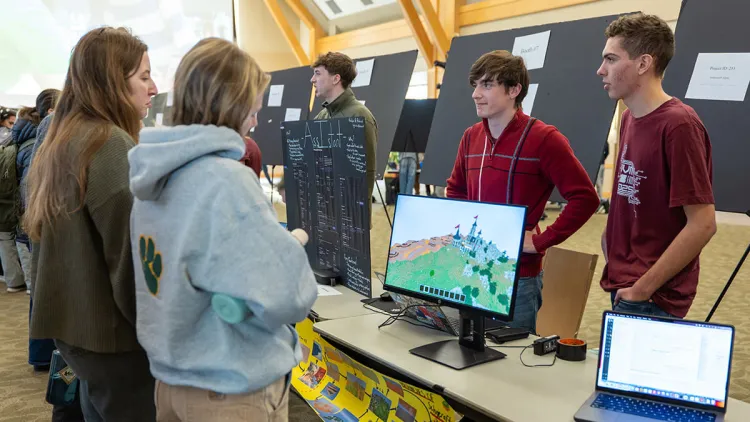
First Place: "Schnecraft Alpha"
by Nicolas Milazzo and Kent Schneider
Mimicking Minecraft, Schnecraft Alpha is an infinite, procedurally generated terrain simulation/voxel engine. Including many interactive elements including collision-bounded movement, placing and breaking blocks, and GUI for manipulating held items, exploration and creativity opportunities are endless. Schnecraft Alpha explores Perlin noise, modular meshes for custom block geometry, multithreading, and OpenGL, all in C++.
Second Place: "Blackjack Bot"
by Jonas Hemmett
Raspberry Pi based project which can patriciate in real world games of blackjack.
Third Place: "HackHelp"
by Henrik Van Tassell
HackHelp is the ticketing system that was used at the 2025 UVM Hackathon. It was built in 32 days and was used by all mentors and code-contributing participants of the event. Features include: - Self-service team forming & challenge selection - GitHub permissions management (ensuring that users had access to the right resources within the shared GitHub organization) - Help tickets integrated with GitHub Issues - teams indicate location, mentors can assign themselves and change their status.
LOVELACE:
Utilizes knowledge gained from mid-level (CS3xxx) CS course sequence. (22 entrants)
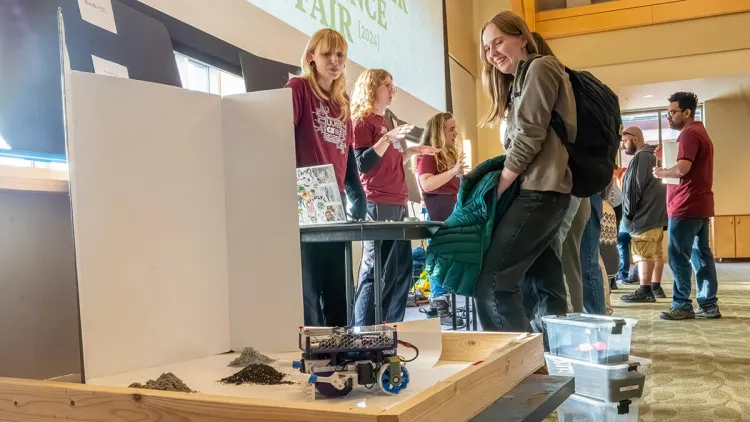
First Place: "Substrate Detection and Classification for Robotic Excavation"
by Callie Levitt and Darby Lane
Our project demonstrates implementation of several computer vision models for image detection and classification on a custom dataset of substrates. This model will be deployed on the Raspberry Pi based 'StapleBot' robotic system, using Sony IMX500 AI Camera to identify different classes of granular media, and interact with them based on inferred properties.
Second Place: "Ticket to Ride "
by Kate Estabrook, Oliver Baker, Elisabeth Kollrack, and Mateo Bouquier Castellanos
We made the hit board game Ticket to Ride for our CS3050 Software Engineering course. We coded in Python with the PythonArcade library to create a visually attractive interactive interface for the game.
Third Place: "OBGYN Clerkship App"
by Hannah Deyst, Mia Corcoran, and Lindsay Hall
Our app is designed for medical students in their clinical OBGYN rotation at UVM Medical Center. It allows students to access quick medical references - infographics, videos, and links, helping them evaluate patients quickly. The app is also for clerkship preceptors, giving them the ability to fill out evaluations for the medical students on their rotations.
TURING:
For graduate or independent projects that don't otherwise fit into the previous categories. (22 entrants)
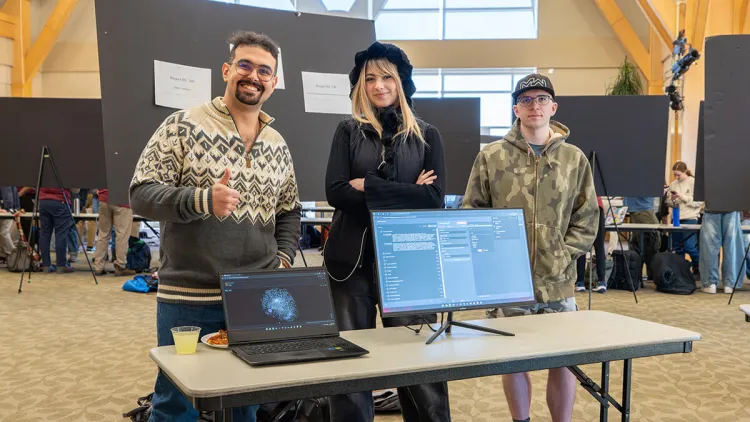
First Place: "Cyber Threat Intelligence Reporting Workflow with Agentic AI"
by Omar Awajan, Sasha Abuin, and Broadie Duprey
We have designed, developed, and deployed an automation workflow enhanced with Agentic AI and a GraphRAG database for Cyber Threat Intelligence reporting. This tool ingests live cyber threat intelligence reports, news, and articles, feeds them into our GraphRAG database, and incorporates them into our existing corpus. The tool aims to facilitate improved relevancy and accuracy in Cyber Threat Intelligence reporting by extending traditional LLM AI agents with a GraphRAG populated from a range of diverse Cyber Threat Intelligence data sources we have collected.
Second Place: "Tight Lower Bounds on Memory Complexity for Realizability Testing under the Streaming Model"
by Lauren Knopp
In learning theory, we say that a distribution ( X × Y where X is a set of attribute vectors and Y = {0, 1} ) is realizable if there exists a hypothesis within a class of hypotheses H such that the true error of the selected hypothesis is 0. In other words, ∃ h ∈ H | L_D def = D({(x, y) : h(x)̸ = y}) = 0. When we aim to determine whether a specific distribution is realizable, using property testing can help us tolerantly test for realizability. In this project, I introduce two different algorithms that explore efficient low-memory strategies in both the strict realizability testing case (aiming to accept only when true realizability is met) and the tolerant realizability testing case (accepting when hypothesis classes contain a hypothesis that is within ϵ from realizable, and rejecting all hypothesis classes that only contain hypotheses that are at least ϵ-far from realizable). I also provide additional future directions and conjectures about low memory realizability testing, as well as applications of low memory hypothesis testing.
Third Place: "Nexus Network Simulator"
by Jordan Bourdeau
A network simulator/emulator designed for IoT applications to make simulating real embedded code easy and scalable. Uses Linux FUSE file system to provide a file system abstraction for device IO over point-to-point and shared channels. Statistically models communication link properties such as delays, bit errors, and packet loss based on simulated node distance and data quantity. Leverages Linux cgroups to precisely control host OS scheduler time, preserving simulation time-fidelity.
BETA PRIZE:
The winners of this new special prize provided supplied by Beta Technologies will enjoy an exclusive experience to discover the future of aviation. The prize winners will receive a behind-the-scenes tour of their South Burlington headquarters where they will see firsthand the innovative technology driving the future of electric flight. The experience includes a curated lunch bv Chef Tim Peters and our BETA Eats team. Afterward, take the controls in a virtual flight simulation of our advanced ALIA aircraft.
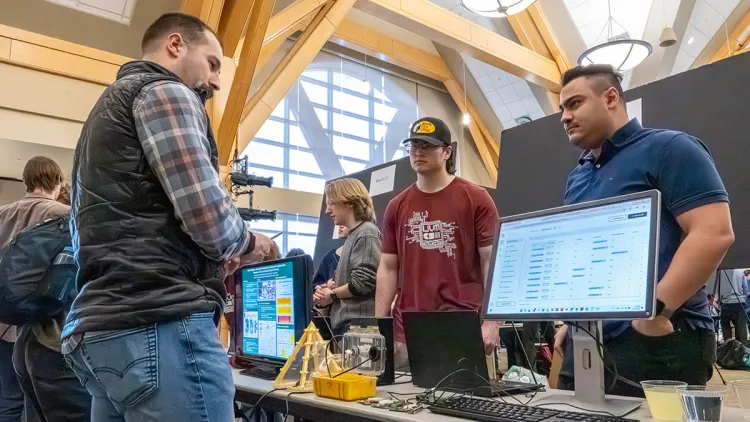
"Single and Multi-Channel Noise Reduction Techniques for Embedded Platforms"
by Jordan Bourdeau, Soheyl Faghir Hagh, and Lucas Levine
Design of a high-frequency, multi-channel audio recording library for AVR-based microcontrollers. Capable of sampling up to 54kHz 8-bit audio and 52kHz 10-bit audio. Improves on existing libraries by supporting 68.75% faster sampling with 8-bit audio, as well as introducing 10-bit and multi-channel sampling capabilities. Research into single and multi-channel noise reduction techniques with amplitude thresholds, spectral subtraction, and Wiener filters. Aimed at removing environmental noise like wind from audio recordings, enabling higher-quality inputs to machine learning models for classifying precipitation phase.
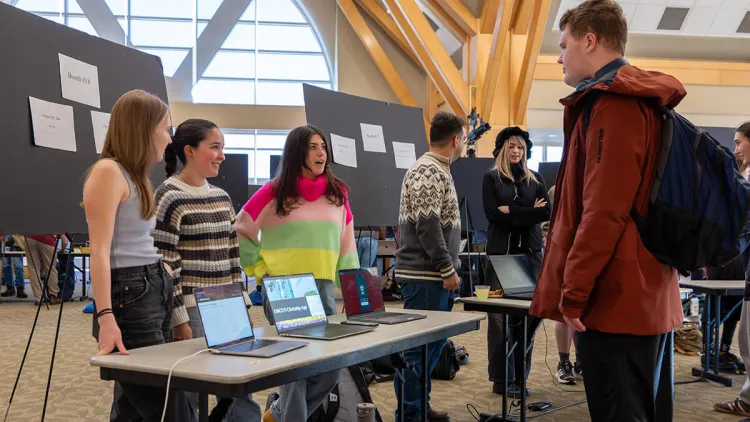
"OBGYN Clerkship App"
by Hannah Deyst, Mia Corcoran, and Lindsay Hall
Our app is designed for medical students in their clinical OBGYN rotation at UVM Medical Center. It allows students to access quick medical references - infographics, videos, and links, helping them evaluate patients quickly. The app is also for clerkship preceptors, giving them the ability to fill out evaluations for the medical students on their rotations.
PEOPLE'S CHOICE:
"Prove It | Social Accountability"
by Nico Lippiatt-Cook
Prove It is a React Native mobile app designed to keep you accountable for tasks and goals. Set goals, prove you accomplished them and share to a feed of friends for feedback and support.