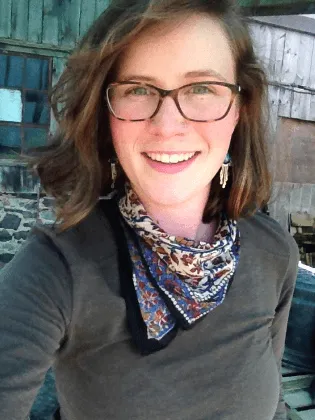
On a beautiful Saturday at the Burlington Farmers’ Market, Faren Worthington ’12 was surrounded by a crowd of bustling customers eager to buy the produce she’d harvested. Her work at the popular Bella Farm stand brings together many threads of community connections made through service-learning coursework at UVM.
Worthington came to UVM as a transfer student seeking an educational experience filled with community engagement. She enrolled in the Rubenstein School of Environment and Natural Resources as a Natural Resource major, with a concentration in Ecology and minors in both forestry and ecological agriculture.
Of the service-learning courses she took at UVM, the “most significant,” she feels, was Advanced Agroecology (PSS 212) with professor Ernesto Mendez. “The course was split up into several lab groups. We all did similar service-learning projects on different farms, learning about so many different farms through interviews, maps, and data analysis,” she explained. “We were challenged to make the same project assignment meaningful for both students and community partners in different settings. Much of my learning in that course happened outside of the classroom.”
Other service-learning classes helped shape her UVM experience. Worthington honed her skills as a teacher when she served as a service learning teaching assistant (TA) in 2012 for a service-learning internship practicum with professor Mary Beth Barritt. Another course, Environmental Problem Solving and Impact Assessment (NR 206) stood out to her because “I was able to establish contacts with a new community partners about problems to solve and how to propose an effective project. I learned a lot about asking the right questions, accountability, and setting realistic expectations for myself and others.”
From Service-Learning to the Real World
Worthington’s service-learning coursework in the Advanced Agroecology course led to a connection within the community at Bella Farm, an organic herb and vegetable farm based in Monkton. She developed a good relationship with Bella working on a group project analyzing biophysical and social aspects of the farm. She also volunteered time to help set up new high tunnels. Her previous work experience on other farms and relationship with the Bella Farm staff lead her to a seasonal job opportunity upon graduation. She gladly accepted and has been working at the farm the last two years. “I am a member of the farm crew at Bella. We are a small team, so I am involved in almost all aspects of vegetable production throughout the course of the season.
“Service-learning is continuing to influence me as I think about going to graduate school. It has taught me that I want a program that is very hands-on,” she continues, adding that the outside-classroom coursework was essential in creating a lasting learning experience. “Service-learning is important because it requires students to be fully engaged in an academic project that leaves a mark of positive impact in the community,” she explains. “A university that is insulated from the surrounding community would be underserving students by failing to offer opportunities for learning skills that can’t be learned in a classroom. That same university would also be underserving the community that can benefit so much from its resources.
“I recommend service-learning because it is challenging, fun, and good way to make your degree count.”