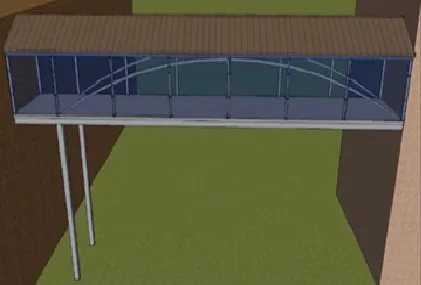
Can you imagine a skybridge connecting Votey Hall and Angell Lecture Hall? Students in Dr. Mandar Dewoolkar’s senior Engineering Capstone Course could, and they created a detailed proposal for the College of Engineering and Mathematical Sciences to consider making the skybridge a reality. The course is one of many that UVM offers that connects students to real-life projects and community partners.
Engineering in a Real-world Context
In Dewoolkar’s Senior Capstone Design course, for engineering majors (CE 175) provides students with the opportunity to use what they have learned throughout their four years at UVM, and apply it in a real-world setting. Students have participated in a variety of tasks from designing traffic roundabouts to planning landslide and historic structure remediation, all of which have benefitted local community partners.
Students are required to submit specific dimensions, costs, and materials as they would in a professional job. For the skybridge assignment, students created detailed sketches and computer-generated models that were included in their final presentation. These projects are designed to prepare students for the interdisciplinary world of engineering, and encourage students to really invest themselves in all aspects of these projects.
The service-learning approach makes the class more interesting, explains Dewoolkar, because “students are more motivated and work harder to meet the increased expectations.” In a traditional classroom, he continues, there is “less accountability because there is no real life component.” The community partners, however, add a new dimension that creates a more stimulating learning environment.
Faculty and Community Benefits
Service-learning professors value these courses because of increased levels of student success, higher levels of participation, and student contributions to published papers. The university benefits, as many community partners are encouraged to give back to UVM in the future. Community partners have given students internships and shadowing opportunities, and continue to participate in SL courses.
Many of the small towns and organizations Dewoolkar’s students work with benefit because they don’t have the staff or expertise to begin these projects. They are often energized by students’ ambition and value their engineering knowledge, explains Dewoolkar. “Students bring fresh ideas that may not have been taken into account in the planning stages, and community partners value this insight.”
Dewoolkar enjoys hearing back “from community partners two, three, or four years down the road that they completed a project that my students worked on.”
What’s next?
Dewoolkar is always looking ahead to next semester’s service-learning projects. Whatever’s in the pipeline, everyone will benefit: Students, community partners, and Dewoolkar will all end the semester with new expertise, relationships, and experiences that will be with them forever.
Check out some of Dewoolkar’s other projects and find more information on taking or teaching Service Learning courses at the links below.
Skybridge Project:
https://www.youtube.com/watch?v=dH78YKobPcs&feature=youtu.be
Senior Engineering Capstone Projects:
http://www.uvm.edu/~sysedcee/?Page=capstone/default.php
CUPS: