In a classroom in St. Lucia, Rachel Benjamin figured out she had a passion for working with young people.
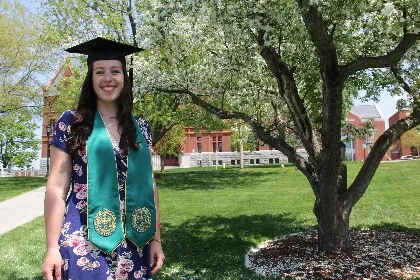
Rachel Benjamin graduated from UVM in 2017 with a bachelor's degree in Community & International Development. Throughout her undergraduate career, she had the opportunity to partake in a series of service-learning courses.
When asked which service-learning course she was most impacted by, Rachel had to think. “In the Community Development & Applied Economics program, I was very fortunate to have the opportunity to participate in several excellent service-learning courses, so this was difficult to choose! I would say the course that was most impactful was my 'Sustainable Development in Small Island States' course.”
Sustainable Development in Small Island States is a course in which students work in groups over a semester to create a community development project in partnership with a local entity and then travel to St. Lucia to execute their plan over four days.
For Rachel’s project, her team developed a curriculum focused on HIV and AIDs prevention for middle school students living on the island. Rachel and her team planned for the curriculum to take place both in the classroom as well as on the soccer field.
“This experience taught me the importance of thinking on my feet and being adaptable to a variety of different situations.” she reflected. “As well as the importance of being open-minded in every situation you enter. When our team was working with the middle school students in St. Lucia, we had to be open to learning new ideas, both from the students and the health teacher we collaborated with”
Since graduating, Rachel has worked as a College Success Advisor at Bottom Line in Boston, Massachusetts. Although her work is not exactly what she did while in her service-learning course, she sees a lot of the skills she developed at play each day in her work.
“Something I learned during my time in St. Lucia is the importance of meeting students where they’re at, and making sure your curriculum and advising approach is very student-centered.”