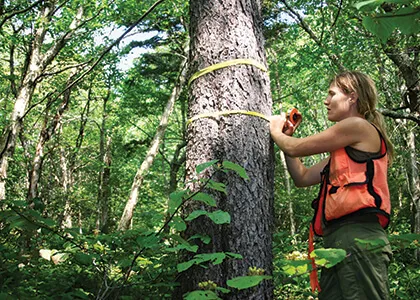
Since the 1960s, scientists at the University of Vermont have been documenting the decline of red spruce trees, casualties of the damage caused by acid rain on northeastern forests.
But now, surprising new research shows that red spruce are making a comeback—and that a combination of reduced pollution mandated by the 1990 Amendments to the Clean Air Act and changing climate are behind the resurgence.
The new study was led by Alexandra Kosiba of the University of Vermont with co-authors Paul Schaberg of the USDA Forest Service and University of Vermont researchers Shelly Rayback and Gary Hawley.
The scientists examined data from 658 trees in 52 plots spanning five states—and found that more than 75 percent of red spruce trees and 90 percent of the plots exhibited increasing growth since 2001.
“Our evidence suggests that the Clean Air Act is working to enhance conditions for red spruce,” says Kosiba, a staff scientist for the Forest Ecosystem Monitoring Cooperative at UVM. “This is a surprising and positive story.”
The team’s study was published in the journal Science of the Total Environment.
This project has been connected to a service learning course available to students in the Rubenstein School of Environement and Natural Resources. In the course, Environmental Problem-Solving and Impact Assessments, students work under the partnership of faculty member, Zachary Ispa-Landa, and Ali Kosiba to develop forest health curriculums for students of all grade levels based on research performed at the university. To read more about the study, click here.