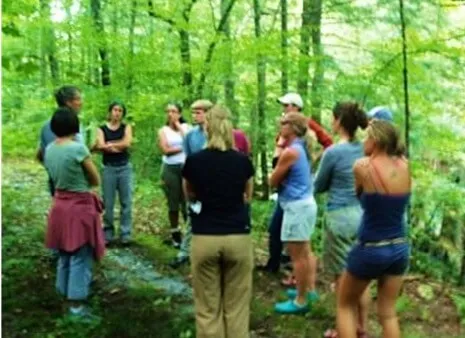
Cheryl Morse, PhD., an assistant professor in the university’s geography department, believes that service-learning classes have a great impact on her students and the community - and her students have the muddy boots to prove it.
Morse engages her students to delve into the world of human geography by conducting research outside of the classroom in her “Vermont Field Studies: Working Landscapes” course. This course “requires students to be adventuresome, flexible, innovative, creative, and willing to get wet, cold and muddy in the pursuit of knowledge and experience.”
Through service-learning and field study courses, students get the full-feel experience of studying human geography by going out into the UVM research forest located in Jericho, Vermont, where they are sent to talk to the active users and learn from them what they take away from this forest and their significance of the land. The four hundred-acre forest, which has belonged to UVM since 1941, also has a farm and farm buildings within its limits, which have been used for research as well as the surrounding land. The course focuses on how different people have used and benefitted from this area over time. Their work is amassed in a report known as The Jericho Research Forest: Landscape Use and Perception Study.
“A main component of the course is to use interviews to understand how people today use the land, what they find valuable about it and how they interact with this space on a personal level,” says Morse. Students look deeper into the lives of many active users of this Forest and observe how the forest caters to their personal wellbeing. They are additionally required to map out the current and previous uses of the land through means of Geographic Information Systems (GIS) software and dig deep into the historical research to inform their findings. The students are required to keep an online research journal blog throughout the course to keep record of their findings and experience.
The research conducted in this course will eventually be complied into what will become a historical archive of the land, Morse explains, “focusing on how the area has been affected and shaped by people over time.” The data will help inform recommendations for future uses of the Forest.
The research, service and field experience all contribute to the overall priceless experience gained from this course,” says Morse. “It involves a lot of trust, time, and a lot of flexibility,” she explains. “It’s less of a class where the information is being shared to the students by a professor, and more of having the professor serving like a coach.
Professors can prep their students all they want with practice, and students can come over to the sidelines for advice,” she continues, “but the real learning experience takes place when the students have to go in and do it themselves.”