
|
Unit 4
|
| the 6 contextual factors |
  |
• OUTCOMES: To develop an understanding of what
Contextual Factors are, and how they impact the
collaboration. • ACTIVITY: Questions designed to help clarify partici-pants understanding about the six Contextual Factors are posed in the following paragraphs. Use these questions for the large group, individually or in small groups as you see fit. The results to this activity also tie in with the Spider Web Analysis at the end of this unit. (1) Have participants write their ideas (the more specific the better) on sticky notes and place them on flip charts for each factor, or (2) Divide participants into small groups focusing upon one or two factors, and then have them report back to the full group, or (3) Record answers on a large flip chart poster with the large group. |
|
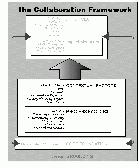 |
• DISCUSS: Contextual Factors are characteristics of
the physical and structural setting of the community,
the resources available within the community,
and the social and political contexts related to the
effectiveness of a collaboration. The relationship
between Contextual Factors and Process Factors is
reciprocal and mutually influential. The six identi-fied
factors are (1) Connectedness, (2) History of
Working Together, (3) Political Climate, (4) Policies/
Laws/Regulations, (5) Resources, and (6)
Catalysts. Respect for diversity is a key issue and the
capacity of the community to value the represented
voices influences each factor. (1) Connectedness: How do people know each other and how do they connect with one another? What are the linkages between individuals, groups, and communities? What formal and informal networks of communication support or hinder these linkages? Successful collaborations involve individuals, groups, organizations and communities that are well connected and have established informal and formal communication networks at all levels of connectedness. (2) History of Working Together/Customs: How has the community worked cooperatively or collaboratively in the past? How does the commu-nity solve problems? When the community worked on difficult issues in the past, how did it welcome diversity, embrace creative solutions, and develop community-wide strategies? How competitive is/was the climate? Collaborations tend to succeed in environments oriented toward cooperation, not competition. (3) Political Climate: This entails the history and environment surrounding power and decision making. What politicians will support your plans? Who will resist? Are political leaders open to dia-logue around new ideas? What leaders, systems within the community, and networks of people make up the communities political climate? How can you best influence decision makers and gain their support and endorsement? (4) Policies/Laws/Regulations: These represent the concepts and activities used to solve problems. This includes laws and policies within the community as a whole, and the policies, job descriptions, and agency expectations of individual collaborator's organizations. What supportive policies, laws, and regulations are in place? What resistive ones? (5) Resources: There are four types of capitol within collaborations—Environmental, In-kind, Financial, and Human. Is there an environment that supports connectedness, a history of working together, a supportive political climate, and laws and policies that encourage cooperative behavior? What In-kind contributions form collaborators are there (meeting rooms, supplies, computers, etc.? Is there any financial or monetary resources for the collaboration to draw upon? And most important for the continued success of the collaboration, what investment will there be of people's time, expertise and energy? (6) Catalysts: Two types of catalysts are needed. The first catalyst includes the existing problem(s) or reason(s) for the collaboration to exist. Do the community and/or potential collaboration members view the issue as requiring a comprehensive response? The second type of catalyst needed is a convener, or person who calls the initial meeting. Who is your convener? Is s/he respected and viewed as a legitimate player? Does s/he have good organizational and interpersonal skills? Does s/he have passion and fairness? |
| organization of information (from Leadership and the New Science by Margaret J. Wheatley.) |
|
• OUTCOMES: To bring the group to an understand-ing about how they'll organize the information they collect | |
|
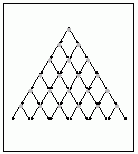 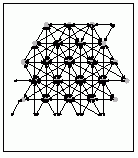 |
• DISCUSS: "Newer theories of the brain describe
information as widely distributed, not necessarily
limited to specific neuron sites." -p111. Research
finds a fluid pattern of memory and electrical
activity that arises from relationships within the
entire neural network. The image is information
transmitted simultaneously in all directions rather
than through a strict neural pathway. The implications,
however, are clear: hierarchical channels
restrict communication and dampen relationships.
As we move toward more collaborative models of
behavior we must shift the way we organize and
disseminate our information to include as many
people in as open a manner as possible. "The literature on organizational innovation is rich in lessons that apply here; and, not surprisingly, it describes processes that are also prevalent in the natural universe. Innovation is fostered by information gathered from new connections; from insights gained by journeys into other disciplines or places; from active, collegial networks and fluid, open boundaries. Innovation arises from ongoing circles of exchange, where information is not just accumulated or stored, but created. " -p113. • ACTIVITY: Have participants interact with one another, sharing their ideas and observations about the discussion points. How will you create an environment that supports diverse opinions for your collaboration? How will you structure the way you organize and discuss information? How will you nurture individual and group relationships? |
| analysis of process & contextual factors | ||
|
• OUTCOMES: To identify the strengths and weak-nesses of each factor in it's relation to the collabora-tion in a visual manner easily read by all group members. | |
|
 |
• DISCUSS: A Spider Web analysis can help measure
the positive and negative influences on both process
and contextual factors for your collaboration. In a
very visual way, participants can obtain an easily
identified map of where they'll need to devote their
time, energy and expertise. The responses to the
questions posed earlier in this unit regarding Process
and Contextual Factors allow participants to quickly
and easily plot each factor along it's line. • ACTIVITY: (1) Go through the factors with the full group, getting a sense of where the collaboration is on each factor's continuum and plotting its point on a flip chart or an acetate overhead, (2) Divide the group into two and have participants in one group plot Context Factors, and the other group plot Process Factors, then report back to each other, and (3) Develop each factor's measure at the same time it is first discussed in this unit, as an adjunct or replacement to the questions. FOR ALL ACTIVITY OPTIONS: after each line is plotted connect the dots for a visual representation of the spider web's outline, clearly showing the strengths and weaknesses of the present collaboration in regards to all Process and Contextual Fac-tors. The closer the factor is to a positive influence, the further out from the center the point will be located. |
