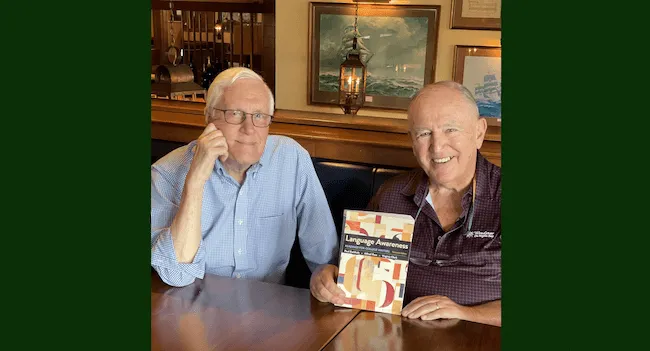
Several years ago, I caught up with Paul Eschholz and Alfred Rosa for a sort of reunion lunch at the Woodstock Inn in central Vermont. The three of us had been colleagues in the English Department at the University of Vermont for thirty years. Even though we had all retired in the early 2000s, I was surprised to learn that they were still actively working together, doing what they always did best—teach. The more we talked that day, the more I realized how little I knew about the special working relationship they shared. When we parted that day, we all agreed to stay in touch and to gather for lunch whenever Paul happened to be in Vermont. Little did I know that our luncheon at Sarducci’s in Montpelier last August would be our final gathering. Al Rosa passed away in January, after battling pancreatic cancer for over four years
Their story is remarkable in today’s academic world, one that I would like to tell you about. Paul and Al arrived at the University of Vermont in the fall of 1969, two years ahead of me. They were two of the nine new ABDs— “all but dissertation” --hired by the English Department. Soon these two young instructors, who were family men, fell into what I consider a very rare type of creative partnership.
Al Rosa describes an early encounter with Paul Eschholz in this way: “We met during the first weeks of our first fall semester, 1969, at department meetings and social gatherings. At one of the parties at Professor Betty Bandel’s farmhouse on Cheese Factory Road in South Burlington, we ended up on the same touch football team. I assured Paul that if, as quarterback, he could throw the football as far as he could across the cow-plop-studded field, I could catch it. He could and I did, and I still feel the thrill of racing way down the field, catching the ball, and not breaking both my legs in the process. Our friendship was on the right track from that point on.”
The remarkable conjunction of their backgrounds was surely a factor. In addition to the academic side of things, Paul and Al were almost the same age and both from Connecticut, both recently married and starting their families. Paul was a Wesleyan University graduate, and Al had graduated from University of Connecticut, both class of ’64. Paul had even grown up in West Hartford where Al’s older brother settled and resided for many years.
In addition, both men had separate areas of expertise that enlarged each other’s vision. “While Al had more training, understanding, and experience in things musical and the visual arts,” says Paul, “I knew more about language study, since I’d taken linguistics courses as a graduate student in Minnesota. Also, I was well-grounded in math, sciences, and agriculture—I was raising my kids on a sheep farm.”
A Shared Dream
Right from the start their friendship was not just close but cooperative (beyond touch football). Paul makes clear that it was their teaching the same course—a linguistics-based course in 1970—that drew them together professionally. “We were both teaching composition using our English language as a theme for study. That’s when we recognized the chemistry that would energize our working relationship. We regularly talked about our teaching and pedagogy, occasionally team-teaching our combined sections.” Because they could not find a textbook they liked for this course, quite naturally they decided to rectify the situation by writing one.
“All of our books were ‘kitchen-tested,’ you might say, in classrooms. The new editions were created by working with our UVM students as well as consulting the teachers across the country who used our books.” –Paul Eschholz, UVM Emeritus Professor of English
Their working together in defining their new course and in hammering out a textbook proposal quickly exposed them to the qualities of each other’s thinking. “We were more like-minded than complementary,” says Al, and Paul agrees that they both have a strong work ethic and are not afraid of challenges. Back then they shared the same dream: to be the editors of a major textbook before they turned 30 years old. They never missed meetings or deadlines. If they disagreed on any issues, the disagreements were quickly and easily resolved.
Al recalls, “There was too much at stake to waste time.” And the two men did not let themselves be discouraged by the fact that textbook publishers were in a fallow period. A hiatus had followed what had been a tremendously active period in which any idea at all for a textbook had been received excitedly by New York and Boston editors. In fact, they had often signed authors over the phone without even meeting them. Al explains, “Sadly, or not so sadly, that bubble had burst. The field had been oversold, editors were let go, and very, very few textbooks were being signed when we came along.”
Finding an editor was the first barrier they had to surmount to get a textbook contract. Luck was with them when they came upon Tom Broadbent, an editor who warmed to their proposal immediately and thought that there could be no better subject on which to base his revitalization of the St. Martin’s imprint (a division of Macmillan, in England). “In no time,” says Paul, “we had a contract for what would become our first book, Language: Introductory Readings.”
While at first Al and Paul relied heavily on their more senior colleague Virginia Clark’s linguistics expertise to guide the content, they engineered “the more pedagogical side of the book” and developed work strategies to make sure the project would move forward despite all the other demands on young teachers’ time. Al describes their hectic life at the time: “We were busy people, teaching six days a week, carrying four-course workloads, and finishing the writing of our dissertations.”
Paul remembers that, as their creative association began, “Al and I were just coming off several years of dissertation (and article) research and writing, which can often be isolating work. For us, collaboration was a real breath of fresh air.” From that beginning, their collaboration was to develop over time into a true professional as well as personal relationship lasting more than fifty years—“the closest thing to a marriage that I can think of,” says Paul, and a “marriage” both their wives applauded.
The two men hadn’t been working together for long before they realized that they could literally “finish each other’s sentences” on the page and off. Tom Broadbent, moreover, admired their energy and their effortless collaboration. He also enjoyed their company. Al describes the relationship that he and Paul developed with their editor this way: “He loved that we wrote prose from which he could not distinguish us stylistically (essential for editing, from his position). All three of us, of course, were advocates of clear, communicative prose, what Orwell called ‘windowpane prose’ (prose that, like a windowpane, did its job without drawing attention to itself). Tom could see at once the longevity of our book were we to be so lucky as to see it into multiple editions.” Finding two such professors, both inventive writers and teachers committed to the long haul, inspired editor Broadbent to sign the rest of their books with Bedford/St. Martin’s in the ensuing years.
Birth of a “Quiet Revolution”
When such terms as "writing process" or "process writing" became buzz words of the mid-70s, Al and Paul were right there with a workable and teachable pedagogy to fit this new "theory." Al and Paul soon found their world expanding when a large grant from the National Endowment for the Humanities offered them the opportunity to share their newly discovered pedagogy with hundreds of teachers and administrators throughout Vermont. Their five years of work with English teachers, principals, and superintendents from the four corners of the state effectively took them out of their department. Although not every one of their university colleagues fully understood what Al and Paul were doing, the two collaborators knew from their wider perspective that they were right where they wanted and needed to be. They were on the cutting edge of helping to develop how teachers would teach the crucially important skill of writing.
At the heart of the Vermont Writing Program was the fundamental belief that teachers had to be writers themselves before they could teach writing. So, for six weeks during each Summer Institute, teachers wrote. They experienced the struggles that all writers grapple with, and they learned how to talk about their struggles with each other. Linda Ayer, a reading specialist at Westford Elementary School, remembers “feeling validated as a writer, as a teacher, and as a person” at the conclusion of the 1979 Summer Institute. Teachers discovered that their own struggles with and feelings about writing were not unlike those of their students, and it was this knowledge that helped them be better teachers of writing.
The program, with its Summer Institutes that allowed follow-ups with in-school visits during the school year, grew by leaps and bounds during its first three years. When then UVM President Lattie Coor witnessed what was happening in Vermont’s public schools, he dubbed the program Vermont’s “Quiet Revolution.” In 1982, at the end of the program’s fifth year, Rick Marcotte, Principal at South Burlington’s Central Elementary School and enthusiastic participant in the program, believed that the Vermont Writing Program was “Vermont’s most innovative educational program during the second half of the twentieth century.” What surprised him most was that not only did the standardized writing scores for Central students go up, but their reading scores did as well.” Writing and reading are, indeed, the two sides of the same coin.
Program participants learned that when students are asked to share their writing with other students in peer conferences, they become better writers. And when they read their own writing aloud, they start to become more effective and discerning readers. Over the next 20 years, and through the auspices of UVM Continuing Education, the program trained more than 2,500 Vermont public school teachers and administrators. They, in turn, provided sound writing instruction for more than 100,000 Vermont students.
Paul makes the point that “in a sense, you could say that we taught that writing instruction at its best is a collaboration between a teacher and a student or between a student and a student. We both endeavored to model this in the many writing courses--Written Expression, Expository Writing, Writing Vermont Life, Writing Vermont Drama, Writing Vermont Poetry, and Editing and Publishing—we taught over the years at UVM.”
Everything that Al and Paul put their minds to and their hands on, they were able to publish. Perhaps the reason for such continued success was that they never took on a project without first giving it a lot of forethought. Each textbook needed to have an academic necessity and to meet the academic and pedagogical needs of enough teachers and students to ensure it would run through multiple editions and thereby have a real impact on teaching across the country. “As you can see from the considerable number of books we were able to produce over the years that went into multiple editions,” says Al, “there was a lot of purpose, drive, and efficiency in the way we worked.”
Over the years colleagues sometimes questioned whether textbook work was really an academic achievement. Al credits a wise man with helping them achieve the right perspective. “Walker Gibson, a rhetoric professor and mentor I admired at the University of Massachusetts, saw textbook authorship as a dignified and worthwhile endeavor in a world where textbooks were much maligned and devalued. My having been under his tutelage was a lucky break for me, because he showed me that I, too, could aspire to teach millions of students beyond what one normally thinks of as the writing classroom.”
Collaboration was a major part of the many books that Al and Paul did together. In the early days when they were learning to write together, they hardly understood that they were, in fact, developing an intimate understanding of what teachers came to call the "writing process." Paul and Al would start by discussing between themselves what they thought they wanted to say and to whom. “Ideas would well up” during their brainstorming sessions and neither man could later be quite sure where those ideas came from. They knew to judge whether their collaboration was working or not by the results, and they didn’t pay much attention to the dynamics of the process itself. Sometimes they would each take a distinctive role—bad cop/good cop, so to speak. As a writing team, they took care never to lock themselves into a rigid scheme. They prized flexibility. They call “scaffolding” their use of temporary ideas or materials to build or develop core ideas. “This was a highly productive part of our process,” Paul affirms. “As the analogy suggests, once an essential idea is fully realized, the excess material can be removed, and you can continue to build on the core.”
“Catching collaboration working,” Al says, “is a bit like catching yourself breathing. If you are aware of it, perhaps you aren’t really collaborating.” Furthermore, they have always taken credit together for what they’ve written, expressing no pride in authorship or ownership individually, only collectively.
Both Al and Paul agree that a key ingredient to their writing successful textbooks has been their knowing their audience. “And we really knew--and collaborated with--our audience on a daily basis,” Paul affirms. “All of our books were ‘kitchen-tested,’ you might say, in classrooms. The new editions were created by working with our UVM students as well as consulting the teachers across the country who used our books.”
Of all the textbooks they have created together, Al and Paul concur that the writing of their Writer’s Brief Handbook was a Herculean project that took them years. It comprises more than 450 pages of technical information that had to be accurate in every detail. They hadn’t predicted this book would take them so long to produce and require so much hard work.
“We are proud of it as a crowning achievement in so many ways,” says Al. “Personally, to be in the position of co-authoring a text that set standards for usage, mechanics, grammar, research techniques, and documentation guidelines, among many other pedagogical aids, is a source of immense pride for Paul and me. Since I am the grandson of four Italian immigrants to this country (and Paul the grandson of German and Irish immigrants) who arrived knowing very little English, I am especially proud that our textbook has been nationally at the forefront of English language studies and writing.”
A Working Retirement
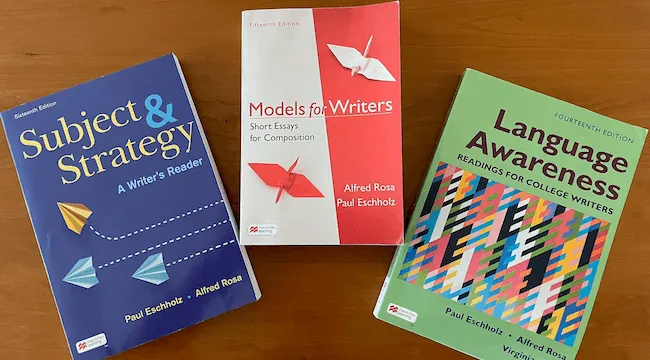
Perhaps the miracle of their long partnership was that it was still thriving right up to the end when Al passed. Both men were long retired from the University of Vermont--Paul still living in Florida while Al stayed in Vermont. Every summer since Paul moved to Naples, he and his wife Betsy would return so that Al and Paul could work together for three or four weeks as they had during their 34 years at UVM. During the rest of the year, their weekly phone calls and back-and-forth emails to each other never let up. They made hay during the pandemic years: the sixteenth edition of their textbook Subject & Strategy appeared in 2022, and the fiftieth anniversary edition of Language Awareness in 2023. Finally, the fiftieth anniversary edition of their classic Models for Writers was published in 2024---a remarkable achievement for this more than five-decade collaboration. Al and Paul spent their last afternoon together on January 9th in the living room of Al’s South Burlington home reminiscing about fifty plus years of working together and what they could look forward to in the coming months.
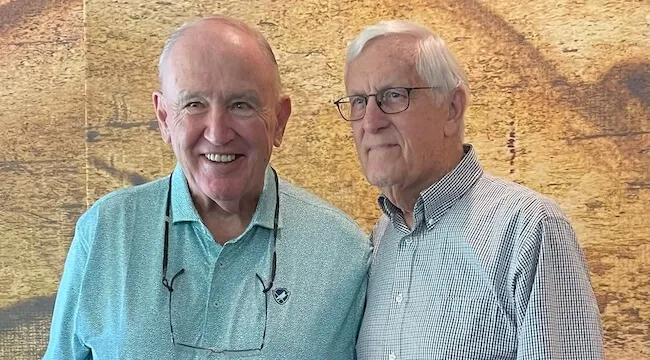
In a world increasingly caught up in this “theory” or that “theory,” Paul thinks that he and Al found success in writing and teaching (as well as in playing touch football) by keeping things simple. “We always grounded our work on a solid foundation of the basics and fundamentals. We sought to take the ‘mystery’ out of writing and always encouraged student writers to take ‘ownership’ of their work.” Looking back on my colleagues’ careers today, I believe that the legacy of their productive partnership in the world of teaching writing is extraordinary. Their hands-on work with Vermont school teachers and administrators through the Vermont Writing Program, their many textbooks on writing for students and teachers coast to coast, and their 34 years in the classroom at UVM stand as an example of dedicated teaching the whole University of Vermont community can celebrate.
Margaret Edwards is a UVM Emerita Associate Professor of English