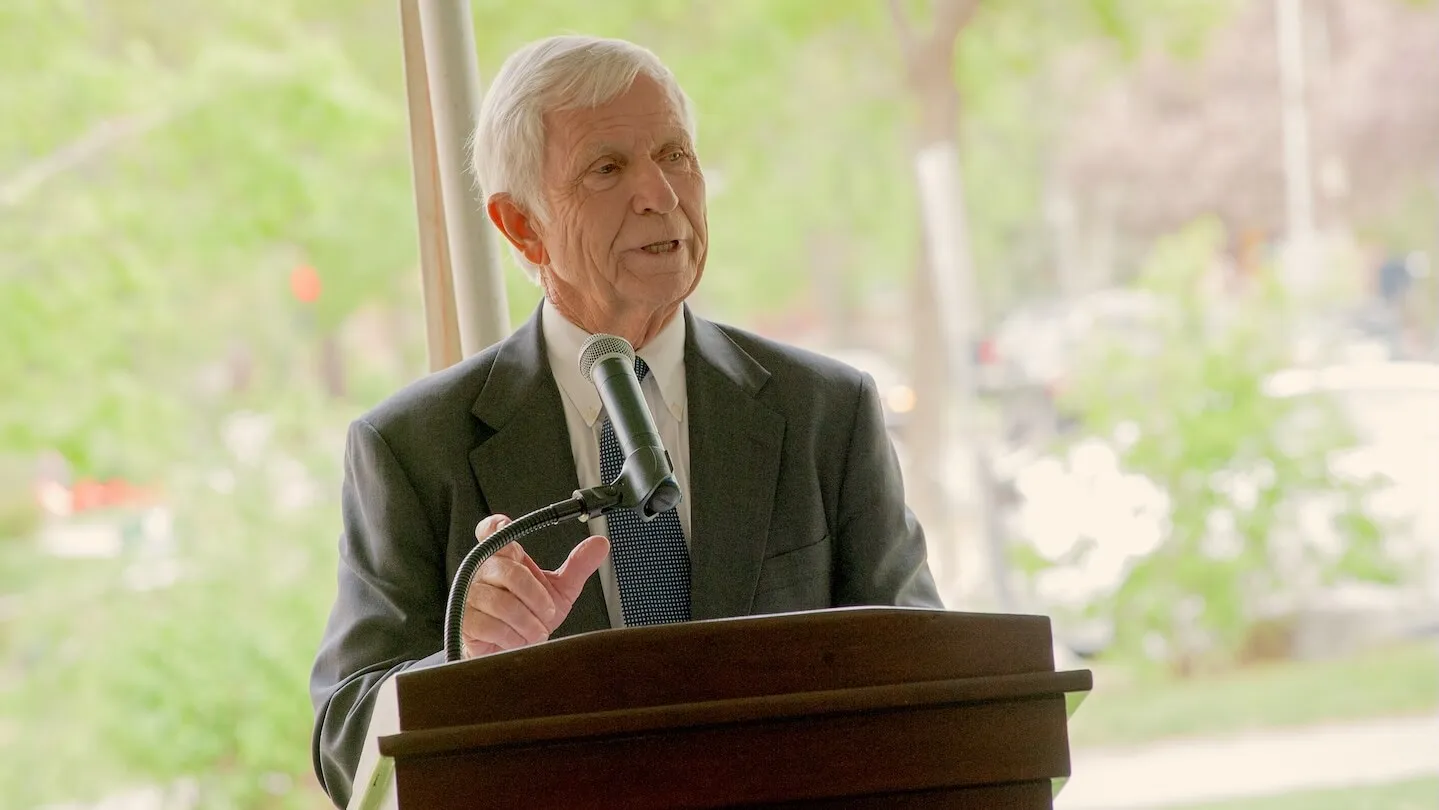
Lattie F. Coor, who died Thursday, July 16, at 89, was the second-longest serving president of the University of Vermont, beginning his 14-year tenure in 1976 at what he called “an extraordinary moment” in the life of the university.
The son of schoolteachers and a native Arizonan, he received his bachelor’s degree in political science from Northern Arizona University and his master’s and doctoral degrees from Washington University in St. Louis. He was a faculty member and administrator at Washington University, eventually serving as vice chancellor, before assuming the presidency of UVM.
Coor came to a UVM that had more than doubled its student body in the preceding decade. It was a time of great promise, but also great challenges for the university. Through the late 1970s and the 1980s, UVM developed a national reputation as a high-quality institution, recognized as a leading “public Ivy” –a state university offering the academic experience of an elite institution. UVM gained that reputation in great measure through Coor’s determined efforts to strengthen undergraduate education and the institution’s faculty and research enterprise. He was a builder with bricks and mortar, too: the “Coor years” at UVM saw a marked improvement of the institution’s infrastructure, including the construction of Kalkin, Aiken and Stafford Halls, and a major expansion of the university’s library. Under his leadership, the financial base of the university was stabilized, and philanthropy grew sevenfold. The building housing the College of Arts and Sciences was named in his honor in 2013.
Coor returned to the Southwest in 1990 as president of Arizona State University. Over his 12-year tenure there, ASU achieved major milestones as a multi-campus research institution, achieving R1 status in 1994. After retiring from ASU he co-founded the Center for the Future of Arizona.
Coor always saw UVM as a place of bold thinking and action. Reflecting on his time in Vermont, he said: “There is that combination of will and determination and mutually reenforcing collective commitment [at UVM] that allows triumph to happen.”