Meta, the parent company of Facebook, owns the three largest social media companies in the world. Each platform has twice as many users as the population of India—not bad for a company that is a mere 22 years old.
When social media first emerged, it was perceived as a benign space for college students to post pictures of cheeseburgers and snark—a virtual world that disappeared once you closed the app. But as the user ranks swelled, and private companies, media figures, governments, and bad actors got into the mix, the lines between the online world and the “real” one was erased.
Now, social movements coordinate using hashtags and tweets and politicians communicate directly to the masses rather than through traditional press releases. A single tweet from a world leader can upend financial markets. Social media is no longer a place to pop off and log off without real consequences.
This is why University of Vermont scholars including Pablo Bose, professor of geography, are studying how narratives evolve and spread online through the Science of Online Corpora, Knowledge, and Stories (SOCKS) program. The work is funded through the National Science Foundation’s Established Program to Stimulate Competitive Research (EPSCOR) and uses tools developed by UVM computer scientists to analyze content from large-scale datasets including text from library collections and across social media.
Bose, a geographer by training, studies migration and environmental displacement—the forced movement of people due to fire and flood, hurricanes and drought. For decades he has focused on refugees and resettlement in the United States and Europe, often through qualitative work that offers small but deep explorations of the human experience.
While there is positive rhetoric that we are a nation of immigrants, which is true, Bose says, immigrants historically have been treated with suspicion. “These issues have always been charged.”
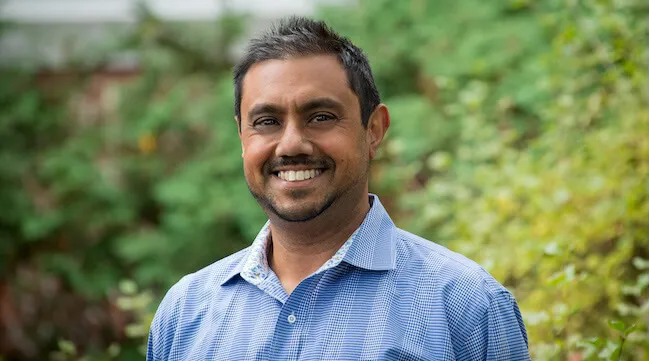
In 2015, he saw more vocal pushback to immigration and wondered if big data from social media could serve as a proxy to understand sentiments on a broader scale. Bose’s SOCKS project examines the evolution of communication patterns about population dynamics and migration around the world. He was curious if researchers could detect a signal of sentiment amidst the billions of daily posts even before headline-making events.
We often focus on big moments, events like Brexit or the U.S. Election to tell a story, Bose explains. But that may be more like starting to read a story at its climax. How did we get to this moment? Were there previous indicators in the noise? Think of seismic activity and the instruments that note tremors humans can’t feel. What if you could predict an earthquake on social media before the walls come down?
Meredith Loney ’26, a Global Studies and Environmental Studies major, is helping mine social media data to find out. She joined Bose’s project last summer as part of the 2025 cohort of Vermont EPSCOR interns. Loney created burner accounts for platforms including Twitter/X, YouTube, TikTok, and Instagram to conduct netnography—"it's like ethnography but on the Internet so you just really go and immerse yourself in these Internet communities,” Loney explains. She will soon examine more platforms such as Truth Social and Telegram.
“We actually need to create all new accounts for every platform,” Loney says, “… Because your phone or your device tracks everything that you do, even if I'm scrolling on my phone the algorithm for my entire phone influences the throwaway accounts.”
Starting fresh allowed the researchers to use key words and specific rhetoric from influencers to build and train new algorithms. It usually snowballs, unearthing communities and influencers using coded language that one outside the circle might go their whole lives online and never view. The discovery was jarring at first.
“Since I have been online for so long, I have just kind of set up my own world,” Loney says.
Her involvement in the SOCKS project showed her that there were other universes generated by different algorithms filled with indicators and secret signals she had never encountered before.
“It was kind of an internet culture shock,” she says. “It is crazy to think that people have been using this exact same platform as me.”
"It took a lot of detective work. Because there is not a lot of stuff that you can’t find right off the bat.” - Meredith Loney '26
Social media users are fed different content to keep us engaged. The algorithms on social media platforms test our interests, and at the same time, shape what we will see in the future and potentially how we feel and the stories we tell ourselves. For example, a starting point Loney might use of “2020 election” will take her down two very different paths.
This type of word and phrase testing helped Loney understand how people fully immersed in their own online worlds could believe certain narratives and spread stories—true or not—across the internet.
“A lot of research shows that algorithms sometimes give you conspiracy content on purpose,” she explains. “… Usually, they get more likes or comments or reactions, that sort of thing.”
And that spreads unreliable content to more and more feeds. Over the summer, Loney and another undergraduate research partner began uncovering themes, repeated rhetoric, and conspiracies found in tweets, YouTube videos, and comments related to migration narratives such as rural resettlement and displacement.
“We are focused on how the tools might allow us to better understand the spread of discourses,” Loney says. “It is more a of a focus on how we understand narratives rather than what the narratives actually are.”
They compiled a list of creators and key words about migration that can later be used to track how narratives spread. Sometimes the researchers found most discourse about a particular subject originated primarily from one or two content creators who have lots of followers. Other times, Loney says, we would see a theory start from a small post, deep into a nationalist group, which then spilled out of their circle and reached a popular podcaster or creator. This person would spread the language, but maybe not as intensely as in the original post, Loney says. “It’s kind of a watered-down version.”
“It took a lot of detective work,” Loney explains. “… Because there is not a lot of stuff that you can’t find right off the bat.”
For instance, what one person calls climate migration—typically news accounts—another person might call a hoax. That is why understanding the language and context of stories told online matters.
“One of the key aspects of understanding the science of stories and why the SOCKS tools (and more importantly its approach to understanding narrative at scale, especially in a new technological medium) is that as with text throughout human history, this does not exist in an apolitical vacuum,” Bose explains. “What we say, what we create, what we imagine, and how we frame these stories has very real effects in the world around us.”
And the speed at which narratives are formed and shared across the world can be alarming—particularly if what is shared is a lie. Scientists have previously found that misinformation spreads faster and wider than truth. Bose is hopeful that SOCKS research can help scientists better understand how and why stories spread.
“At present such narratives are being shaped and reshaped in newer, faster and unexpected ways,” he says. “It becomes crucial for us to think through how to catalogue, understand and hopefully intervene in a number of these dynamics and we hope that the tools we develop will help do so.”
For instance, while one person might scroll their social feeds and see photos of Alan Kurdi, a two-year-old Syrian refugee who drowned in 2015 while his family tried to cross the Mediterranean Sea, another user might view theories that the photos were staged, or be shown images of women who suffered violent crimes committed by undocumented immigrants. Because social feeds reflect what various algorithms synthesize your politics and beliefs to be, this can become an unvirtuous cycle that reinforces and hardens viewpoints.
“What we say, what we create, what we imagine, and how we frame these stories has very real effects in the world around us.” - Pablo Bose
Three years into the project, Bose’s team has examined Twitter/X data to see if there were signals about migration discourse one could detect before big events. So far, they have not found a “discernible predictive signal” he says. “That is, if we were to look at phrases like ‘immigrant invasion’ or ‘migrant caravan’ or ‘refugee crisis’ these tend to rise in social media mentions as a trailing, not preceding indicator.”
What does seem clear is the role prominent people and media outlets play in repeating terms that then spread throughout social media and within certain online communities.
“If we filter out the social media mentions by the politicians, political campaigns and news media, it again reinforces the fact that these are echoes and ripples, not precursors,” Bose says.
At this point, the team has refined the tools they are using and will continue looking for signals from four datasets including Twitter/X, Bluesky, Reddit, and Wikipedia. Despite difficulty of teasing out sentiment based on real support by users or by troll farms with a digital thumb on the scale, Bose still believes that social media can reveal certain kinds of signals. Interpreting them correctly is the tricky part.
Bose recently hired a digital anthropologist and a linguist to help, because to understand the content posted online you also need to have an understanding of history, art, and culture—including of groups like white supremacists to understand the memes they produce.
If you know, you know. If you don’t, you might just see what sounds like an innocuous statement about protecting the homeland, Bose explains. Only when you understand this history of the art and selected phrases does the full meaning become clear. And even then, Bose remains skeptical about how much online data can truly reveal.
“You ought not to and it is dangerous to make assumptions” of what the data is really telling you, Bose says. “The idea that language is an unvarnished bridge to truth—that is just not the case.”