The fate of a single insect is not the sort of thing that often keeps one up at night. But Finn Flynn isn’t most people.
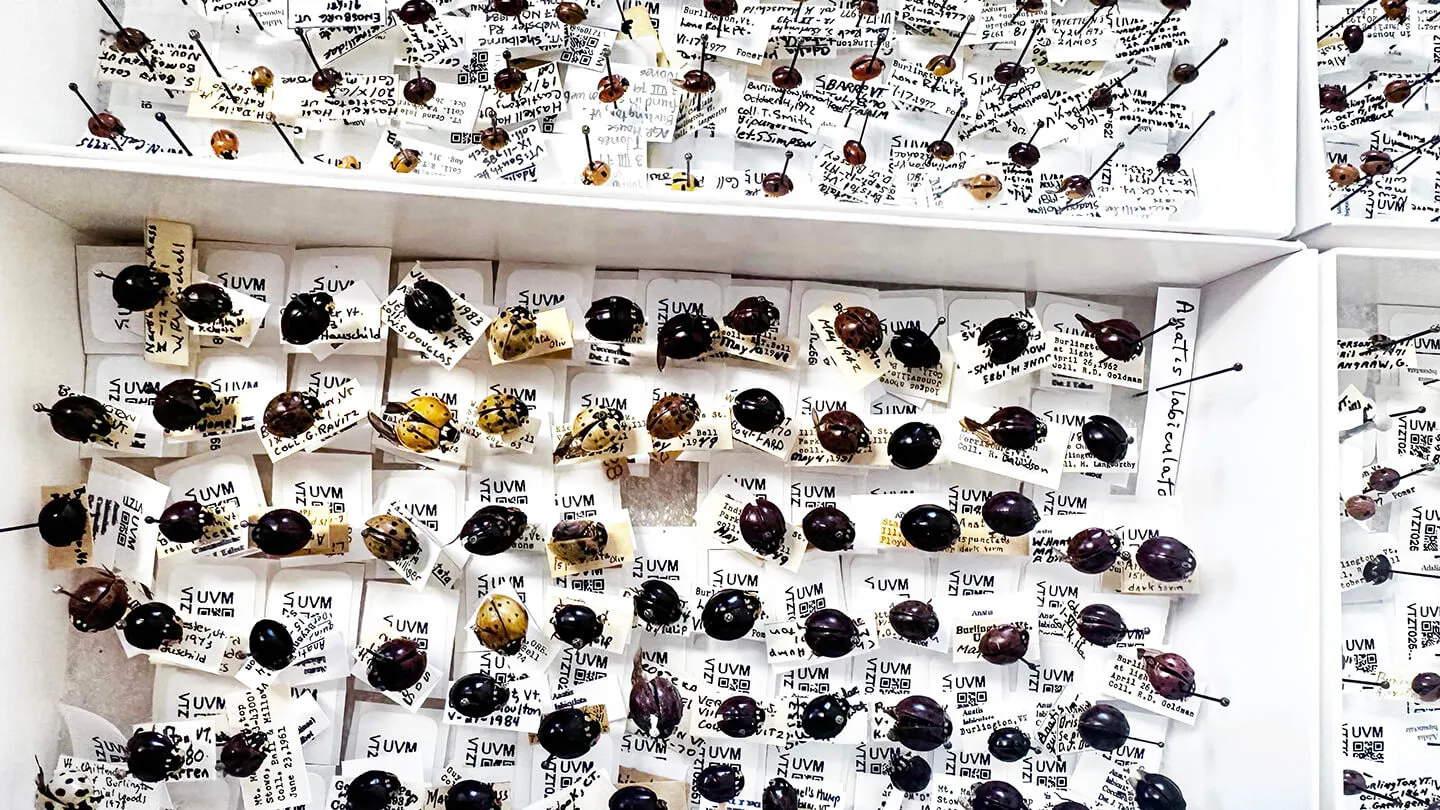
The third-year biology student recently spent months sorting through more than 60,000 beetle specimens in the University of Vermont’s Zadock Thompson Zoological Collections—for fun.
“It definitely feels like you are organizing a library but instead of books you have beetles,” he says.
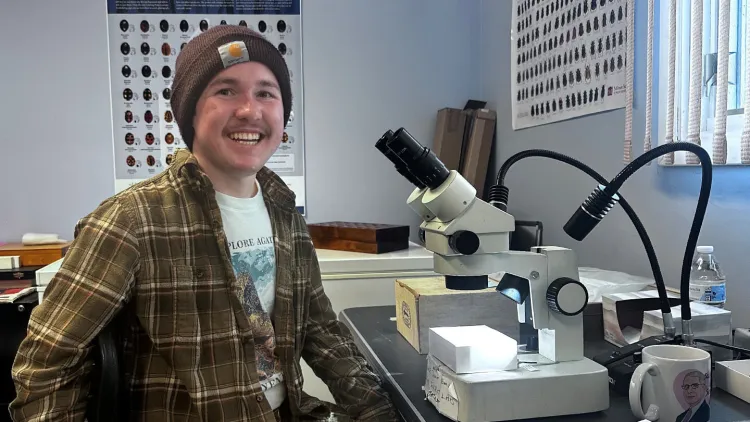
When Flynn first learned he could intern with the university's natural history collections he admits that he was more of a bird person. But he quickly found a liking to these tiny creatures.
“You would be surprised how many weird, cool beetles you can find just by looking around,” Flynn says.
In addition to housing species native to Vermont, the Zadock Thompson Zoological Collections has the second largest collection of Haitian insects in the world, Flynn says, heading to a room with near floor to ceiling metal cabinets. Each cabinet is lined with wooden drawers containing thousands of species organized by Flynn and curators from years past. It’s the tedious side of the work but work he enjoys—because natural history collections tell stories.
There is the history of the insects, but there is also this record of the collectors’ lives, Flynn explains.
Natural history collections tell of changes in the environment. Specimens can reveal new and emerging threats. For instance, tracking the presence of certain species—pests—some might call them, is of vital economic and agricultural importance, Flynn explains. “It’s important to know what has been here for monitoring purposes.”
Natural history collections are critical for conservation, too. They reveal not only what is in a place, but what is missing from it—like lady beetles.
Flynn was deep into the work identifying the lady beetles from Vermont in the Zadock Thompson collection for the Vermont Atlas of Life, a digital library of the state’s biodiversity, when he had a hunch about a rare specimen that was nowhere to be found.
“That was a big effort,” Flynn says with a smile.
The hunt for Vermont lady beetles built on work Kent McFarland, director of the Vermont Center for Ecostudies, started in 2020 to build a database of the state’s native and nonnative lady beetles. It involved scouring records across Vermont, Canada, and iNaturalist.org, and digitizing the findings as part of the Vermont Lady Beetle Atlas to understand historical populations and flag vulnerable species. Flynn suspected more Vermont specimens might be hidden in the collection and uncovered 2,500 more beetles to catalog and digitize.
During his research, Flynn found references to a type specimen of Coccidula lepida, or snow lady beetle, supposedly collected in Vermont in mid-1800s. Type specimens are the organism entomologists use to describe new species, but this one wasn’t listed in any Vermont collection. Flynn emailed McFarland, hoping he could help track it down. If found, it would boost the state’s total count to 48 lady beetle species.
“You would be surprised how many weird, cool beetles you can find just by looking around.” - Finn Flynn
While McFarland did trace the type specimen to a misclassified sample in the Harvard Museum of Comparative Zoology, Flynn uncovered a small box of 12 Coccidula lepida in the UVM collection, 11 of which were collected in the 1950s in Burlington. A single specimen was gathered March 7,1966 near Shelburne Pond.
“And that is the last time it’s been seen in Vermont,” Flynn says.
It’s an all too familiar story with lady beetles across North America. Native populations have dwindled in recent decades, so much so that entomologists at Cornell University launched the Lost Lady Bug Project, an effort to track populations and untangle their decline.
“You used to go outside and find thousands,” Flynn says.
Most Vermont gardeners know lady beetles to be helpful companions with their voracious appetite for aphids. But over the decades, several native species such as the Nine-spotted lady beetle have nearly disappeared across the Northeast. Pinpointing why certain species have declined is a complicated endeavor. While invasive species arrived and outcompeted some native species, that is only some of the story.
In Vermont, the landscape flipped as grazed lands were reforested, displacing lady beetle species that prefer fields to trees. Other species, Flynn explains, like the Pink-spotted lady beetle don’t have to worry about competition for aphids because they also eat pollen and can flex their diet.
Ecological genomics can help scientists understand evolutionary traits associated with big declines, Flynn says. “We need to know that to stop these massive declines.”
Some lady beetles may be so rare in the state it’s unclear if they are truly lost or if people just haven’t found them in a while. Flynn pulls out a small box of tiny Snow Lady beetles. They are oval shaped with a spade like pattern and smaller than Tic Tacs. He slides a specimen under the microscope to reveal tiny hairs on the abdomen.
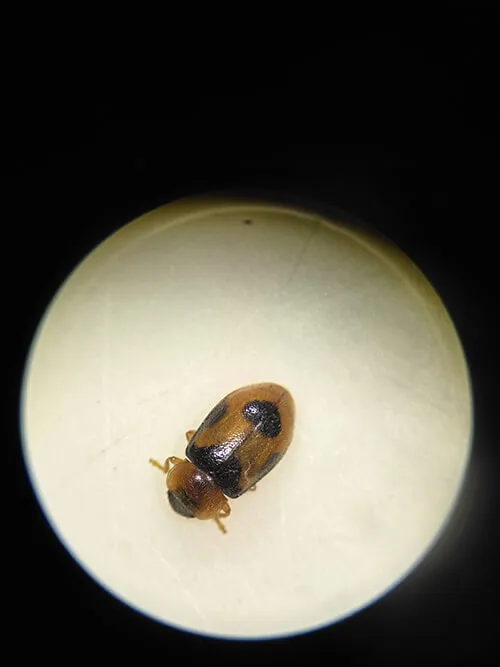
“Maybe a cold weather adaptation,” Flynn says. “They emerge right after the snow melts.”
Early next month, he will swap the stacks of the Zadock Thompson collection for marshy areas like Shelburne Pond where he will comb the ground for Snow Lady beetles that may be emerging. Flynn hopes he isn’t alone.
“It would be so wonderful to find it,” he says. “I think if a lot of people look and they know when to look—there is a chance.”
If you do spot a snow lady beetle this spring, snap a photo and upload the information to iNaturalist.org so it can reviewed by individuals at the Vermont Center for Ecostudies' Lady Beetle Project and added to their dataset.