Across all these core areas, our goal is to perform rigorous scholarship that helps unlock practical, scalable solutions that meet multiple sustainability objectives for people and the environment. This requires strong partnerships with academic collaborators, industry, government agencies, local communities, and other stakeholders.
Core Areas
Biological Cycles
Biological cycles involving carbon and nutrients sustain life on Earth. A more circular economy requires approaches to food production and organic waste management that recycle nutrients, harness energy, create valuable products, protect ecosystems, and support sustainable consumption and production. We investigate various circular approaches to sustainably managing biological material flows.
Technical Cycles
Technical cycles involve the recovery, reuse, and continued circulation of manufactured materials and resources. These flows require intentional design and management to reduce waste and environmental harm, while creating economic opportunities. We study circular economy solutions aiming to extend the life of materials, minimize reliance on virgin resources, and establish beneficial synergies between industries.
Environmental Infrastructure
Sustainable, resilient infrastructure is essential to support circularity in materials management, protect the environment, and enable businesses pursuing circular economy solutions to thrive. We design and evaluate systems that protect natural resources, facilitate circular practices, and meet diverse needs. By integrating nature-based solutions and circular design principles, we aim to help bring about environmental, social, and economic co-benefits.
Pollution Control
Pollutants pose significant risks to human health and ecosystems and can also create roadblocks on the path to a more circular economy. Our research supports the advancement of technologies and strategies to detect, prevent, and mitigate contamination across waste and materials management systems. This includes addressing contaminants such as PFAS and microplastics in materials ranging from landfill leachate to food waste derived compost.
Social Dimensions and Policy
Technical solutions alone are not enough to drive sustainable change and circularity. Public engagement and enabling policy frameworks are also essential. We examine human and institutional factors that enable or hinder the transition to circular systems. Our research explores behavioral change, policy instruments, market incentives, and equity considerations to support the emergence of inclusive and effective solutions.
Sustainability Assessment
Evaluation of sustainability requires understanding the complete picture of environmental benefits and burdens, along with related social and economic implications. We use life cycle assessment (LCA), techno-economic analysis, and other modeling methods to help guide technology design, decision-making, and policy. This approach allows us to identify trade-offs, highlight synergies, and ensure that products and systems are meeting desired goals.
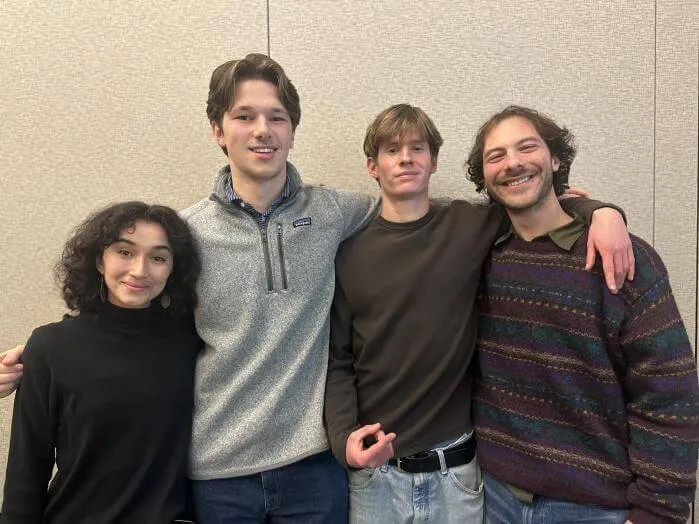
Casella Center Student Design Competition
The Casella Center’s Student Design Competition gives students an opportunity to work collaboratively while designing innovative ways to bring Vermont's circular economy to life.
Student Design Competition