What would the University of Vermont look like today—indeed, what would any American university look like—if, sometime around the year 1812, a farm boy from Hartford, Vt., named Roswell Marsh had decided to go to college?
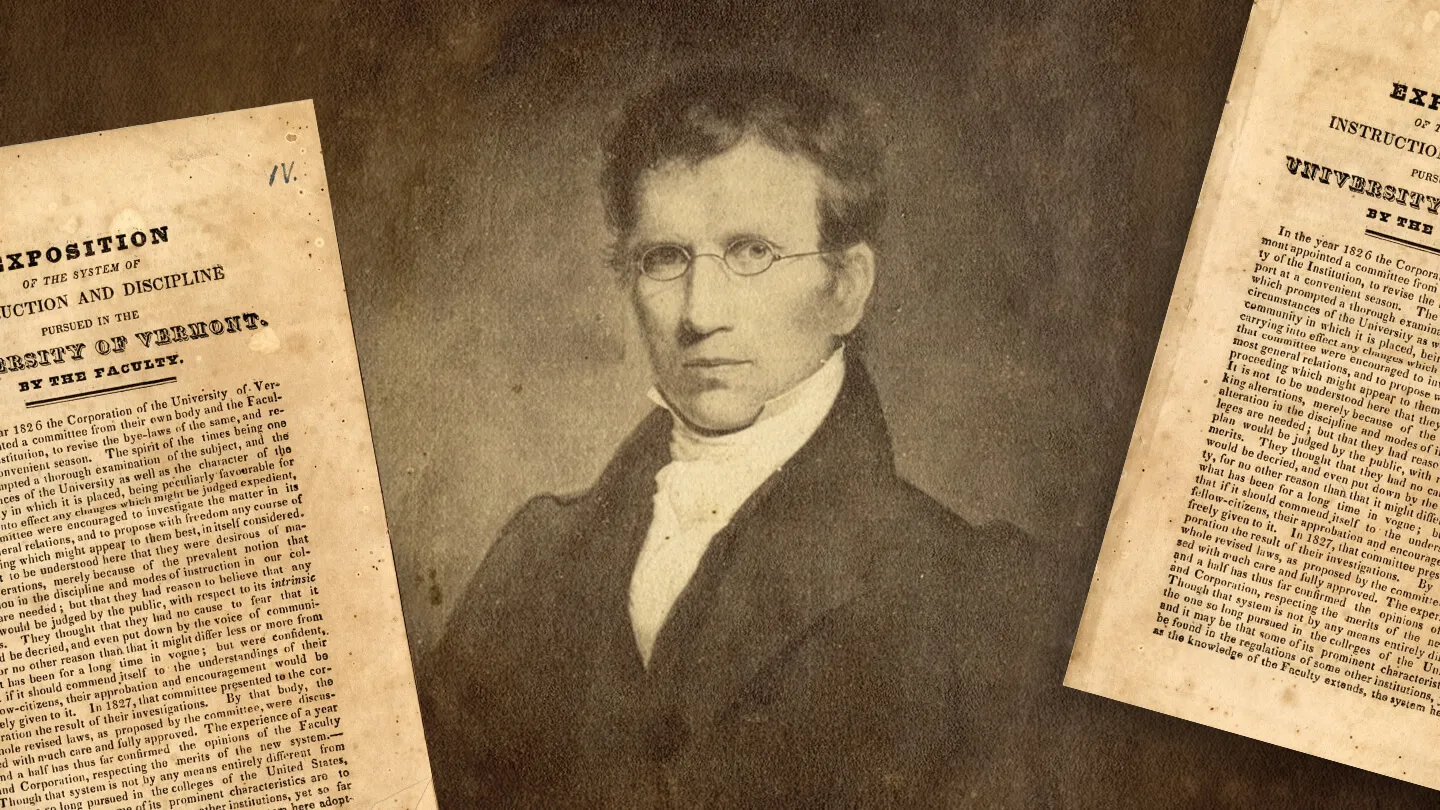
Roswell was the eldest son of Daniel and Marion Marsh. The Marshes were a prominent family in a young nation: Roswell’s grandfa-ther, Joseph, was one of the earliest white settlers of Vermont, and was a member of the 1777 Westminster Convention that declared Vermont’s independence. The Marshes had reserved for Roswell, as their eldest son, the privilege of attending university. For reasons now lost to time, Roswell demurred, and the opportunity passed to his younger brother, James. James said “yes.” That decision was the first link in a chain of events that would bring James Marsh to UVM as its fifth president, where he would foster a series of struc-tural reforms that put the University of Vermont at the forefront of educational innovation, including the founding of the first univer-sity English department in the Americas, one that celebrates its bicentennial in 2027. Marsh would also figure prominently in the founding of American Transcendentalism, the most important 19th century school of thought in the young country.
UVM has the oldest Department of English in the nation and, arguably, is the site of the first system of university departments. The very structure and guiding ethos behind almost all institutions of higher learning in North America can be traced back to James Marsh and his revolutionary reworking of the University of Vermont in the 1820s.
——
James Marsh was about 18 years old in 1812, and had never planned to leave the family farm; but after his older brother passed on the opportunity to go to college James resolved to spend a year in preparation, schooling himself in the Latin and classical Greek that was a requirement for any man of his time–and they were all men–who intended to seek a degree. At the time, most universities in Europe, and all in the United States, were basically training schools for future clergymen, and the reigning pedagogical style was recita-tion and response: students studied and memorized texts, and recited them back to their professors when queried. The dominant phi-losophy influencing education at that time came from the writings of John Locke, who theorized that the human mind began as a sort of blank slate, upon which knowledge should be written. This was the university world Marsh entered at Dartmouth in 1813.
The farm boy with only a year of formal preparation quickly grew into an accomplished scholar. Later, his friend and fellow UVM fac-ulty member Joseph Torrey (who would serve as UVM’s ninth president) commented on Marsh’s blossoming at Dartmouth: “The dis-advantage of an imperfect preparation operated within him only as a stimulant for greater exertion, and was in fact compensated, in no slight degree, by that maturity of mind and those industrious habits he brought with him from the farm.”
Marsh dove into his studies, finding a talent for languages, a deep resonance in philosophy, and a love of English literature. He also underwent a heartfelt religious awakening to Christianity. After receiving his degree from Dartmouth in 1817, he studied at Andover Theological Seminary. He was ordained as a Congregational minister in 1824, married his wife, Lucia (they had met in Hanover), and then took a position as a professor of languages and biblical literature at Virginia’s Hampden-Sydney College. In October of 1826 the UVM Board of Trustees elected him president of the University of Vermont.
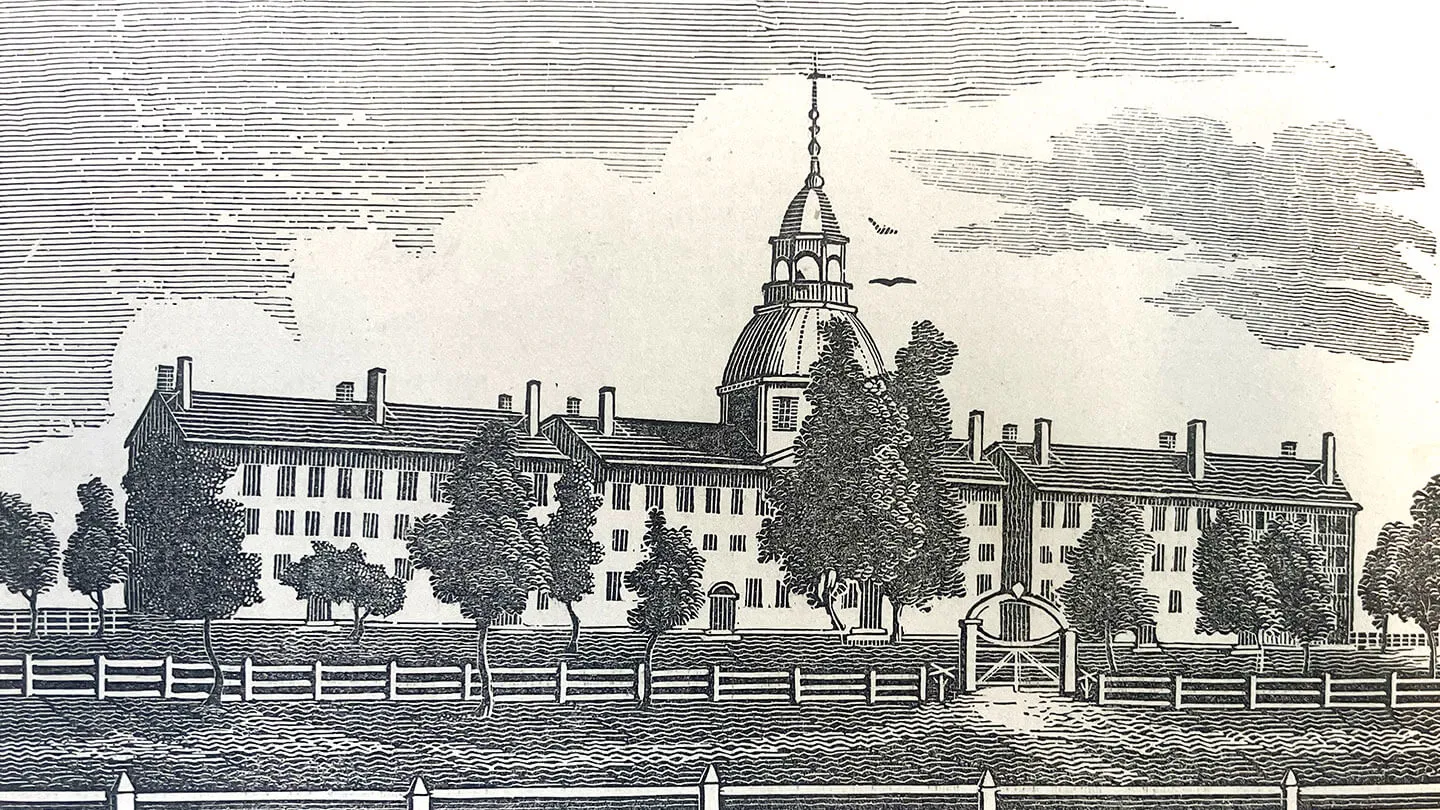
Marsh arrived in Burlington the next month, to find a university that had been though trying times. Two years before, fire had de-stroyed University Hall, the building that housed all the functions of the institution, including housing its students. The surrounding
community had rallied to help, raising money to rebuild what is now Old Mill, and the Marquis de Lafayette, on his tour through the United States the prior year, had stopped in Burlington to lay the new structure’s cornerstone. (See “The Cornerstone” in the spring 2025 UVM Magazine.) But Marsh was the third president of the university in five years, and the sense of disarray at the place was pal-pable. Joseph Torrey, who joined the faculty in 1827, described the scene: “The students were few in number; the funds not wholly free from embarrassment; the library and apparatus a mere name; and besides, an impression seemed to prevail with many, that an institution doomed to so many strange calamities, was never destined to succeed, and had better be given up by its friends.”
But instead of being daunted, Marsh wrote in his journal that he saw his way clear, that saving this institution was, as Torrey put it “an ob-ject worthy of his highest efforts.” Importantly, Torrey also says, Marsh saw “an opportunity, the most favorable that could be desired, for introducing such improvements in the system of discipline and instruction, as were called for by the wants of the age.” It was just those “wants of the age” that had been the talk of American educators and others for the preceding 25 years.
The trustees of Yale College had a pretty clear idea about the wants of the age and, in their opinion, no matter what the age wanted, what it needed was what they’d been serving up for 125 years: what present-day literary critic Louis Menand describes as “primarily a finishing school for Anglo-American men,” a sort of preparatory school for clergymen and upper-class gentlemen, rooted in an unvarying curriculum that emphasized Latin and classical Greek.
There were many citizens of the young republic who thought that new times demanded new approaches. Founding Father Benjamin Rush of Pennsylvania was one of those. “We occupy a new country. Our principal business should be to explore and apply its resources, all of which press us to enterprize (sic) and haste,” Rush wrote. “Under these circumstances, to spend four or five years in learning two dead languages, is to turn our backs upon a gold mine, in order to amuse ourselves catching butterflies.”
A national conversation on education had been sparked in 1795 by the members of the American Philosophical Society, which sponsored the first national competition for ideas about educational reform. That year the society announced an ambitious essay contest, with a $1,000 prize going to the best suggestion for a national educational system. Though nothing concrete came from the contest (two winners ultimately split the prize) it sparked a continuing discussion about new ways to approach education. In 1828, Yale’s faculty examined their system and produced their report, which staunchly defended the status quo classical education, with all students following the same path to a degree.
At the upstart university in the north woods, James Marsh and the UVM faculty staked a claim at the other end of the spectrum. Beginning almost as soon as he arrived in Burlington in late 1826, Marsh, with the approval of UVM’s trustees and the help of Torrey and other faculty, began a thorough examination of every aspect of university education—looking at not only what was taught, but also the concrete needs of learners.
Within a year, the group came up with a new curricular system that introduced some truly landmark reforms. Chief among these was the formation of a structure of four departments: English Literature; Mathematics and Physics; Languages; and Political, Moral, and Intel-lectual Philosophy. Thus, UVM became the first university in North America with a Department of English Literature. Students could now pursue a bachelor’s degree within a certain concentration—the beginning of the “major.” As a farm boy who’d practically stumbled into college, Marsh was aware of the needs across a democratic society, and the UVM plan made room for students who might only be able to pursue a part of the four-year curriculum, or need to leave to work within the course of study.
Influenced by the works of German philosopher Immanuel Kant and the English poet and philosopher Samuel Taylor Coleridge, Marsh sought a curriculum that, instead of looking at students as empty vessels into which one prescribed formula of knowledge would be poured, fostered the natural powers of reflection and reason they believed all students possessed.
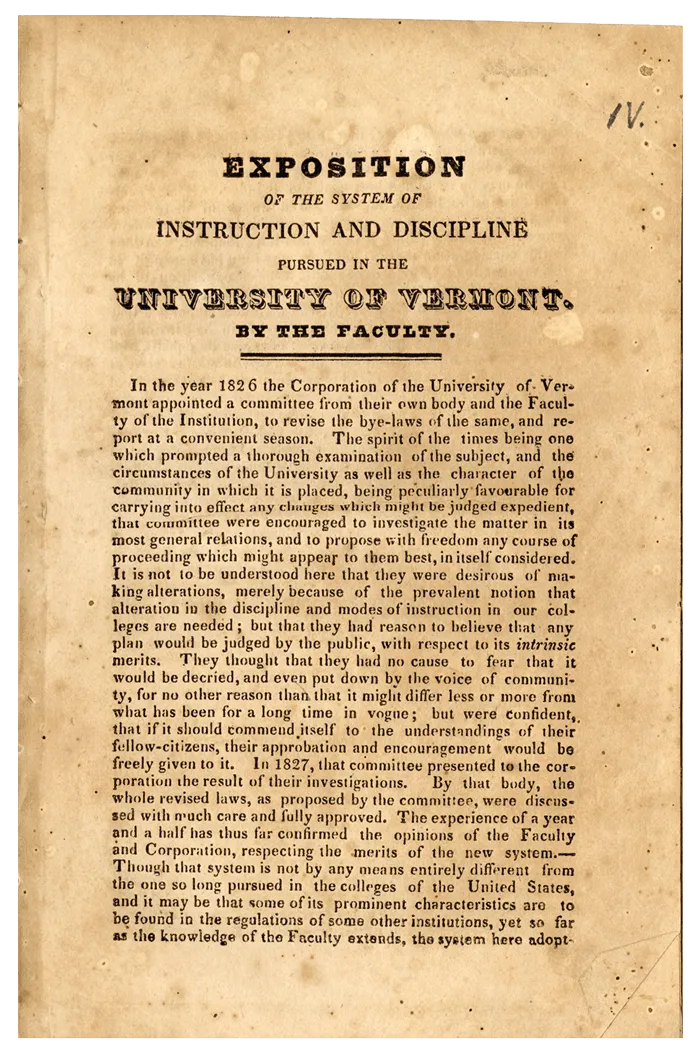
Marsh and the faculty laid out this new university structure in Exposition of the System of Instruction and Discipline Pursued in the Universi-ty of Vermont, a 32-page pamphlet published in 1829. It was a resounding reply to the Yale Report, and was widely circulated throughout the country. With the opening of the Erie Canal in 1825, thousands of settlers started pouring into the Midwest territories, and they took with them copies of this slender publication, which no doubt influenced the structure of many new colleges and universities founded across America in the years to come.
Though he’d made his mark as an educational reformer, Marsh was at heart a philosopher, and in this realm he had a longstanding effect as the founder of the most prominent 19th century school of American thought: Transcendentalism. Though more commonly associated today with Ralph Waldo Emerson and the world of Boston and Concord in the 1830s and 40s, Marsh was the person who actually intro-duced transcendental thought–with its emphasis on rising beyond the objective world to find a deeper meaning in subjective knowledge–in
a long preface he wrote to an edition of Coleridge’s “Aids to Reflection” that was published by his brother-in-law, Burlington printer Chauncey Goodrich, in 1829. The book was read by the young Emerson that very year. According to Louis Menand, Emerson wrote to his aunt to announce, “his new enthusiasm for Coleridge.” It was the birth of a movement that would encompass not only Emerson, but Henry David Thoreau, Margaret Fuller, the Alcotts, and Walt Whitman.
Marsh left the presidency of UVM in 1833, worn down by administrative details and, more significantly, by sickness and death. His wife Lucia succumbed to tuberculosis in 1828. The same disease claimed his second wife, Laura, in 1838, and brought about Marsh’s death the following year. He had spent only about a dozen years at UVM, but in that time had set in motion educational reforms and philosophical notions that would resound for the next two centuries. Henry A.P. Torrey, the nephew of Marsh’s compatriot, Joseph Torrey, would be schooled in Marsh’s thought at UVM and would, in the 1870s, mentor John Dewey, nurturing Dewey’s own theories of learning as an active, social process.
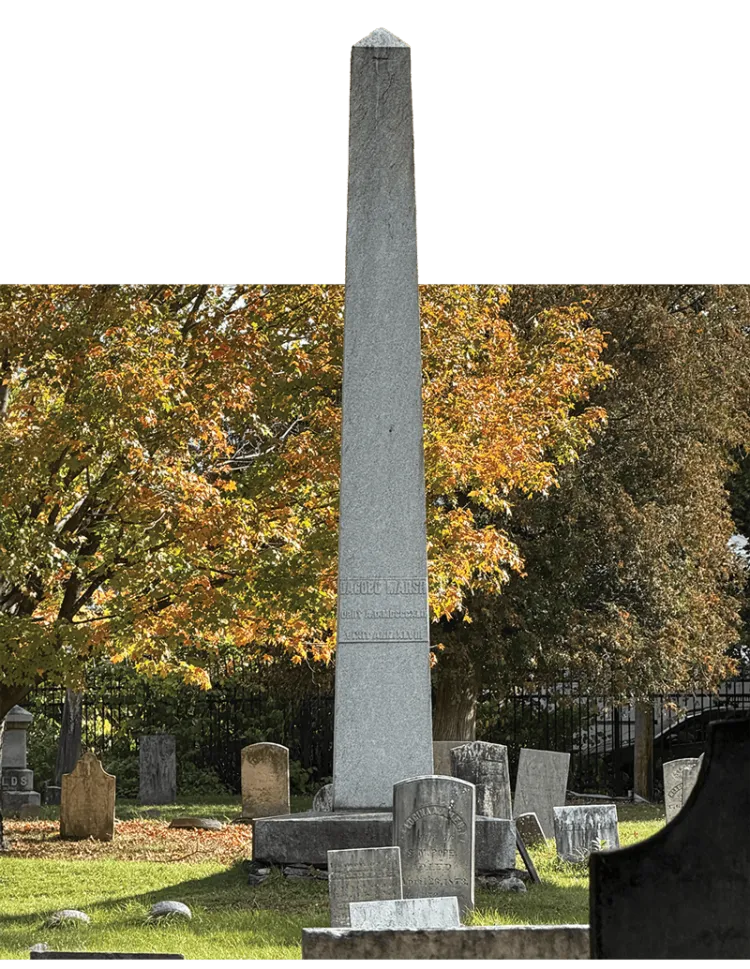
At Marsh’s death in 1839, his wives were gone, his children lodged with relatives. But his memory and reputation among his friends and colleagues remained. Burlington’s Elmwood Cemetery, a short distance behind the Unitarian Meeting House at the top of Church Street, was first used as a burial ground around 1800. Walking through its rows of gravestones today–some simple slabs, some elaborately carved stone simulacra of grief-tinged urns or ruffled shrouds–you see memorials sacred to the memory of Allens, of Buells, Kings, and Willards: all the old families who came here, made their fortunes in land or lumber or rail, left their names on local streets, and passed on. In the south end of the graveyard, a bit set apart, in the open area between a spreading river birch and a twisted hemlock, a pale granite obelisk stretches skyward. This is the last resting place of James Marsh.
Just his Latinized name, birth, and death years are carved on the obelisk–no list of Marsh’s considerable offices and accomplishments, as if the people who set this massive stone in place felt that Marsh’s work, embodied in the university overlooking the city, was so significant, so lasting, as to make more detail unnecessary. Of all the monuments across the cemetery’s gently undulating five acres, it is by far the tallest.