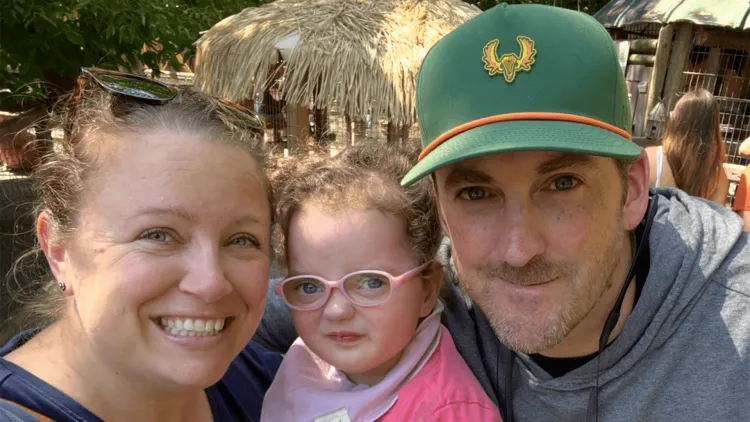
In summer 2024, Katie and Bo McDougall and their daughter, Nora, went to the beach.
It was a simple family getaway, but for the McDougalls, it was a watershed moment—Nora was born in 2020 with a rare genetic disorder that causes severe, frequent seizures.
The family credits a new approach—developed by Christian D. Pulcini, M.D., M.Ed., M.P.H., assistant professor of emergency medicine and pediatrics at the Larner College of Medicine and a pediatric emergency medicine physician at University of Vermont Health—that brings Nora’s medical providers together in innovative ways while helping her parents participate in her care.
Dr. Pulcini and the McDougalls hope their story can benefit any family with children who have complex medical needs—especially those in rural areas.
“For me, as a mom, it gave me a sense of control over something that I had no control over,” says Katie McDougall.
A rare disorder
The McDougall family lives in Rutland, a charming small city in the heart of Vermont’s Green Mountains. During Katie’s pregnancy, concerns led her providers to transfer care from Rutland Regional Medical Center to Golisano Children’s Hospital at UVM Health in Burlington, about a two-hour drive from their home. Nora spent her first three weeks in the neonatal intensive care unit there, weighing less than five pounds and facing issues including high blood pressure, a collapsed lung, and respiratory failure.
In early 2021, Nora had her first seizure and was diagnosed with Wolf-Hirschhorn syndrome, a rare genetic condition that affects fewer than 50,000 people in the U.S. Nora suffered 18 seizures by her fourth birthday, often requiring emergency care. Six times, seizure medications caused her to stop breathing.
On one of those occasions, the McDougalls were on their way to Nora’s scheduled outpatient appointments at the Children’s Specialty Center within Golisano Children’s Hospital. Nora experienced a seizure in the hospital lobby just as Pulcini was starting his shift in the emergency department (ED).
“The call for a ‘Code Blue’ was terrifying, but seeing all the staff rushing our way was beyond relief,” Katie says. After stabilizing Nora, Pulcini asked a question that would change the lives of the McDougall family.
“I said, does this happen often? And they said, yes,” Pulcini recalls.
Challenges with rural emergency care
Living in a rural area with a medically complex child poses unique challenges, including fragmented emergency care, inconsistent medical records, lack of access to medications and medical devices, and a shortage of caregivers trained in complex care. Nora’s care has involved providers from five different hospitals. Local hospitals often lack pediatric expertise and necessary resources, necessitating medical transport to facilities with pediatric specialists. Nora has been transported 12 times by ambulance, helicopter, or medical bus.
Ensuring that specialized medications are available on short notice can be difficult in rural area. Some of Nora’s intravenous medications are not regularly stocked at local hospital EDs, resulting in treatment delays. Her small size also makes vein access challenging, which has further delayed treatment and prolonged seizures.
To address her vein access issues, Nora underwent surgery for a port and a gastrostomy tube. However, some EDs lack the specific needles required to access her port, and staff members may not be trained to use pediatric ports, leading to further complications. Many EDs also typically only have adult-sized respiratory equipment, which is too large for a child of Nora’s size.
“Kids with medical complexity, we say they have a ‘health neighborhood,’ and this is a good example of that. We connected that health neighborhood for Nora” – Christian D. Pulcini, M.D., M.Ed., M.P.H.
It takes a neighborhood
Pulcini had been working on a template for an “emergency care action plan” for children with medical complexity. These plans are meant to help children with medical complexity (CMC), which is defined as multiple significant chronic health problems requiring complex care that many general, rural hospitals and pediatric practices may not be equipped to provide. CMC are a growing population that represent a subset of children and youth with special health care needs, yet account for high use of outpatient and inpatient health care resources, including up to 20 percent of pediatric ED visits.
After hearing Nora’s story, Pulcini knew she was the perfect candidate for an emergency care action plan. “Kids with medical complexity, we say they have a ‘health neighborhood,’ and this is a good example of that. We connected that health neighborhood for Nora,” Pulcini says.
Pulcini and the McDougalls created a plan addressing Nora’s seizures and respiratory issues, connecting providers from Vermont and Boston Children’s Hospital. That collaboration led to new strategies to make sure Nora gets fast, reliable care, even in a rural state. Here’s what they put in place:
- An emergency department care plan with medical protocols, the equipment needed, and contact information for Nora’s care team in Rutland and Boston.
- Ready-to-use access kits for seizure treatment, created with help from her infusion team. “We can walk into an ED and put this on her bed and say, ‘Here’s her plan, here’s the needle you need,’” Bo McDougall says. “Everywhere Nora goes, this goes.”
- A respiratory care box at Rutland Regional Medical Center’s ED, including equipment that’s the right size for Nora.
- Regular check-ins among Nora’s primary care physician, specialists, therapists, and others. Providers from five hospitals have participated in these meetings, to coordinate and adjust Nora’s care plan.
Empowering and ‘life-changing’
These steps don’t just support Nora’s health—they give her parents peace of mind.
“For us, it was huge,” Katie McDougall says. “Because otherwise, you’re sitting there watching your 2-year-old convulse on a table, and there’s nothing you can do besides hold their hand.”
Leah Pence, M.S.W., a pediatric complex care case manager at UVM Medical Center, has been a key connection, including handling logistics and pulling appointments together. Pence specializes in children with complex care needs who face additional challenges in rural areas. She has seen, firsthand, the benefits of Nora’s emergency care action plan.
“It’s a short document that highlights the most important things,” Pence says. “And I don’t think I would be mistaken to say it’s life changing.”
Lessons for others
Pulcini and the McDougalls shared Nora’s story in the national journal Pediatrics, because they believe this case can be a national model for proactive planning and teamwork in children with medical complexity.
“Our hope is that care providers, policymakers, and others who read this will be inspired to continue improving systems of care so that every family, regardless of their circumstances, can benefit from the incredible support and partnership that has made such a difference for Nora,” they wrote.
Pulcini’s research continues, supported by the National Institutes of Health (NIH) Eunice Kennedy Shriver National Institute of Child Health and Human Development (NICHD). He believes that emergency care action plans can help the growing number of families dealing with medical complexity—and their health care providers, too.
“It takes quite a bit of work,” Pulcini says. “But it’s worth it if it improves quality of care, increases child and family quality of life, reduces health care utilization, and reduces cost.”
Nora’s progress continues: She started school, where her care plan has been embraced. It’s further evidence of how these plans can make a big difference for children and families in Vermont, northern New York, and beyond.
For Pulcini, the ultimate reward was a photo of Nora on vacation, her family feeling safe because of the plan.
“They sent me a picture, saying they feel safe because they have an emergency care action plan—that’s what’s truly inspiring.”