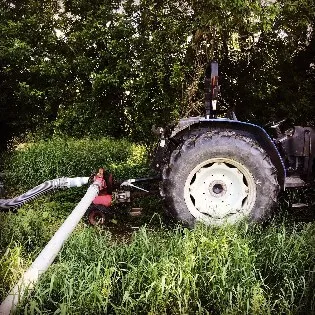
It is hard to miss discussions about how agriculture affects water quality in Vermont, but on-farm water usage is discussed much less - and even less is known about it.
That realization is at the heart of a newly launched partnership between the Center for Sustainable Agriculture’s Farming & Climate Change program,the USDA Northeast Climate Hub, and the UVM Extension Vegetable and Berry Program.
The team’s specific interest is in how farmers are using irrigation (which can mean any method of delivering water to plants) to keep their crops growing. With current weather patterns, farmers are less able to count on regular rainfall to keep their crops consistently watered.
“We know that climate change is increasing the importance of irrigation in Vermont, but there is currently very little information available on actual water usage practices. We wanted to understand how water is being used on diversified vegetable farms, and what room there may be for improvements in efficiency,” says Rachel Schattman, Research Fellow with the USDA Northeast Climate Hub, and affiliate with the University of Vermont Extension Vegetable and Berry Program.”
Farming & Climate Change Program Coordinator Joshua Faulkner says, “As we look ahead to more frequent seasonal droughts, we need to keep our eye on whether farmers in the Northeast will have reliable access to sufficient volume of irrigation water in the future. This project is the first step in helping us figure it out. He adds, “To start, I’m hoping we will gain insight into whether farmers in Vermont are over- or under-irrigating, and by how much."
With water seeming abundant in the region, why does it matter? Joshua explains, “Over-irrigating would mean that fertilizer is probably getting washed away or leached before crops can use it. Under-irrigating would mean farmers losing out on potential yield and quality.” If fertilizer gets washed away, it’s not only reducing the farm’s fertility, but also can be affecting water quality in its watershed, and reduced yields result in reductions in a farm’s earnings.
To start, the project will focus on using an evolving technology for two diversified vegetable farms to monitor their crops’ needs. Joshua says, “I’m excited to trial a couple of different types of soil moisture meters (tools that use a probe to test for indicators of water in the soil and transmit that information remotely), and get a better handle on how easy these are to use for farmers. Few if any Vermont vegetable farmers are currently using soil moisture sensors, and we think they could be a great tool to help growers really dial in how much water they apply.”
It’s about a lot more than measuring, though. Joshua points out, “The best tool in the world isn’t useful if you can’t understand - and then put to use - what it tells you. So for us, identifying which platforms are easiest for farmers to interpret is important. We think that the trialing of cutting edge technology will yield lessons that will benefit farmers around the state, but it’s also exciting to generate site-specific data that is immediately useful to our cooperating farms.
We will share observations and results as they become available. In the meantime, contact Joshua or Rachel to learn more.
This story first appeared in the July 2018 Fresh from the Field email newsletter.