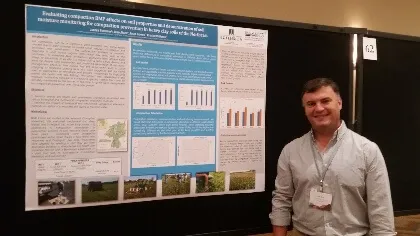
From July 29 - August 1, the Center's Farming & Climate Change Coordinator Joshua Faulkner and Pasture Program Technical Coordinator Juan Alvez attended the annual gathering of members of the Soil and Water Conservation Society (SWCS) in Albuquerque, New Mexico. It was a special opportunity to discuss some preliminary findings from a multi-year Conservation Innovation Grant project, and to learn from colleagues in the field. Dr. Faulkner sat down to answer a few questions about what they observed and what they learned.
What is the SWCS, and what was this conference about?
"SWCS is 'the premier international organization for professionals who practice and advance the science and art of natural resource conservation.' The conference attracts a mix of academics, Extension staff and faculty, and agency and non-profit folks from all over the country. Because this year it took place in an area currently experiencing extreme drought, there was a lot of talk about water conservation, and that set the frame for much the conference. Climate change and its effects were also a major focus."
What was it like representing the state and University of Vermont there?
"People from all over were interested in how agriculture is done in Vermont. When it came to the poster and presentation about our work trying to address compaction in Vermont soils, research colleagues were interested in details like seeding rate and particular seed mixes we trialed, and specifics on our research methodology.
"But what really stood out there is that agriculture across the country is very different. Dairy systems in other parts of the country are really different than dairy systems in Vermont. The challenges we face because of clay soils and compaction here are not the challenges that other people face, which shows the complexity and diversity that farmers face.
"Agriculture in Vermont is really important for Vermont. Agriculture in New Mexico is really important for New Mexico. Our Vermont-ness is really closely linked to agriculture here, and the same goes for the southwest.
"And it was really exciting when during a plenary talk, the director of the USDA Southwest Climate Hub mentioned our own case study on gully erosion as an example of work that the climate hubs are doing nationwide. It was notable that she highlighted the finding that - even with cost - addressing erosion provides a financial return to the farmer, and there’s also a return to the land and society, preventing erosion and the phosphorous loss that can impact regional water quality."
What information did you come back with that seems important for Vermont?
"We attended some really good presentations on phosphorus loss from agricultural fields in other northern dairy states, and the lessons learned there. In general we noted that incremental knowledge on phosphorus loss from farm fields is building, and I'm excited to think that we're going to be able to use that knowledge to make changes for real improvements to water quality around nutrient issues. And then after the conference there was a meeting of the Soil Health Institute, and it was great to see how soil health is approached in other states in the region and around the country, and how people are starting to look regionally at soil health. There’s a lot more energy and a lot more science that’s coming along that will improve our tools and our ability to move on that."
This story first appeared in the August 2018 Fresh from the Field newsletter.