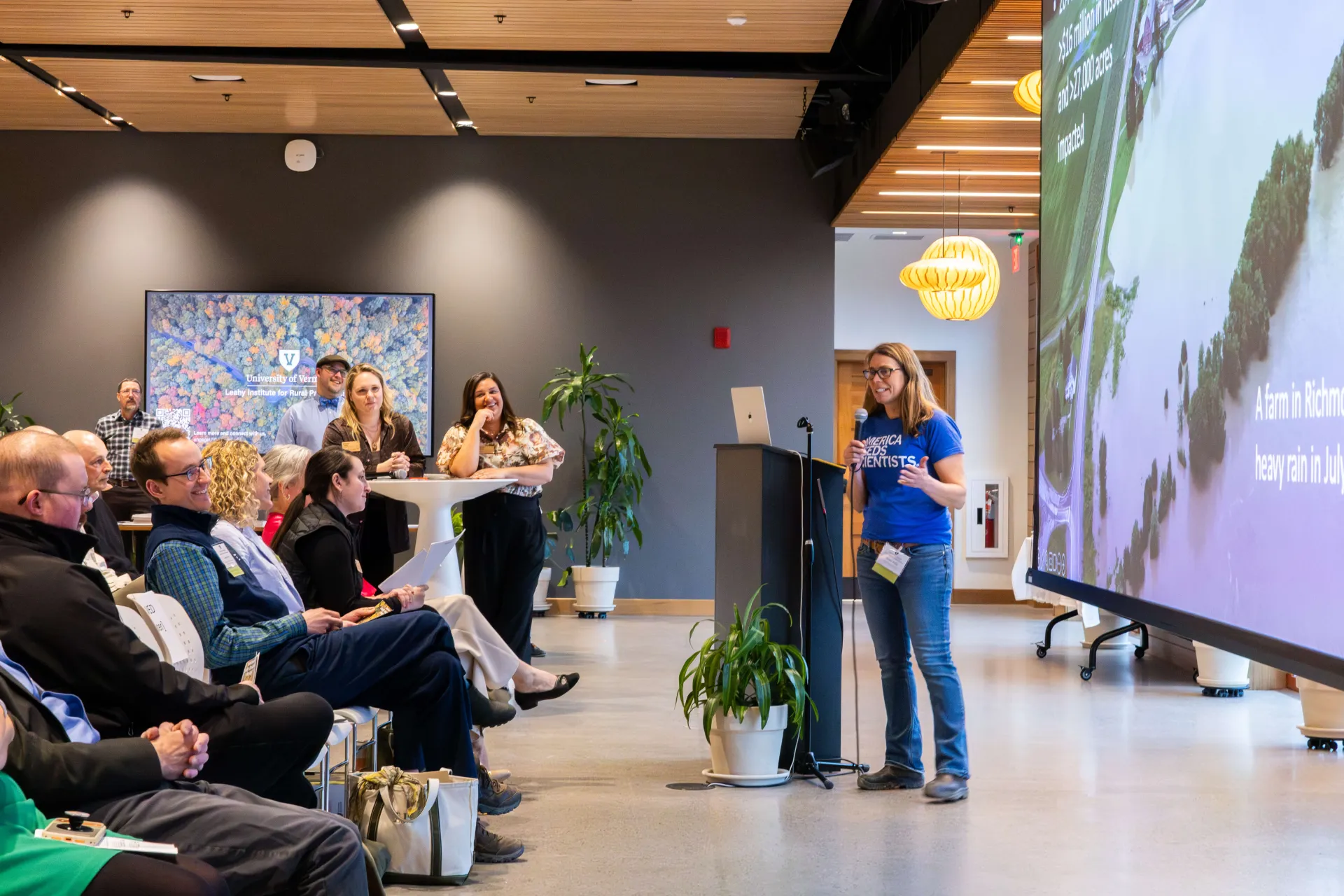
Microbots that remove microplastics from water, an initiative to reduce chronic absences in rural schools, and a platform for farmer-led research collaborations. These are just a few of the projects lauded at the second annual Leahy Institute for Rural Partnerships Pitch Night in March at Hula in South Burlington, Vermont.
The Leahy Institute operates alongside the UVM Office of Engagement to build collaborations between the university and state partners to benefit rural places. The institute dedicates resources to researching the causes and conditions of challenges facing rural areas and supporting partnerships to address them. The institute is made possible by a $14 million award from the U.S. Department of Agriculture’s National Institute for Food and Agriculture (NIFA), with leadership and support from retired U.S. Sen. Patrick Leahy, D-Vt. Since 2024 the institute has awarded more than $6.6 million in grants for 45 projects throughout Vermont.
At the pitch night, about 15 grant recipients described their work and appealed to attendees for support. The audience of about 115 included philanthropists, investors, agency personnel, legislators, and Leahy Partnership staff and partners.
UVM Extension Agronomist Dr. Heather Darby received a grant from the institute in 2025 for a project titled “Instilling Resiliency in Vermont Agriculture Through Farmer-led Research and Implementation of Regenerative Practices.” She leads the Northwest Crops and Soils Program (NWCS), including on-farm applied research, which is more important than ever as farmers face rapidly changing economic and environmental conditions.
To support and encourage farmers to participate in on-farm research, Darby and her team have used the Leahy Partnership funds to create the online platform AgConnect.
“We created AgConnect to bring researchers and farmers together to collaborate on answering farmers’ questions,” Darby said at the pitch night. “AgConnect … makes it easy for farmers to suggest on-farm experiments, join existing ones, collect data, and receive results. AgConnect also makes it easier for researchers to learn of farmers’ questions, recruit farmers, and manage on-farm experiments.”
Dr. Darby’s presentation began with a striking photo of a flooded farm field in Richmond. In July 2023, an average of 9.72 inches fell across the state. In a survey by the Vermont Agency of Agriculture, 264 farms reported $16 million in financial losses and more than 27,000 acres impacted. When fields flood this way, crops are destroyed or damaged, essential topsoil is lost, and remaining soil is contaminated.
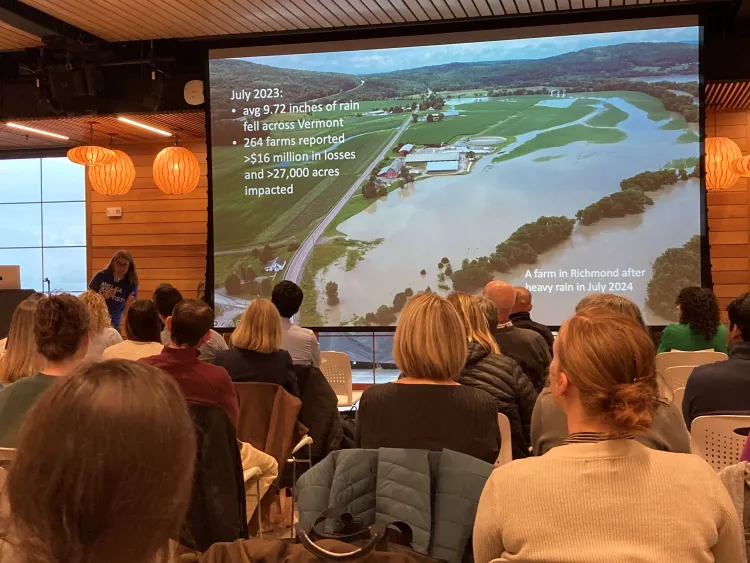
Last year, by contrast, Vermont had record drought. Climate change is just one of the crises farmers are facing. They’re navigating increasing costs of labor, gas, and fertilizer while combatting insects, diseases, and wildlife pests. They’re also choosing crops, farm animals, and management practices and navigating new technology. For some of these challenges, they need current, local data; for others, they could benefit from research already conducted.
AgConnect will serve the latter need by being a repository of more than 20 years of UVM Extension research. Its free, open-access searchable database will allow farmers to access on-farm data and reports that might otherwise be hard to find.
But the database won’t just benefit farmers. “AgConnect serves everyone,” Darby emphasized. “Farmers can use it to find information generated on farms similar to their own, researchers can use it to better identify gaps in knowledge, and policy makers can use it to inform programs and legislation.”
Collaboration between farmers and researchers isn’t new! “Farmers already use data all the time,” Darby remarked. “For example, they regularly have their soil and manure tested to better manage those resources. They want more data and have many more questions specific to their own farms.”
Farmer input has been central to AgConnect’s creation to ensure that it meets their needs. In two rounds of beta testing, two local farmers’ watershed groups provided feedback on the platform’s usability and helped clarify its purpose.
One farmer remarked that AgConnect could be a great way for farmers to share outcomes of on-farm research. “If we discover something unexpected and positive, AgConnect gives us a way to share it with each other and with the public. We can reach a wider audience, showing the real impact of on-farm research.”
Two partners in creating AgConnect are the University of Vermont Food Systems Research Institute and local strategy firm GameTheory Co.
In a conversation at the pitch night, Shannon Mitchell, co-owner of GameTheory, emphasized the platform’s focus on collaboration: “What excites me most about AgConnect is the kind of relationship it supports between farmers and researchers, a true partnership. Every part of the creative process was grounded in listening to farmers and researchers and adapting the tool to exactly meet their needs. It's been so rewarding to see what that's grown into. It gives farmers a way to ground their decision-making in evidence, and to work directly with researchers to find the answers to questions that need asking. Throughout the process, we heard again and again that there's a real need for this kind of work, something that can help translate farmers' day-to-day knowledge of the land into the valuable, place-based research it deserves to be.”
This summer, NWCS staff and local farmers will pilot test AgConnect with a research project on the effects of neonicotinoid seed treatments, as well as potential alternatives, in anticipation of the neonicotinoid ban scheduled for 2029.
Learn more about AgConnect on the website. Stay up to date and learn how to get involved by subscribing to the NWCS monthly email newsletter.