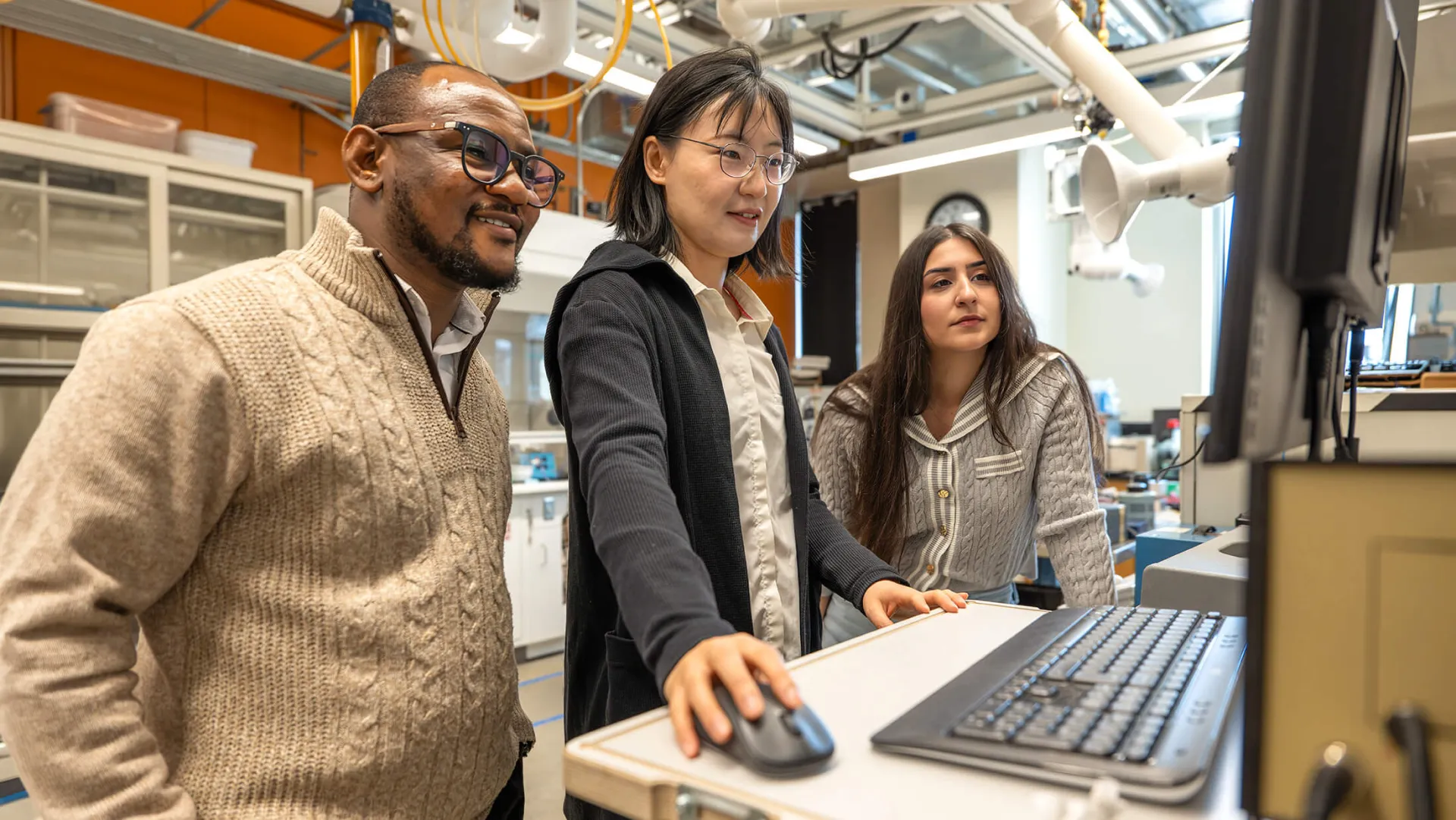
When an airplane flies through turbulence, a bridge sways under heavy traffic, or a building vibrates during an earthquake, invisible waves of energy travel through the materials that support them. Controlling those vibrations—before they cause damage or failure—is one of the most important and challenging problems in modern engineering.
University of Vermont Assistant Professor of Mechanical Engineering Jihong Ma is tackling that challenge in a novel way: by borrowing principles from quantum mechanics and applying them to problems traditionally studied using classical mechanics. Her innovative approach has earned her a highly competitive National Science Foundation (NSF) CAREER Award, one of the most prestigious honors for early-career faculty in science and engineering.
The CAREER Award supports cutting-edge research with real-world impact while emphasizing strong integration with education and outreach. It recognizes faculty who show exceptional promise as both researchers and educators, signaling national recognition of their potential to become leaders in their fields while advancing the NSF’s mission to broaden participation in science and engineering.
Rethinking Vibrations Through a Quantum Lens
Traditional vibration-control strategies rely on classical mechanics—methods that treat vibrations as predictable movements in physical space. While effective in many situations, these approaches can fall short under extreme conditions or when structures contain defects, wear, or unexpected disturbances.
Ma’s research takes a different approach. Her work is quantum-inspired, meaning it adapts principles originally developed to describe phenomena at the smallest scales of nature and applies them to large, classical systems. Instead of focusing only on vibrations as motions we can directly observe, Ma studies them as waves—similar to light or electrons. This perspective opens new possibilities for controlling how vibrations move, interact, and dissipate.
By studying wave behavior through a quantum lens, Ma aims to uncover new elastodynamic properties—how vibrations move through materials that deform and then return to their original shape—and develop more effective ways to control them.
“Quantum and classical mechanics are often seen as two separate worlds,” Ma said. “My research is about building a bridge between them.”
Classical mechanics describes the physical world as we typically experience it: objects have definite positions and speeds, and their motion follows predictable laws. In contrast, quantum mechanics applies at much smaller scales—such as atoms and subatomic particles—where certainty breaks down, and behavior is described in terms of probabilities. Bridging these two frameworks is challenging, but it also creates opportunities for new ways of understanding and controlling physical systems.
A Career Built Across Disciplines
Ma’s ability to bridge classical and quantum perspectives is rooted in her interdisciplinary academic background. She began her training in engineering mechanics as an undergraduate before shifting toward quantum physics during her PhD at the University of Minnesota, where her doctoral research focused on nanoscale heat transport using atomistic simulations—computer models that study materials at the atomic scale.
She continued this interdisciplinary work as a postdoctoral associate in civil, environmental, and geo-engineering at the University of Minnesota, Twin Cities, where she studied topological metamaterials, before joining Oak Ridge National Laboratory’s Center for Nanophase Materials Sciences as a soft matter researcher.
“That combination of classical mechanics and quantum physics shaped how I approach my research,” she said. “This project is really the convergence of everything I’ve worked on.”
After joining UVM in 2020, Ma established the Laboratory for Advanced Materials, where her team of graduate and undergraduate researchers works to enhance material performance using theoretical analysis, computational simulations, and experimental testing.
Metamaterials That Go Beyond Material Properties
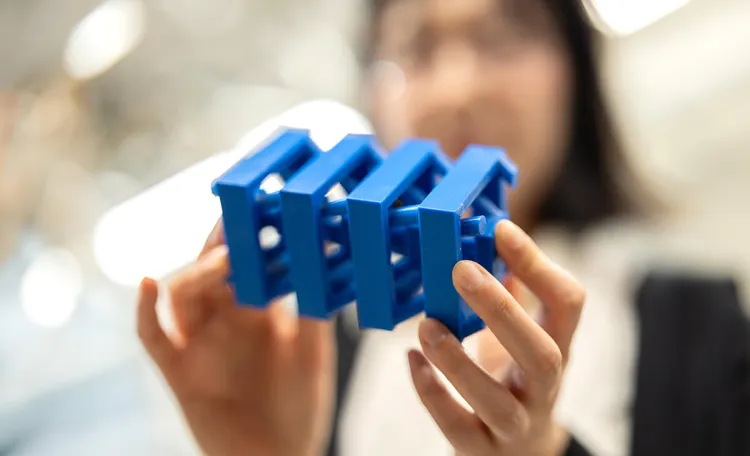
Two areas of specific focus in Ma’s lab include nanomaterials—tiny structures whose scales range from 1 to 100 nm—and metamaterials—engineered structures whose behavior depends more on their internal architecture than on the material they are made from.
“Meta means ‘beyond,’” Ma explained. “What matters most isn’t the material itself, but the structure we design.”
As current real-world approaches often struggle to detect and respond to dangerous vibrations in time, Ma’s research hopes to address this gap by developing systems that can both localize vibrations—keeping them confined to safe regions—and measure their strength in real time with high precision.
By using layered, composite metastructures with carefully engineered connections, Ma and her team aim to create systems that can both localize vibrations—keeping them confined to safe regions—and sense their amplitude with high precision in real time. This dual capability addresses a major gap in current vibration-control technologies, which often focus on where vibrations travel but not how strong they are.
Safer Infrastructure, Aerospace, and Beyond
The potential applications of Ma’s research are wide-ranging. Uncontrolled vibrations are a leading cause of mechanical failure in bridges, buildings, aircraft, vehicles, and industrial equipment—posing safety risks and costing billions annually in repairs and downtime.
By developing new principles for vibration suppression and wave control, Ma’s work could lead to safer aircraft engines, more resilient infrastructure, and better protection for sensitive components, from large-scale structures to microelectronics.
One of the most powerful aspects of her approach is its scalability. “These mechanisms aren’t restricted to a specific size,” Ma said. “They can be scaled up to protect bridges or scaled down for microchips.”
Because these vibration-control strategies depend more on structure than material, they could also be adapted in unconventional ways—from arranging trees to help mitigate seismic waves to enabling new applications in biomedical engineering.
From Theory to the Lab—and the Classroom
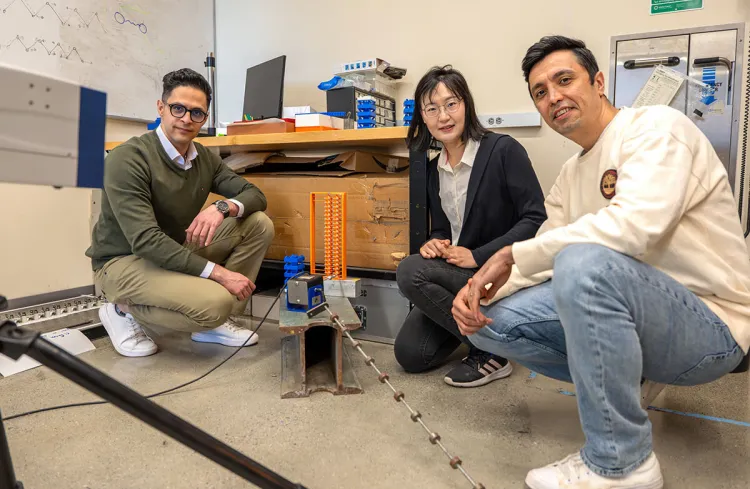
Although grounded in advanced theory, Ma’s research is far from purely abstract and employs rigorous experimental validation. Using 3D-printed metastructures designed in her lab, along with precise laser-based measurement techniques, her team can directly observe—with a high degree of accuracy—how vibrations move through these systems and evaluate how effectively they respond.
Advanced computational tools, including deep-learning algorithms, are also playing an increasing role in optimizing these designs—helping predict vibration behavior and refine structures more efficiently.
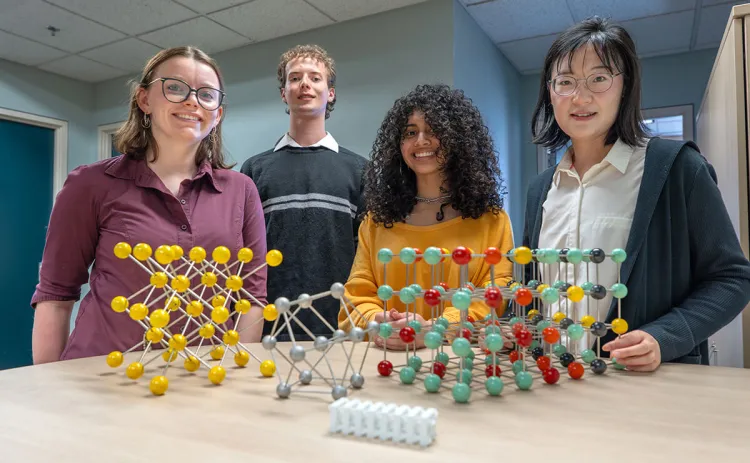
The NSF CAREER Award program also places a strong emphasis on education and outreach; an area Ma sees as integral to her work. While Ma’s Laboratory for Advanced Materials currently engages both undergraduate and graduate students, the award will allow the project to expand college-level mentoring opportunities, support the development of a new graduate-level course on quantum-inspired vibration control, and expand engagement with K–12 students to introduce them to interdisciplinary engineering concepts.
To make the research more accessible, Ma also plans to create interactive tools that allow students and the public to visualize how vibrations move through structures, reinforcing the connection between research and education.
Engineering the Future of Dynamic Control
By reimagining vibration control through a quantum-inspired framework, Jihong Ma’s work could transform how engineers design for safety, resilience, and performance. Just as importantly, it is helping train a new generation of engineers who are comfortable crossing traditional disciplinary boundaries.
“Some of the most exciting breakthroughs happen when fields come together,” Ma said. “That’s what this research is about—combining ideas in new ways to solve real-world problems.”