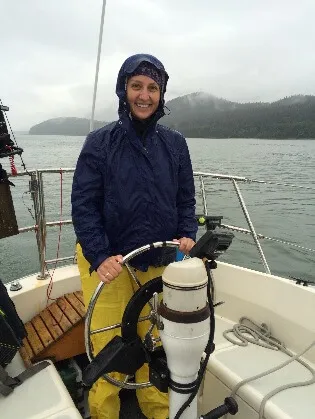
Hometown: Medway, Massachusetts
Educational Background: BA in Anthropology with a Minor in Food Systems from UVM
What Food Systems program track are you on? The Accelerated Master's (AMP)
How did you learn about the Food Systems program and what made you interested in applying? While I was working on my undergraduate thesis in anthropology, my advisor, Dr. Teresa Mares mentioned that the Graduate College was in the process of approving a new one-year Masters in Food Systems. Because I graduated with my BA in three years, I was excited to have another year at UVM to continue studying the complexity of food systems. I was also looking forward to staying in Vermont to expand my network of the incredible researchers and professionals in this region that continue to serve as my mentors and peers.
Tell us more about your educational background and your interests. I have always loved learning about and observing people, so my first anthropology class at UVM fit like a glove. I specifically gained an interest in cultural anthropology, and decided to study the value and exchange systems of three different farmers markets in Burlington, VT for my undergraduate thesis. Throughout my studies, I always enjoyed jumping from extreme detail to big-picture, large systems ideas, and I feel the transdisciplinary program in Food Systems not only allows but also encourages this kind of thinking. My current project for the Masters program involves working with the Vermont Folklife Center to create an exhibit plan for a qualitative research project focusing on grassroots food and agriculture in Vermont. When I’m not in class, you can usually find me hiking, playing the violin, or cooking up a storm in my apartment.
How has your educational background and experience prepared you for studying food systems? In the last several years I’ve had some incredible opportunities to get to know different food producers and people working in the food system across Vermont. Through these relationships I’ve also learned about the challenges of creating a viable food system in Vermont. Many of these challenges were connected to changes that our entire country or world was experiencing, including immigration patterns, shifting diets and lifestyles, and climate change. While it is sometimes intimidating to approach a topic knowing that it cannot be isolated from any one part of the food system, it is also this complexity that I love to engage with! I think the high level of self-discipline and creativity that was required to complete my undergraduate thesis has served me well in developing my Masters project. Something I continue to have fun with is working on letting go of my need to compartmentalize, from our seminars to the array of problems in the food system we discuss. It all comes back to being a system!
What are your future career goals? I have recently been invited to serve as a volunteer in the Peace Corps as a Sustainable Agriculture Specialist in Senegal – I am thrilled to be leaving for service in September 2016! While I have some ideas of what I would like to do after service (Culinary education? Running my own bread bakery or creamery?), I will not be returning to the US until the end of 2018. I’ve heard career goals can change a lot after Peace Corps service, so I’m looking forward to keeping an open mind and not planning my next steps too far in advance!
Have you learned anything in particular, since entering the program that has surprised you? Have you heard of Soylent? It’s this human-constructed “food” (though it contains some plant ingredients) that supposedly contains all of the nutrients required to maintain a healthy lifestyle. We had a great discussion on Soylent in one of our seminars – I’ll leave further research to others to form your own opinion on this product. For now, I think I’ll stick with solid foods…
Please leave us with a fun fact about yourself. During a solo trip through the Northwest, Alaska, and Hawaii last summer, I stumbled into work as an amateur surf photographer for a few days in Paukaa, HI.