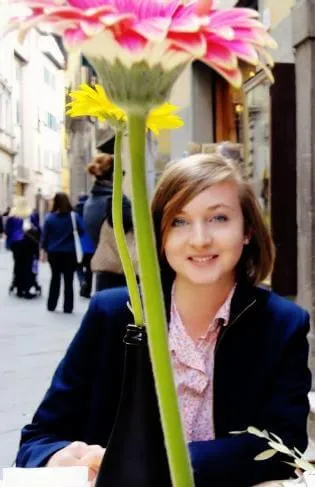
Hometown: Dublin, New Hampshire
Education: B.S., Nutrition and Food Sciences, Anthropology Minor | University of Vermont (UVM), 2013
How did you learn about the Food Systems program and what made you interested in applying? As I entered my senior year at UVM I found myself gravitating towards research and upper-level seminar courses that took a very broad and holistic approach to the study of food and dietary choices. This all culminated in my senior thesis, through which I explored what individuals’ everyday home cooking practices reveal about the process, and practice, of following established dietary guidelines. I learned two important lessons from this study: 1) dietary choices and decision-making are best understood within the context of the broader food system, whose factors and forces greatly shape the choices and options made available to consumers, and 2) I absolutely love doing food systems research. Thus, when I learned about the opportunity to stay at UVM and further my research at the graduate level, the decision to apply came pretty easily.
Tell us more about your educational background and your interests. I majored in nutrition and food sciences with a premedical focus as an undergraduate, having been interested in the connections between food and health since high school. As I proceeded through my course work and was introduced to the more holistic perspective and methods used by anthropologists my interests began to extend beyond nutritional science, to also consider the ways in which aspects of American culture more broadly shape individuals’ eating behaviors and meal preparation habits—an area of interest that very much continues to fuel and inspire my academic work.
How has your educational background and experience prepared you for studying food systems? I think I started studying food systems before I even realized it was an actual field of study. My undergraduate education, balanced between the natural and social sciences, provided me with an excellent foundation for this program. Food systems issues are often complexly situated at the borders of science and society, climate and culture, and being able to think through issues from both scientific and social angles has facilitated and enriched my studies tremendously.
What are your future career goals? I’d like to get a Ph.D. in food systems, community nutrition, or cultural anthropology, with the aspiration to continue to learn, research, and teach about these topics in both university and community settings for years to come.
Have you learned anything in particular, since entering the program that has surprised you? Yes, absolutely, everyday it seems. I think I have been most surprised, though, by the diversity of backgrounds and perspectives that are represented by the students and faculty in this program, and how much depth and nuance they have lent to my own evolving understanding of critical food systems issues ranging from the efficacy of obesity prevention efforts to the cases for and against GMO labeling. There is no black and white, and I’m learning to appreciate the many shades of gray.
Please leave us with a fun fact about yourself. I like puns, a lot.