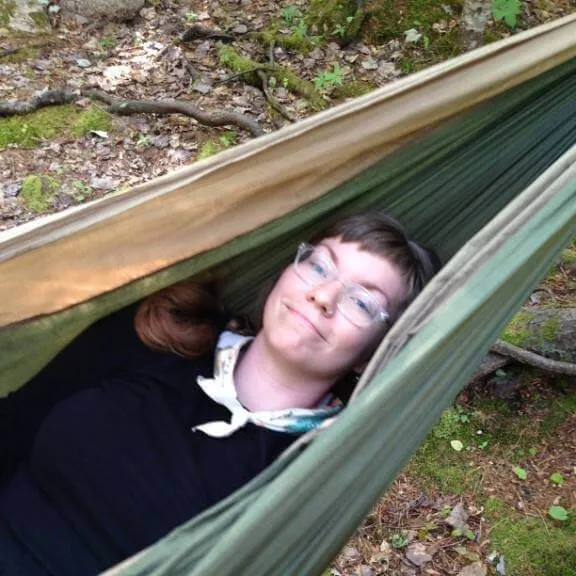
Hometown: Carbondale, Illinois
Educational Background: Dual BA in Critical Studies of Race and Ethnicity, and Women’s Studies, St. Catherine University, St. Paul, MN
What Food Systems program track are you on? Research Master's
How did you learn about the Food Systems program and what made you interested in applying? I completed an undergraduate thesis on government subsidized food access programs, and wanted to further pursue issues of food access and food justice. I was initially interested in agroecology and environmental justice programs and looked for a graduate program with this focus, hoping to be able to carve out space for a project concerning food and critical identity issues. I was happy to find UVM’s Food Systems graduate program because it allowed me to focus more specifically on systemic issues as part of a broader understanding of food, identity and sustainability.
Tell us more about your educational background and your interests. I’ve done a fair amount of work in food systems, both from inside and outside of academia. I consider it all educational, because I believe some of the best ways to learn about food systems is through those who are living the realities of farming, marketing, laboring, service, distribution, and consumption. I’m always interested in the ways power works throughout a system and where it manifests. At UVM, I study identity and how it influences, and is influenced by, cultural practice, space, and power. I do this by talking with gatherers of wild edibles in Vermont, listening to their stories, eating great food, and going on foraging hikes. I’m glad this is my “work” for now!
How has your educational background and experience prepared you for studying food systems? I enjoy abstract thinking and connecting big, theoretical constructs to empirical practice. I think food gets at that empirical practice and my critical theory-focused background informs the paradigm through which I approach these topics. Also, this is a great field for people who find it difficult to identify simply one problem (or one solution) to the many issues that face our globalized food system. Systems thinking requires that you consider everything, how it all works together, and where the most impactful points of leverage may be.
What are your future career goals? I feel prepared to work in a number of career fields, or to pursue a PhD. I had the pleasure of co-teaching the first Vermont Food Systems Summer Study Tour and would love to continue working with experiential learning programs around food systems education. I’ve also become more interested in the ways food security is viewed, measured, and pursued globally, so maybe there’s something in the INGO field calling me.
Have you learned anything in particular, since entering the program that has surprised you? I’m way more interested in policy than I thought!
Please leave us with a fun fact about yourself. I’m named after a ship currently moored in Galveston, TX.