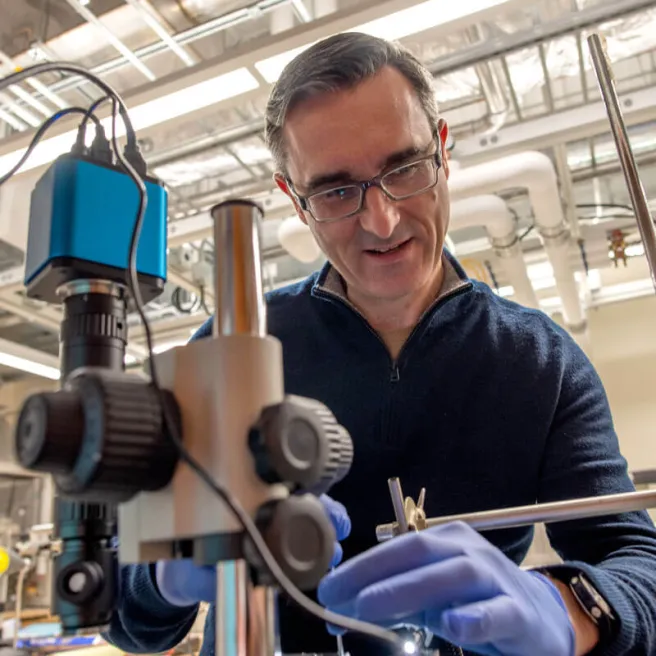
Dr. Frederic
Sansoz
Dr. Frederic Sansoz, assistant professor of mechanical
engineering and materials science in UVM's College of Engineering and
Mathematical Sciences (CEMS), has received a five-year National Science
Foundation (NSF) Faculty Early Career Development (CAREER) Award for
$400,000 for his research entitled, "Microstructure and Size Effects on
Metal Plasticity at Limited Length Scale." This is one of the most
prestigious awards given by the NSF.
"To receive this award and be
placed amongst some of the top American researchers in my field is a great
honor," says Sansoz. "This is an opportunity to conduct fundamental
research in the area of metallic nanomaterials, which can dramatically
improve the existing state of knowledge in the experimental and
computational mechanics community. I sincerely thank Vermont EPSCoR and my
colleagues from the mechanical engineering program, the materials science
program, and the College of Engineering and Mathematical Sciences for their
continuous encouragement."
The award will stimulate use of UVM's
newly established Vermont Advanced Computing Center, a multi-user facility,
and will involve participation of scientists at a new US Department of
Energy's (DOE) national research facility. It will give graduate students
the opportunity to broadly disseminate results of research at national
conferences and meetings to enhance scientific understanding in the field.
In addition, the education program of this CAREER award will broadly
revitalize interest in materials science and engineering at UVM, help
recruit engineering students from underrepresented groups, and improve
multicultural training.
"We are extremely proud that Dr. Sansoz
has received this prestigious NSF CAREER Award," says CEMS Dean Domenico
Grasso.
Nanoscale Research
The nanoscale is unique because it is the size scale where the familiar
day-to-day properties of materials like hardness and strength meet the more
exotic properties of the atomic and molecular world. For example,
nanoscale wires of gold, which is naturally a very soft metal, are
ultra-strong materials with strengths up to 100 times that of bulk metals.
The proposed research is to gain fundamental understanding of the
size-effects associated with microstructural features and sample dimension
on the strength of such metallic "nanowires." To accomplish this, a
combined experimental/modeling research approach will be used that
harnesses the power of both atomistic simulation and atomic force
microscopy. This combination of methodologies is expected to be successful
in bridging the gap between experiment and modeling in the mechanical
characterization of nanomaterials.
Sansoz's research is expected
to show new ways to fabricate nanorods and nanowires with specific defects
that make them stronger, thereby providing a roadmap for others to make
improved materials. Vermont EPSCoR provided start-up funds and several
mini-grants for equipment acquisition for key laboratory instruments, such
as high-resolution microscopes specifically designed for nanomechanical
analysis. The simulation component of this project will be conducted via
massively-parallel molecular dynamics simulations performed using UVM's
newly-established Vermont Advanced Computing Center.