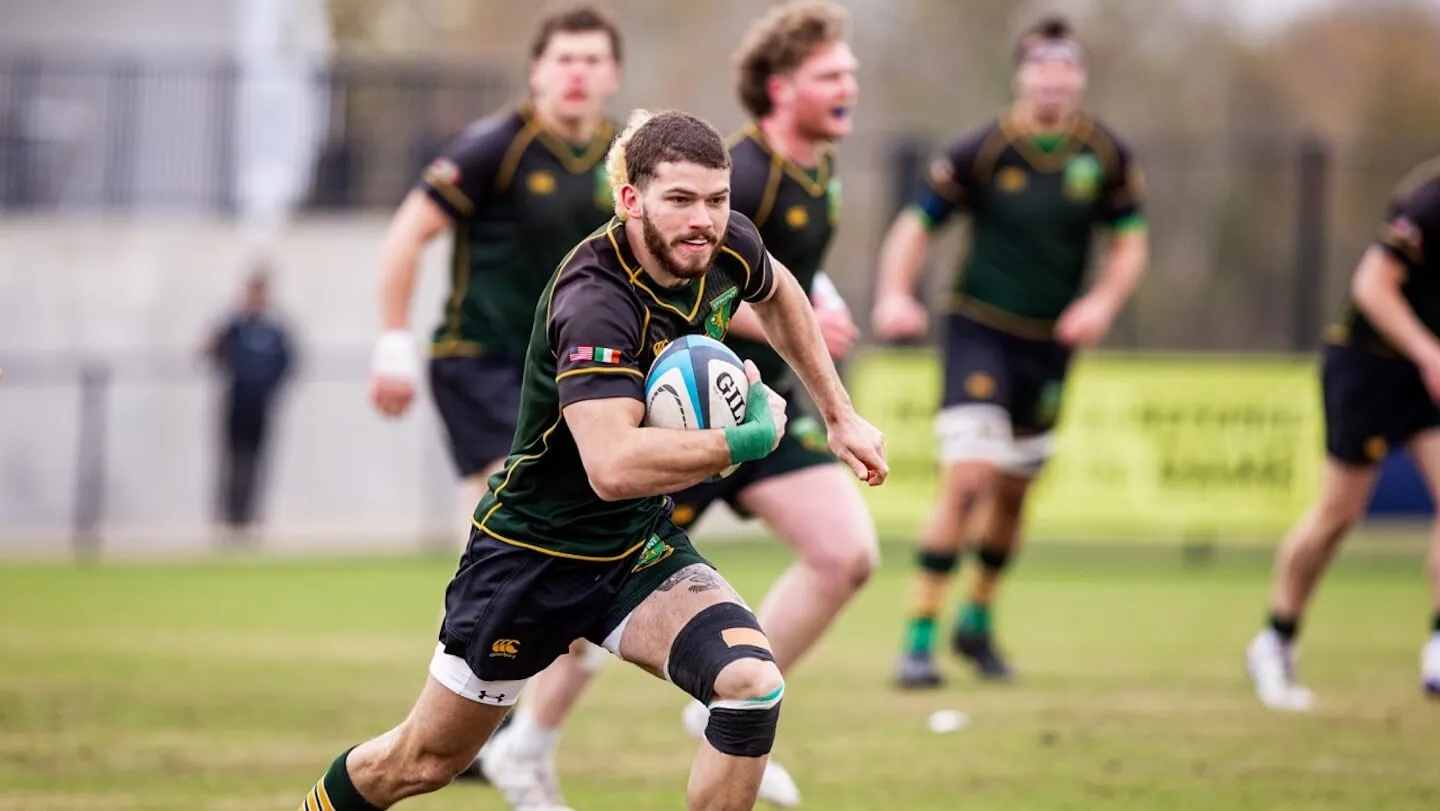
At the opening whistle of the 2025 National Collegiate Rugby championship game on Sunday, December 14, the wind blows strongly in favor of the University of Chicago Maroons. They kick long, press their field position, and force the UVM men onto defense. It’s a classic territorial strategy, and soon Chicago scores in the corner, grounding the ball over the goal line for the first points of the game.
Those turned out to be Chicago’s only points.
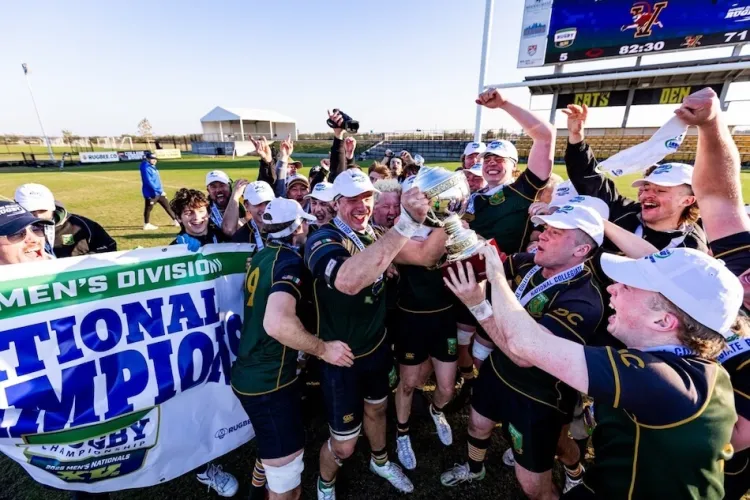
From there, Vermont took control of the pitch at SaberCats Stadium in Houston, Tx., and never gave it back, as the Catamounts dismantled the Maroons 71–5 to win the Division II men’s rugby national championship. It was UVM’s first national title in rugby and the emphatic conclusion to an unbeaten season in which Vermont proved itself the most complete team in the country.
“I’ve never played a game where we were that excited and happy to play,” says senior player Jack Worobel. “In the tunnel, before the game, we were smiling, laughing, having a great time. Chicago looked all super-serious and they seemed a little nervous.”
Rugby can look chaotic to the uninitiated, but its structure is precise. Fifteen players per side compete for continuous possession, advancing the ball by running or kicking—never passing forward. Points come primarily through “tries,” five points scored by bringing the ball into the opponent’s in-goal area and then grounding it. Vermont scored thirteen of them, which is similar to scoring thirteen touchdowns in football: not easy.
The Catamounts game plan was to use their aggressive forwards to run through Chicago's defense, which they had identified as a weakness from watching film. They did—and recycled the ball quickly after each tackle. Locks and flankers—key forward positions responsible for strength and endurance—won physical battles, allowing the backs to attack space.
After a try, the scoring team earns a chance at a “conversion,” a kicked bonus worth two points. Flyhalf Matthew Tevnan converted three kicks, calmly directing traffic from behind the forward pack. By halftime, Vermont led 31–5, including two tries from wing Luca Race.
They just knew
In the second half, Vermont pulled away completely. “About two minutes into the half,” Worobel recalls, “we kicked it down to them and the ball rolled into their try zone. They touched it down, which means they're going to drop-kick it from their own goal line.” Usually this is a strong defensive move that shifts the action downfield. However, Chicago kicked it directly to Luca Race. “He just sliced right through the defense, ran it straight back to the try zone, and touched it down,” says Worobel. “It was a sweet, awesome play.” And, Worobel thinks, the moment when Chicago tasted defeat. “They just knew.”
Race added one more try in the second half to complete a four-try performance. Vermont also capitalized on effective use of what are called grubber kicks, or just “grubbers.” These are low, rolling kicks along the ground, used to send the ball behind the defensive line, making it hard for defenders to handle and allowing attackers to chase and regain possession. “A rather wonky grubber from Tevnan in the first half bounced really weirdly,” reported rugby journalist Alex Goff, “but Luca Race still grabbed it because he trusted what his flyhalf was doing.”
Race’s ability to read the game—anticipating kicks, trusting patterns, and accelerating into open space—earned him the match’s Most Valuable Player honor.
Old bull mentality
The championship was the culmination of years of development. Many seniors began playing together as freshmen, learning the sport from scratch. An “old bull mentality” is central to head coach Joey Besl’s philosophy. “Slow is smooth and smooth is fast,” explains senior Worobel, a mechanical engineering major. “As long as we do things slowly and methodically—that's how we start and we're able to come back and slow the pace of play—then these quick plays, like kicks, will come much easier.”
A former UVM player himself, Besl emphasizes conditioning and cohesion. Practices often involve the entire roster, rather than splitting players into isolated units. The goal is fluency—every player understanding where to be, and when. That fluency showed repeatedly in Houston. Vermont reset quickly after tackles, forming organized “pods” of support runners.
Vermont’s playoff run underscored the team’s long commitment to a balance of joy and discipline. After defeating Villanova in the round of 16, the Catamounts faced Cornell in the quarterfinals and trailed at halftime before mounting a composed comeback. A 22–11 semifinal win over UNC-Wilmington was their toughest game of the tournament and set the championship match-up with Chicago. Across four playoff games, Vermont outscored opponents by a staggering margin, never losing control of its style or strategy.
Club≠Casual
That achievement is particularly notable given rugby’s status on campus. While recognized by the NCAA as an Emerging Sport, men’s rugby operates outside the varsity athletics model. Club teams compete nationally under National Collegiate Rugby, relying on institutional support, alumni engagement, and player commitment rather than scholarships. “Club” does not mean casual. More than 100 Division II teams compete nationwide, and Vermont emerged at the top. In a message to the team, UVM Director of Student Life Lina Balcom praised the players’ dedication: “Every tackle, every sprint, every early morning practice led to this moment, and you earned it.”
Founded in 1970, UVM Rugby tests itself each year against the best Division II programs in the country. This year, on a windy Sunday in Texas, the Catamounts did more than test themselves—they set the standard. “We have practice every day at 6:30 AM in the snow outside,” says Worobel. “And, like, the only thing that keeps us doing that is how much we love each other, and love the game, and just want to win.”