My Year with the Watershed Ambassador Program: Delaney Faucher
By Delaney Faucher, AP Environmental Science Student at Plattsburgh High School
Background: Supported by a Lake Champlain Basin Program Small Education and Outreach Grant, the “Classrooms to Watersheds” project connected Plattsburgh City School District students and teachers with hands-on watershed science and stewardship. Through stream monitoring, microplastic field investigations, watershed pollution models, and other activities, Lake Champlain Sea Grant’s Watershed Alliance education team worked with Plattsburgh High School Environmental Science students, who then brought these lessons to fourth- and sixth-grade classrooms as “Watershed Ambassadors.” The project also gave teachers new tools and approaches for incorporating local watershed science into their classrooms. The following is the perspective of one student who participated in the Watershed Ambassador program–Tori DesRocher, Lake Champlain Sea Grant.
This school year, I was fortunate enough to be a part of the Watershed Ambassador Program. When Tori DesRocher came into our AP Environmental class and explained some of what we’d be doing this year with the program, I was beyond excited. And now that we are nearing the end of the year, I can confidently say that the reality of each activity far exceeded my expectations.
To be honest, I didn’t know much about Lake Champlain other than it’s fun to swim and boat on. And oftentimes, people tend not to care about issues if they are not directly affected by them. This program helped me realize that I actually am being directly affected, and it didn’t just make me worried but motivated me to do more to help create a cleaner and healthier watershed for our community to enjoy.
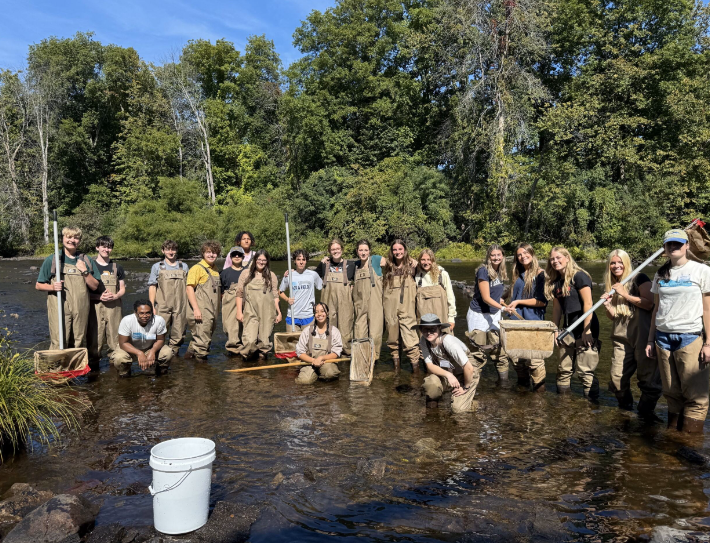
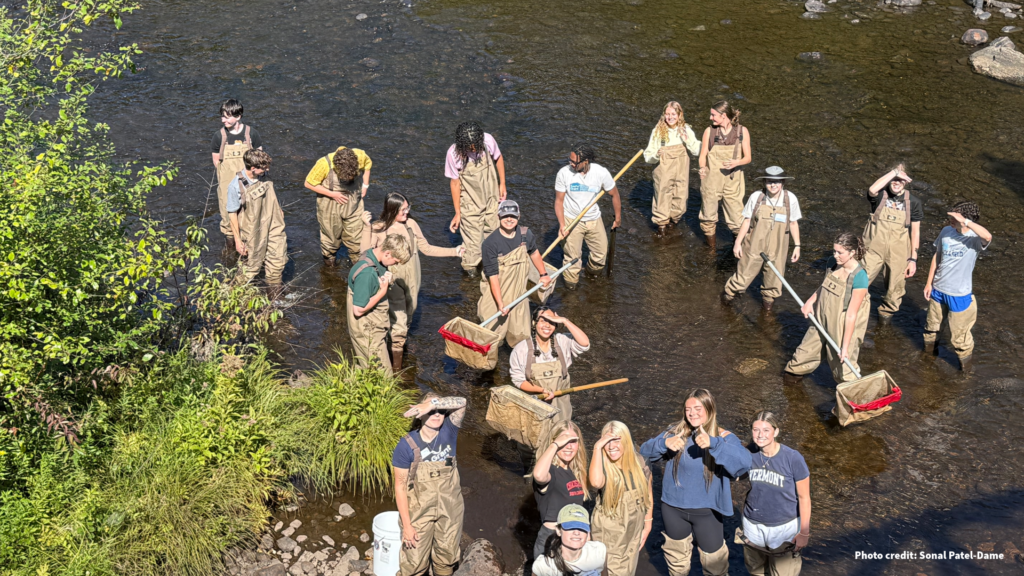
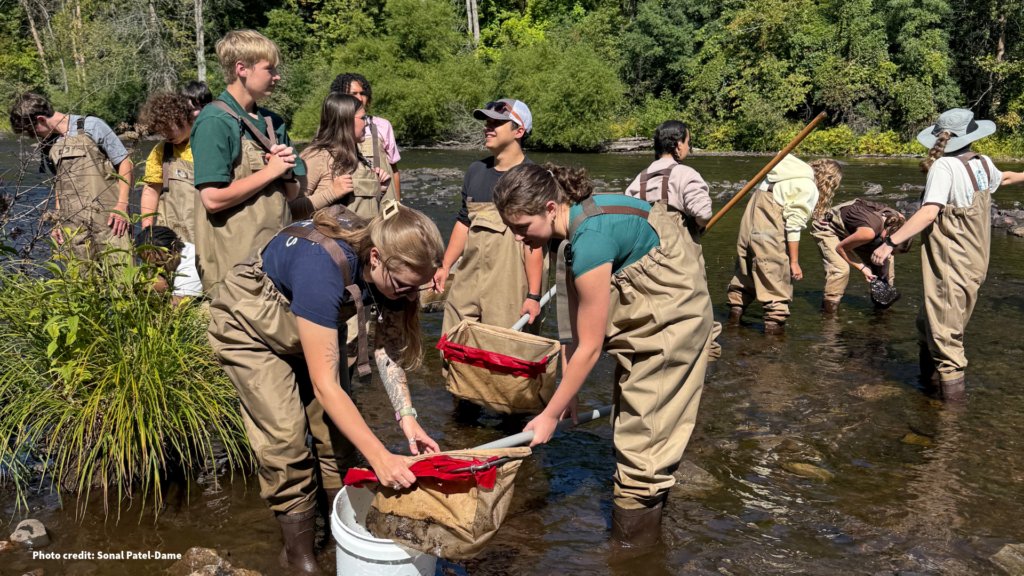
The first thing we did with the program was collect and identify benthic macroinvertebrates in the Saranac River. We started this by doing some research about these organisms in class. I learned that you could get a good sense of pollution levels in a body of water, depending on what type of benthic macroinvertebrates are present. Tori and some interns visited us at the high school, and we collectively walked down to the Saranac River. We got into small groups, and each had an intern as a leader. Everyone got waders, and we headed into the river. We learned that “benthic” means occurring at the bottom of a body of water, and that is where these organisms are. So, to collect them, we brought nets into the water and placed them beneath the water. One person held the net steady downstream, and another went upstream and kicked up rocks and dirt, so that the organisms were released from under the rocks and went into the net. After collecting a decent amount of benthic macroinvertebrates, we separated them by scooping them with a spoon and putting them in an ice cube tray. We found out that the Saranac River was not heavily polluted because one of the types of benthic macroinvertebrates that was in the river can only survive in fairly cold and clean water.
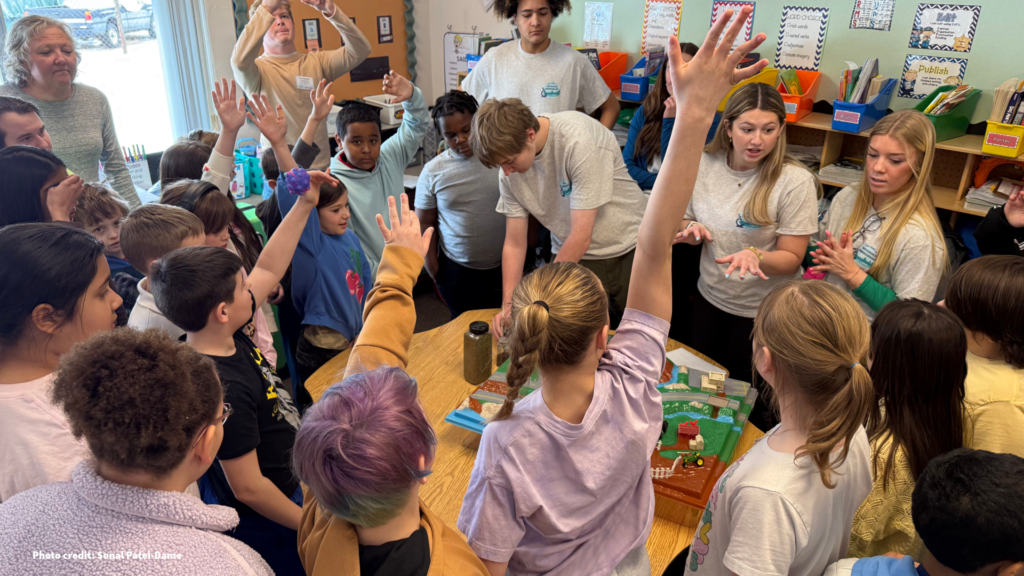
The next activity we did with the program was learning about and being taught with the EnviroScape Model. This is a 3D model that simulates a town. This town has a body of water that resembles a lake, a river, a factory, a neighborhood, and a farm. Tori and the interns first showed us how to use this model, so we could later use it to teach the fourth graders. We learned about different types of pollution that come from different parts of the town. Something I had never thought about before was point and non-point source pollution. I had always thought of pollution as the trash people litter, and then it ends up in the water. One thing that the interns explained that I thought was interesting was how runoff of pesticides and fertilizers can be a major pollutant for our watershed. I learned how fertilizers are filled with nutrients, so when they enter the water, the algae use these nutrients, and it causes algae blooms. This makes the water darker, which absorbs more sunlight, which makes the water warmer, which lowers dissolved oxygen levels. Many fish species and other aquatic organisms need a high dissolved oxygen level to be able to survive in the water. That process really fascinated me and opened my eyes to other “insignificant” things within our town that could be affecting the lake. The interns used different spices and sprinkles to exemplify different pollutants from the model. Then, after the model was covered in different “pollutants”, the town had a rain event. They sprayed water all over the model. The lake on the model quickly became dark and murky. It was a very simple but thorough way to show how most pollutants end up in the lake through runoff.
After we learned how to use the EnviroScape model, we went to Oak Elementary to teach fourth graders about our watershed, using the model. This was a highly enjoyable experience, and I think students retained and understood the majority of the information (even though their favorite part might have been drenching house figures in “pesticides” (rainbow sprinkles)). It’s important to educate on the different kinds of pollution, but it’s only important to propose solutions; and that’s what we did. We explained to the fourth graders some things they could do on an everyday basis to help with the problem of pollution. Some of these things included trying to use reusable food containers and utensils, recycling items that can be recycled, and picking up after your pets. We also explained some solutions such as raising the blade on lawn mowers, wetting road salt so it doesn’t bounce off the road, and using alternatives to pesticides.
Another interactive and informative activity we did with the program was fish dissection. We got to cut the fish open and look for plastic fibers. It is one thing to hear about how plastic gets into the lake, and then fish consume it, but actually seeing it in person can be enlightening. Seeing these fibers fully inside the fish made me not only upset but motivated to do everything I can to contribute to a solution.
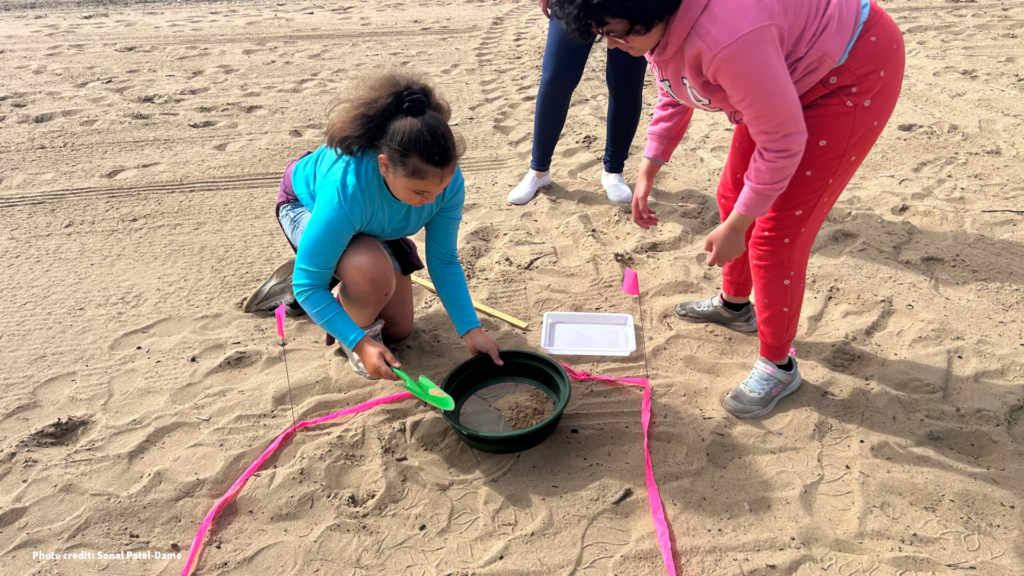
Recently, three other peers and I went to the Plattsburgh City Beach, where we met up with two interns and a fourth-grade class. Once there, we talked to the fourth graders about microplastics: the different kinds and how any piece of plastic 5mm or less (the size of a pencil eraser) qualifies as a microplastic. The fourth graders split up into groups, and each got a plot of sand, where they then went sifting for plastic. The amount that they found was even more than I expected. The interns had different kinds of microplastics in little glass jars, and my classmates and I each took turns explaining where each type comes from. For example, I explained how clothes made from polyester release thousands of fibers each time a load of clothes is washed. I then explained how doing larger loads of laundry less frequently can reduce the number of fibers released. We also passed around a rubber ball that is designed to go into the washer and collect these fibers.
Not only has this experience taught me so much about our watershed and pollutant contributors, but it has inspired me to do more to try and prevent all these pollutants from entering the water. Lake Champlain is used for various activities, both recreational and environmental. It provides us with so much, and this program has made me realize that I can take action to help ensure that the lake continues to be so beneficial to the community