Turning Tides, Turning Seasons: Spring
By Isabella Soddu, LCSG Science Communications Intern
This piece is the third installment of a year-long project that will detail the seasonal changes that occur in and around Lake Champlain. Throughout the four-piece series, Turning Tides, Turning Seasons, is not only examining the “how” and “why” behind these natural changes, but also asking an urgent question: “How are Lake Champlain’s yearly cycles impacted by our rapidly changing weather and landscape?”
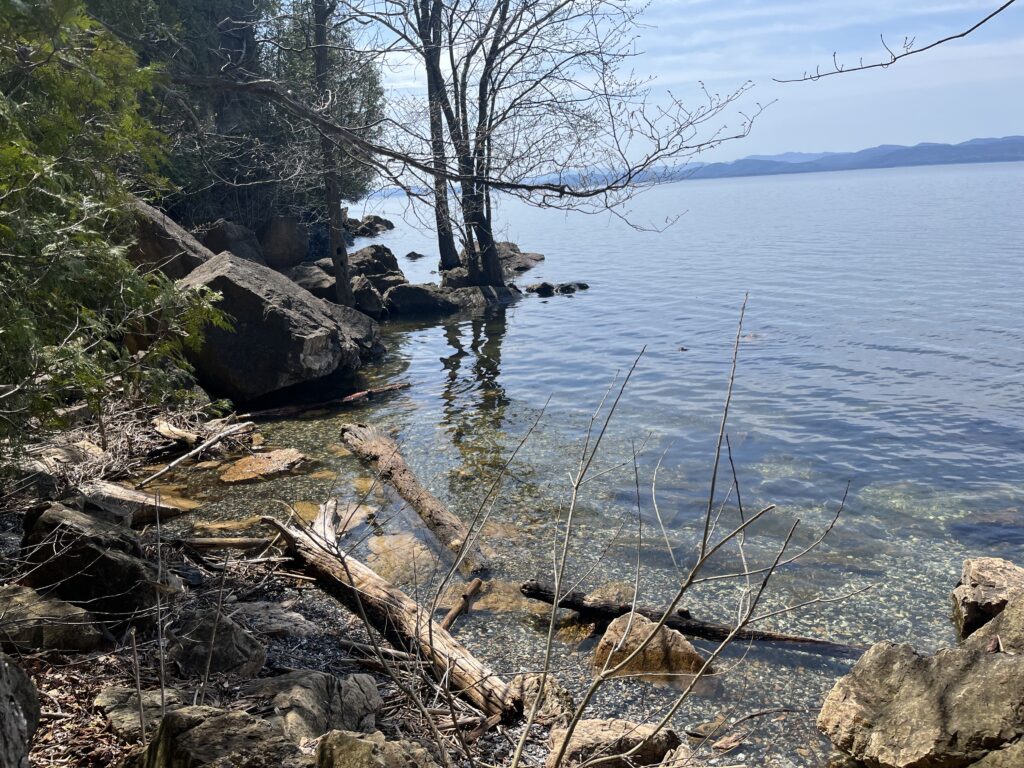
In Vermont, spring is a season of opposition. Periods of bird song and sunshine are interrupted by unexpected flurries and slops of mud. But, no matter how volatile its return, spring always manages to blur into focus across the basin. Snow and ice disappear, wildlife return, and buds begin to swell with the promise of greenery. This year, spring feels especially hard-won to Vermonters after a winter of frigid temperatures and increased snowfall. In January, warm Arctic weather destabilized the polar jet stream, a barrier between northerly and lower latitude winds. With the North East plunged into an unusual arctic chill, Lake Champlain froze over for the first time since 2019. As we continue to fluctuate between extremes each year, spring will arrive in the basin with an even stronger promise of uncertainty.
This year, increased snowfall will result in substantial snowmelt. As warm weather returns, snow stored at high elevations will melt and drain into the Lake Champlain Basin. During this process, slippery snow acts as a guide for melting water, while chunks of ice divert or halt water flow. Annual spring melt usually results in the highest annual water levels on Lake Champlain. With increased fluctuations between warm and cold weather, interactions between ice, snow, and water can become more volatile. This may increase the chance of flooding events through fluvial erosion, the process by which fast-moving water carries materials from stream beds and banks.
On the other hand, for years that do not see high levels of snowmelt, lighter ice loads and water input volumes during early spring could reduce the scouring effects that are necessary for creating and repairing wetlands and “ice meadow” habitat. Ice meadows are created when pieces of ice are pushed into the shoreline of a riverbed, forming an ice pack that remains in place until spring. When this ice melts, it successfully scours the meadow and removes woody species that can suffocate the landscape, allowing herbaceous plants to take root.
As spring temperatures average warmer, the last frost and snowmelt have advanced on average by 14 days. Not only is this changing the physical landscape, but biological clocks across the landscape are also altering. Budburst for sugar maples has advanced by six days, and birds are returning to breed earlier each year. Years in which budburst precedes hard frosts are becoming more common, which can cause severe damage to plants by reducing their cold tolerance and minimizing their biological productivity throughout the year. Migratory birds face a similar gamble. Many species time their northward journeys using day length as a seasonal cue. Arriving early can secure prime nesting territory, but a cold snap can kill insects, limit food supply, or destroy a first clutch of eggs. As weather patterns grow less predictable, these timing mismatches become more consequential for the basin flora and fauna.
For the lake itself, this trend in warming may prove to be even more consequential. Research based on satellite data shows that lake temperatures in high-latitude regions are warming faster than air temperature. New research corroborates this finding by showing that lakes are warming at 1.3 degrees Fahrenheit (0.72 degrees Celsius) per decade at high latitudes.
Unfortunately, this warming will reduce the positive impacts of Spring turnover. Similar to the fall, warm spring weather triggers a thermal mixing event in Lake Champlain. As surface water heats to 39 degrees Fahrenheit (water’s densest temperature), it sinks, bringing oxygen-rich water to the depths of the lake. With the return of warm weather, the top layer of the lake is heated further, creating a boundary between surface water and the cold water below for the remainder of spring and summer. Research led by Richard Woolway at the European Space Agency finds that warming drives earlier and longer periods of this thermal stratification, which can physically restrict the mixing between oxygenated surface water and nutrient-rich cold water over time.
During warm weather, fish attempt to shelter in cool water at lower depths. As this water becomes increasingly deoxygenated, prolonged stratification means a decrease in available fish habitat. Research also suggests that long periods of stratification may stimulate the release of nutrients from lake sediments. In oxygen-rich water, phosphorus remains locked into sediments by binding chemically to iron. In depleted oxygen environments, this bond is broken, releasing sediments into deep water. When the lake remixes in the fall, these released nutrients rise to the surface, fueling algal growth and degrading water quality.
These chemical and thermal shifts ripple through the lake’s food web. Smallmouth and largemouth bass overwinter in deep water, then move to the shallows to spawn as temperatures approach 50°F. Warmer spring temperatures often result in increased productivity due to earlier spawning, but increased flooding and water flow can ruin nests and reduce fry survival, threatening long-term populations. Non-native fish, such as alewives, are also impacted by fluctuating temperatures. In some years, large die-offs of alewives become visible as ice recedes in spring, disrupting recreational and aesthetic enjoyment of Lake Champlain.
Spring in Vermont has always been volatile. What is changing is the scale and speed of that volatility. As plants, fish, and migratory birds struggle to keep pace with these rapid environmental shifts, ecological change across the landscape feels increasingly inevitable. Still, spring remains a season defined by resilience. The same forces that unsettle the basin also renew it, reshaping shorelines, reoxygenating depths, and clearing space for fresh growth. In this way, spring offers no promise of stability, only movement, and reminds us that change is impossible without growth.