Secondary tabs
Submission information
| Study Title | Intentional Transitioning of Acadian Forest Within a Resilient Forest Matrix in Response to Climate Change |
|---|---|
| Case Study Type | Forest type, Forest health, Management type |
| Management Subcategory | forest adaptation, demonstration site |
| Site Photo |
|
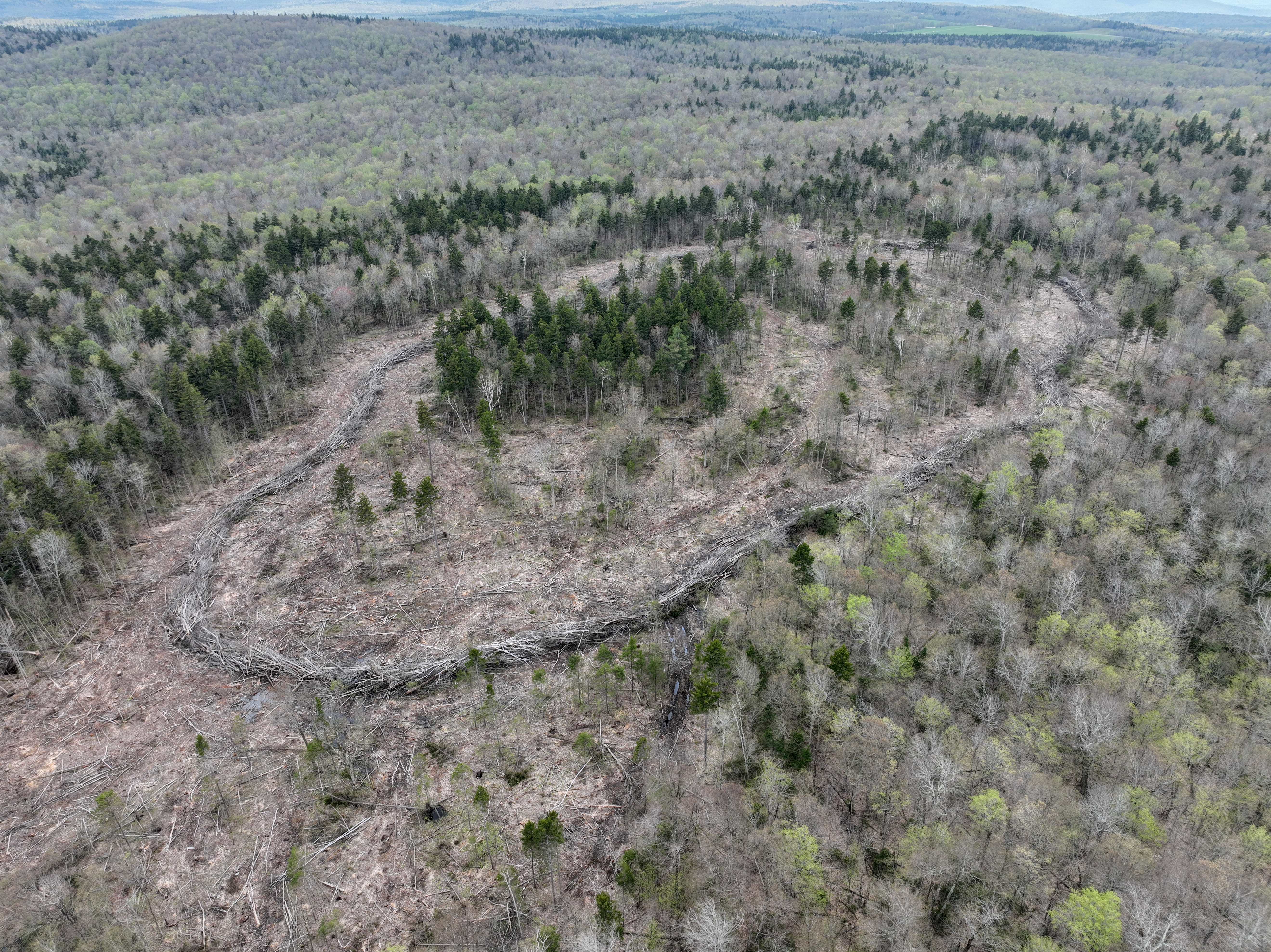
| Image caption | A 12-acre irregular shelterwood harvest enclosed within a slash wall |
| Lay Summary | A 3,200-acre western MA property, Notchview provides key forest ecosystem functions including carbon sequestration, healthy soils and water, and wildlife habitat. Facing increasing temperatures and shifting rainfall patterns due to climate change, the continued functionality of this landscape is at risk. Informed by a 2018 planning effort using the Climate Adaptation Workbook and a forest stewardship plan, The Trustees implemented silvicultural interventions to improve resilience and support transformation of the Acadian Forest. Innovative practices included the planting and deliberate regeneration of central hardwoods to act as seed reservoirs for the future forest and the use of slash walls to protect regeneration from browse, demonstrating to our peers and private landowners the potential of carefully considered forest management. |
| Location | Windsor, Massachusetts |
| Location Description | This is a spruce-hardwood-dominated forest which includes red spruce, red maple, sugar maple, and beech. The project area sits on a gentle knoll with rich mesic features on the lower slope. |
| Latitude | 42.530720 |
| Longitude | 73.032751 |
| Directions | Site is off a closed road. There are no trails leading to the site. |
| Accessibility | By foot, inside the slash wall is inaccessible (gated) |
| Landowner Name | The Trustees of Reservations |
| Landowner phone | +1 413-217-0509 |
| Landowner email | jrichburg@thetrustees.org |
| Stand Area with Units | 42.6 acres |
| Cover Type | Mixedwoods |
| Plant Community/Habitat Class Growth Stage | Developing Mature |
| Primary Forest Health Threat | deer |
| Secondary Forest Health Threats | , |
| Primary Pests/Disease | other foliage / shoot disease (known) |
| Secondary Pests/Disease | emerald ash borer |
| Soils | Well-drained / somewhat excessively drained and shallow Tunbridge-Lyman soils and, to a lesser extent, moderately well drained to well drained and deeper Peru-Marlow, with poorly-drained Pillsbury limited to a small, low area along the western boundary. |
| Stand Origin Year Note | Second growth following farm abandonment |
| Site Index with Units | SM 60 |
| Start date | Fri, 12/20/2024 - 00:00 |
| End date | Sun, 12/20/2026 - 00:00 |
| Pre-Treatment Species Composition | The spruce-hardwood-dominated forest includes red spruce, red maple, sugar maple, and beech. The location for this project occupies the area of a gentle knoll – with rich mesic features on the lower slope (concentrations of ash and spring ephemerals), a sugar bush on one side, and irregular structure of weather-beaten trees and tip-ups to the west. Wind and ice are the predominant disturbance features of this forest. Forest regeneration is impacted by deer/moose browsing, forest health, and shade-tolerance. Some individual trees are quite large, including a 21” ironwood (a hollow cavity tree) and a 45” ash, and shadbush (i.e., serviceberry) reaching 9” in diameter. |
| Species 1 | Picea rubens (red spruce) |
| Species 1 Percent(%) | 33% |
| Species 2 | Fagus grandifolia (American beech) |
| Species 2 Percent(%) | 17% |
| Species 3 | Betula alleghaniensis (yellow birch) |
| Species 3 Percent(%) | 10% |
| Pre-Treatment Forest Health Issues | Competition in the regeneration layer, much of it from non-desirable vegetation, is intense. Partial overstory shade and browse pressure on preferred plants further restrict the ability of many desirable trees (and shrubs) to thrive. Red spruce is present as both a patient understory (<5’) and midstory tree (5’-30’) and is well-suited as a shade tolerant species to persist and take advantage of canopy disturbance that does not mechanically injure it; balsam fir is present at a much lower level and is under elevated browse pressure (as is hemlock). Mixed non-beech hardwood regeneration, mainly sugar maple and yellow birch, with less cherry, ash and red maple is present at a low level. |
| Case Overview | At the southern end of the Acadian Forest, Notchview is likely to experience declines in species most vulnerable to changing climate conditions. These include red spruce, balsam fir, yellow birch, and sugar maple. Although existing individual trees are likely to persist on the landscape for the foreseeable future, evidence of their decline initially will be observed as loss of regeneration. Seedlings are sensitive to environmental stress often requiring favorable conditions that mature trees can overcome. For instance, the shallow root systems of seedlings make them more susceptible than established or mature trees to moisture stress. Species such as black cherry, northern red oak, and for a period American beech may have increased habitats as conditions change. Our project seeks to proactively address the changing forest composition by deliberately introducing and regenerating species characteristic of Central Hardwoods that are projected to be adapted to the new climate conditions in the region, helping ensure resiliency of the landscape. |
| Silviculture Objectives | Promote regeneration of red spruce and central hardwood species using silvicultural techniques (i.e, seed tree, irregular shelterwood); Protect regeneration from deer and moose browse by creating a slash wall around the harvest area; Use enrichment planting to supplement natural regeneration of central hardwood species (i.e., northern red oak) |
| Landowner Objectives | Same as silvicultural objectives. |
| Silviculture Prescription | All hardwoods less than or equal to 6” diameter that are not marked for cutting should be cut or pulled provided they are within reach of marked trees, but small spruce or fir should not be cut or pulled. The silvicultural system is a combination of irregular shelterwood relying on seeding, sprouting and release of spruce and a thinning to promote spruce. To address the chronic overbrowsing of young hardwoods and balsam fir by deer and or moose, a deer- and moose-excluding slash wall was constructed, based on design parameters publicized by Cornell University Extension. |
| Regeneration Method | Irregular shelterwood; seed tree |
| Factors Influencing Prescription Choice |
|
| Climate Adaptation Considerations | The predicted decline of the spruce-fir forest and the expected habitat suitability of red oak (but current challenge of regenerating oak) at the site was a guiding factor. |
| Equipment used | Grapple skidder |
| Additional Resources / External Links | https://forestadaptation.org/trustees-notchview |
| Post-Treatment Assessment Done | no |
| Post-Treatment Assessment Expected | yes |
| Keyword(s) | Slash wall, deer browse, spruce, fir, oak, irregular shelterwood |
| Basal Area Pre-Harvest | 131 |
| Trees Per Acre | 233 |
| Mean Stand Diameter | 10.1 inches |
| Primary Contact | Julie Richburg |
| Contact Title | Director of Inland Ecology |
| Contact Organization | The Trustees of Reservations |
| Contact Email | jrichburg@thetrustees.org |
| Contact Phone | +1 413-217-0509 |
| Contact Address | 100 Main St. Suite 1 Florence, Massachusetts. 01062 |
| Biography | Dr. Julie Richburg is the Director of Inland Ecology with The Trustees. Her focus is on grassland and forest management, implementing habitat management for inland habitats including erosion control projects, invasive plant control, and forest and river projects to increase resiliency of the Trustees properties. Dr. Richburg has a Master’s degree and PhD in forest ecology from the University of Massachusetts Amherst where she studied the impacts of invasive plants on native habitats and both mechanical and prescribed fire as control methods. She is a member (and past chair) of the Massachusetts Invasive Plant Advisory Group, an active member of the Northeast Regional Invasive Species and Climate Change Management network, a member of the MA EEA’s Forest Reserves Scientific and Technical Advisory Committee, and a Certified Ecological Restoration Practitioner (Society for Ecological Restoration). |