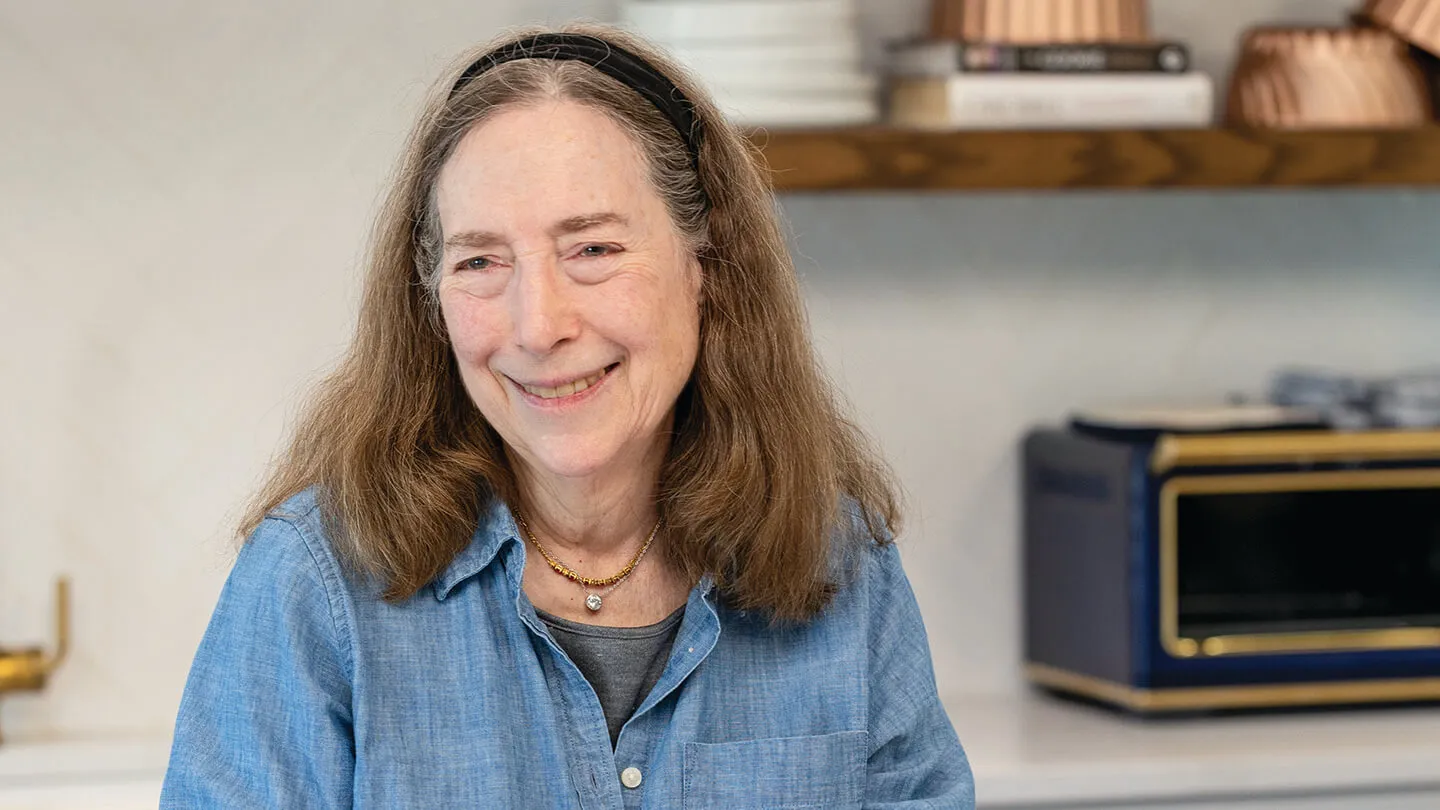
Legend holds that relics of Honoratus of Amiens, the patron saint of baking, could spare wheat fields from drought and deluge. Rose Levy Beranbaum may not wield such powers, but she is a legend. Thanks to her, bakers today weigh their ingredients to produce the miracle of consistently delicious bakes.
The four-time James Beard Award winner and author of 14 cookbooks began chasing ways to capture peak flavor in food while studying at the University of Vermont in the 1960s, and remains a trusted partner in the kitchen because she demystifies recipes, explaining not only what works, but why. Because flour is not just flour and a cup is never simply a cup—precision matters.
While some people may have learned to prepare a dish observing a loved one and using a “more free-spirited way,” Beranbaum says, “the problem is that for other people to come out with the same results they probably are not going to, because everybody measures differently. I didn’t have that background or that tradition so I could look at it with new eyes.”
Beranbaum is credited with developing the reverse-creaming method by mixing softened butter (and some liquid) directly into dry ingredients to produce a finer cake crumb than creaming butter with sugar beforehand. Beranbaum is driven by childlike curiosity to get to the bottom of why. Why choose one mixing method or one frosting recipe over another? What is the effect of a particular flour type on flavor? Her quest for precision is why Beranbaum travels with an oven thermometer and spent weeks retesting recipes in Britain before the release of her 1988 masterpiece, The Cake Bible, to ensure bakers there could achieve the same results using locally sourced flour.
“Flour particles are like little ball bearings, so if they are not bleached or at least heat treated, then they don’t get roughened up enough to hold everything else in suspension,” she explains. “Anything that is not the right texture in a cake also doesn’t have the right flavor.”
The Cake Bible proved to be a landmark in cookbook publishing. “Rarely does a book on baking attract widespread attention in the food world. Rose Levy Beranbaum’s Cake Bible is different,” wrote The New York Times a month after the book’s original publication. It was recognized as Cookbook of the Year from the James Beard Foundation in 1989 and inducted into the James Beard Foundation Cookbook Hall of Fame in 2025. The book is currently in its 54th printing, with over 500,000 copies published.
Beranbaum recalls watching a fellow student use a lab thermometer in a dorm room at UVM and how that need for accuracy “resonated with me.” Years later, out of frustration with inaccurate kitchen thermometers, she searched the Yellow Pages for someone to engineer a short immersion thermometer that she designed and then sold to professional and home bakers alike. Because as fans of Beranbaum know, there are no secrets with Rose.
In her new memoir, Ma Vie en Rose (My Sweet Life), she shares how she pioneered a path in the culinary arts, including details in print that were previously secreted away or divulged only in cooking classes.
“I was not one of the withholders,” she writes.
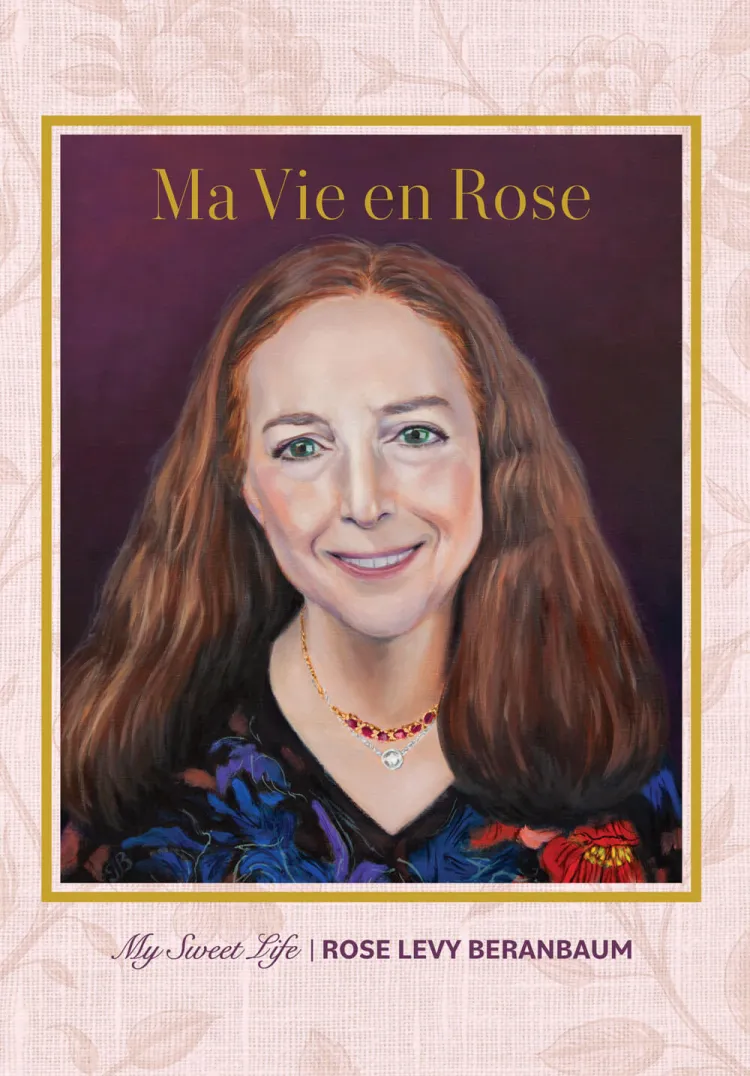
Beranbaum chronicles with characteristic humor how she went from being a picky eater to a kitchen maven, detailing her first failed attempt at making oatmeal cookies and cherry pie to more personal challenges, including divorce. After struggling with infertility and pregnancy loss during her second marriage, Beranbaum found a path through the darkness by baking, teaching, and writing.
“My books became my children, and I gave everything to them,” she writes. “My work gave me extraordinary joy and validation and lifted me from the despair of my loss.”
Beranbaum’s success was forged by sharing her knowledge. She gleaned best practices from corporate laboratories and biochemists to top chefs, food science teachers, and home bakers alike. She learned the science of baking so that others could unlock the art of it, adding headnotes in her cookbooks and giving proper credit to others for their recipes or techniques.
“I really changed the way recipes were written,” Beranbaum says. “I wanted people to be able to follow a recipe with success.”
For the first time, the guesswork was removed, allowing bakers to understand why certain formulas work—or don’t—which ultimately gave people creative freedom in the kitchen. Like her parents, a carpenter father and a dentist mother, Beranbaum showed readers that they needed the proper foundation and tools for the job.
“I began to long for a book which would demystify and reveal all the basic and classic cakes, buttercreams, icings, fillings, and toppings in their simplest form and then show how to combine them to create just about any cake imaginable,” wrote Beranbaum in The Cake Bible.
The book was an answer to her own prayers.
“I think my biggest goal in life has long been to connect with other people,” she says. “And people often think they are the only ones that have a problem, but it’s never the case—there’s always others.”
Hints of Beranbaum’s career as a food writer can be traced to her early years studying at UVM. A home economics course set her on a lifelong quest to make the best cup of coffee. A creative writing class with Professor Leonidas Jones unearthed her storytelling talents.
“I really changed the way recipes were written. I wanted people to be able to follow a recipe with success.” - Rose Beranbaum
“He told me I was a good writer,” she says, recalling an assignment she never thought she could complete. “Seven pages later I couldn’t stop. So that was the first inkling I had that I really was a writer.”
But the path was not straightforward. As a newlywed, she watched the first episodes of Julia Child’s The French Chef on PBS—a relationship that later blossomed into a friendship. By her early 20s, Beranbaum was newly divorced and began wending her way through jobs in the public relations department of Reynolds Metals Company, shipping aluminum foil to editors and chefs around the country, and as a medical secretary. She went back to school for a spell to study fashion design before swapping fabric for fondant and finishing her undergraduate and master’s degrees at NYU in food science and culinary arts.
Beranbaum’s first job after graduating was at Ladies’ Home Journal, testing recipes and finding her feet as a food writer and recipe developer. She later ran the Cordon Rose Cooking School out of her apartment and wrote for publications including Bon Appétit, Food & Wine, Family Circle, The New York Times, and The Cook’s Magazine. She even had her own PBS show—Baking Magic with Rose.
While Beranbaum never imagined achieving this level of success, she credits her mother’s dedication to her work as inspiration. “Even though it wasn’t my plan, it was in the blood. Through her example, I realized what it could mean when you do what you love.”