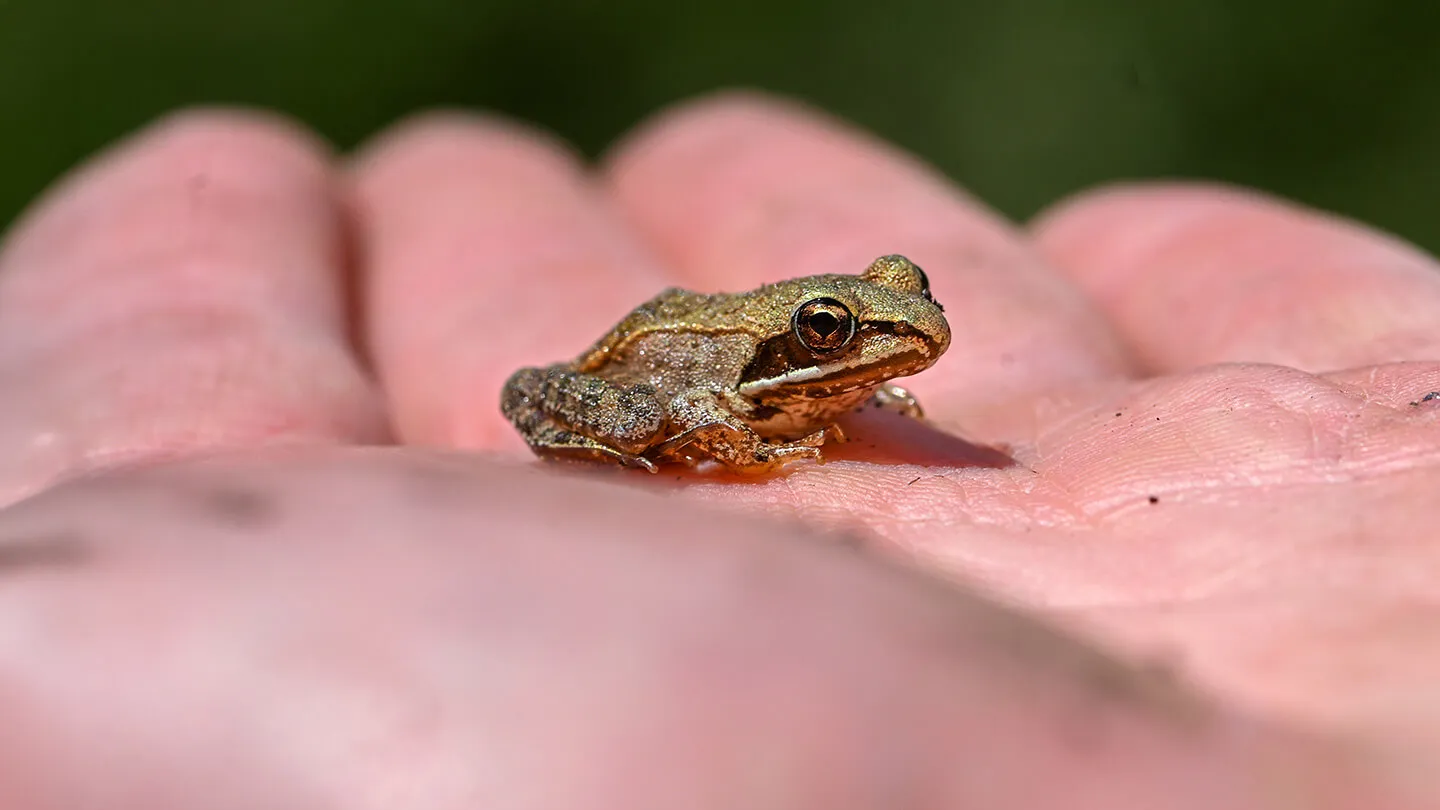
Skin is certainly nature’s most subtle and beguiling invention. Before bending over to kiss a frog, consider that its sparkling surface may be more astonishing than any imagined prince within. Eww? You don’t want to kiss a slimy frog? Well, that’s good because a frog doesn’t want you to kiss it either. Or, at least, many frogs, including the wood frog in this photo, have poison glands all over their skin to fend off predators that might like to kiss—or eat—them.
But falling in love, from a distance, with the skin of frogs, toads, salamanders, snakes, turtles, and other amphibians and reptiles—that wildly inventive, strange, overlooked, and endangered group of creatures, the herpetofauna, that fans call “herps”—can transport you far beneath the surface of everyday life.
When you’re having a bad day, consider that this tiny wood frog will freeze solid all winter—and recover next spring just fine. But it couldn’t do this trick without its nearly magical skin. As the days get cold, ice will start to form outside the frog’s supercooled body where it lies under leaves near a pond in Benson, Vt. Some of these crystals will penetrate the frog’s skin, a required signal that triggers the liver to produce glucose—a potent antifreeze—which the heart pumps into the frog’s organs. While an ice layer forms under the skin and in spaces between cells, the syrupy glucose inside the cells prevents them from splitting open, and the whole frog freezes, hard as a rock. “No breathing, no heartbeat,” says UVM professor Brittany Mosher. It’s a frogsicle until the spring thaw when its heart returns to beating, and its skin begins breathing again.
Yes, breathing. Wood frogs, like most amphibians, have thin, moist, blood-vessel-rich skin that absorbs oxygen from both air and water. This trick is part of the reason that ancient amphibians were the first vertebrates to move onto land, perhaps 365 million years ago: their skin formed an evolutionary bridge out of the sea and up onto the shore. Not only can the skin of amphibians (and some turtles and sea snakes) breathe, but it’s also a two-way membrane, sending water and chemicals in and out. Glands produce hormones for attracting mates and relaying messages—skin to skin. And their skin houses a jungle of beneficial microorganisms while producing specialized proteins to fight disease-causing ones.
Their wondrous skin is also their downfall. Amphibians are highly sensitive to pollution since oils, pesticides, road salts, and other toxins can pass directly into their bodies. The result in a grievous number of species: malformed limbs, reduced reproduction, and death.
“Forty‑one percent of the world’s amphibians face extinction—the greatest decline of any class of animals in human history.”
Add in roadkill, climate change, deforestation, development in wetlands, illegal collection—the list of threats to herps is daunting. Forty-one percent of the more than 8,000 amphibian species around the globe face extinction—the greatest decline of any class of animals in human history. And some twenty percent of reptiles are on the brink too—including more than half of all types of turtles. “They’re in trouble worldwide—including Vermont,” says Mosher, a herpetologist in UVM’s Rubenstein School of Environment and Natural Resources. “It’s easy to think that in Vermont—a place where we have relatively little development, where we’re recovering forest—that these things aren’t happening.”
Wood frogs are plentiful, but of the state’s forty species of herps—nine species of frogs, two toads, ten salamanders, eleven snakes, seven turtles, and one lizard—five are in immediate peril of disappearing from Vermont, and at least eleven others are at risk. Near the top of the list are spotted turtles, Fowler’s toads, and the (very uncommon) common five-lined skink.
For many frogs and salamanders these threats have been turbocharged by a microscopic enemy, two types of chytrid fungi that attach to and invade—you guessed it—their skin. These fungi, spreading around the globe, cause ulcers and skin thickening. This damage leads to depletion of critical minerals, which disrupts the animal’s balance of water and, ultimately, can cause the heart to stop.
UVM people are working to understand amphibians and reptiles and how to protect them. To get a glimpse of these sometimes-warty, sometimes-watery creatures, videographer Bruce Gibbs and I went out into the field with a few of the university’s researchers, students, and alumni who love these ancient animals, who want to help herps. Here are some snapshots of what they do.
Why Did the Salamander Cross the Road?
It’s late April, dark and drizzling, and that pleasant earthy smell—which rises from pavement and soil when rain hits after a dry spell—wafts over Monkton Road. “It’s a perfect night,” says wildlife biologist Matt Marcelino ’19 G ’25 (seen above), shining his flashlight along the road edge. Perfect, that is, if you’re a yellow-spotted salamander looking to get back home after mating. On the east side of the road, a hardwood forest rises toward Hogback Mountain—this is where these salamanders live in shrew or mouse tunnels most of the year. On the west side, a soggy meadow stretches toward Huizenga Swamp. In the swamp, on warm nights earlier in the spring, male salamanders began a waggling dance, called a liebsspiel, where aroused mates circle each other and place their heads on each other’s tails. Soon thereafter the females laid a jellied mass of eggs in quiet water. Now that it’s raining, they’re trying to get back to the forest. Problem is the road.
In the distance, a hissing pair of lights winds down a hill toward us and Vergennes. “Looks like we have a car coming,” says Marcelino, who is standing in the middle of the pavement, his red Pumas astride a salamander that plods east at 0.06 miles per hour. “I’ll grab it and we should get out of the road real quick,” he says, as we all scurry to the shoulder.
This salamander has gotten a free ride instead of squished. But, around the world, roads cut through migration corridors for amphibians and reptiles—like this one—allowing vehicles to crush billions of these slow-moving animals. With help from the Vermont Reptile & Amphibian Atlas, local people had long known that this crossing was one of Vermont’s hottest hotspots for herps. So, in 2006, members of the Monkton Conservation Commission and the Lewis Creek Association went out to watch. What they saw shocked them. “Over just two nights, more than a thousand amphibians were killed on this stretch of road,” says Marcelino.
“This is not that hard and it’s not very expensive. I hope road planners across the country see these results... This is a community coming together to solve a conservation challenge.”
“That’s what inspired this project,” he says, shining his light over the meadow to where a pair of long, three-foot-high concrete walls angle in toward a tunnel under the road. It’s one of two wildlife underpasses built here for salamanders and frogs. It blocks the animals from climbing onto the road and funnels them under instead. The project cost $342,397 and it’s amazingly successful.
For his Ph.D. thesis, working with Professor Brittany Mosher, Marcelino led a first-of-its-kind study showing that these tunnels can reduce amphibian deaths by 80 percent. “It was surprising. I knew that underpasses would work, but I didn’t think they would be that effective,” he said. And when the scientists took climbing amphibians out of the data—primarily spring peeper frogs that can easily scale the walls—the number jumped to 94 percent.
Building and studying the underpasses was a nearly-two-decade effort by citizens, conservation groups, UVM scientists, and state agencies—led by Monkton resident and retired State of Vermont biologist Steve Parren. With foresight, he and others monitored amphibian mortality here for five years before the construction of the underpasses in 2015 and then for seven years after. This let the scientists prove that tunnels work. One spring, using wildlife cameras, the Lewis Creek Association counted 2,208 amphibians using one of the underpasses. Plus, it turns out that bears, bobcats, porcupines, raccoons, snakes, and birds are happy to use them too.
“This is not that hard and it’s not very expensive. I hope road planners across the country see these results,” Marcelino says. “This is a community coming together to solve a conservation challenge.” Then he bends down in the rain. “If you come over here, you can see another species. It just ran into the wall and is turning. This is a blue-spotted/Jefferson salamander hybrid,” he says, following it with his light as the animal lumbers over wet stalks of grass. “There are these beautiful creatures that most people don’t even know exist.”
In Hot Water
It’s an exceptionally warm morning in early June, nearing 80 degrees, and UVM professor Brittany Mosher shades her eyes while graduate student Sam Troast wanders around, hip-deep in hip-waders, in a pond above Sherman Hollow Road in Huntington, Vt. They’re not trying to cool themselves down. They’re trying to catch newts—basking near the surface of the pond—who may be trying to warm themselves up.
“Got one,” says Troast, swiping a net out of the bright and flocculent water and passing it to Mosher on the bank. In a gloved hand, Mosher holds up a gorgeous animal with deep-orange spots along its dark back and cute black polka dots on its yellow belly. If this were a bird, birders would have it as a favorite on their life list. If it were a dog, it would be a Dalmatian puppy (albeit a green and wet puppy) and animal rescue groups would have raised millions to make sure it has a happy home.
Instead, it’s an eastern newt, a type of salamander, found across eastern North America in ponds and lakes in this adult form. As a juvenile, it lives in the forest as a bright orange critter known as a red eft. Common though they are, eastern newts—like many amphibians—may be at risk from new infectious diseases.
When Mosher releases the animal back into the water, it powers away like a tiny alligator, its tail an undulating S. It looks in great health. But this water contains a chytrid fungus called Batrachochytrium dendrobatidis or Bd. In the 1970s, numerous species of amphibians began dying—and nobody knew why. Terrible wipe-outs of frogs in Australia were followed by ones in forests in Central America—and the pandemic kept spreading. It wasn’t until 1998 that Bd was identified, attacking keratin proteins in amphibians’ skin. The fungus probably travelled from eastern Asia, where it is native, but most amphibians have not evolved natural defenses against Bd. It has triggered the extinction of more than 90 species around the world and decimated hundreds more.
“We’re trying to understand—as we capture and swab and assess the health status of these newts—if they’re making good choices about where to go."
“It’s in this pond right now. It’s not necessarily on every newt,” Mosher says. And even if it’s on the newt she just released, Mosher wants to know if the animal may be able to fight off infection by changing its temperature. Since amphibians are cold-blooded, the newt depends on the warmth of the water to control its own body temperature. By lounging in the hot spring sun, it may be creating what Mosher calls a “behavioral fever,” to fight the fungus. Or newts may be clever enough to go down into the sediment at the bottom of the pond where winter chill lingers, since the fungus appears to be sensitive to cold too.
Recently, an even-more-deadly relative of the fungus Batrachochytrium dendrobatidis, Batrachochytrium salamandrivorans—known as Bsal—has been spreading in Europe, killing many salamanders. This new fungus is a major threat to North America, the global hotspot for salamanders. An accidental introduction of Bsal is likely; early detection could stop or slow its spread.
But it’s not clear how changing temperatures—of water, amphibians, fungus, season, climate—all interact to promote, or prevent, disease. Mosher is leading a five-year, $2.6 million research effort, supported by the U.S. National Science Foundation, to find answers. That’s why Sam Troast has been wading into ponds in the region, catching newts and setting up temperature probes.
“We’re trying to understand—as we capture and swab and assess the health status of these newts—if they’re making good choices about where to go. Are sick newts moving to ponds or places that allow them to reduce their infection?” Mosher says. “If newts have good instincts when it comes to these pathogens, and behaviors like basking can really make a difference, well, then you might think about habitat management.” For example, clearing branches so that the forest doesn’t shade the entire pond to provide areas for basking, or making sure that connections remain between ponds that have different temperatures.
Charming Snakes
It’s the first day of August, and Jim Andrews has driven 25 miles from his home in Salisbury down to Benson, Vt., to check in to a hotel. A snake hotel. It’s a crisscrossed pile of sawmill slabs, covered with a black rubber tarp, in a meadow at the edge of a wetland, on the 140-acre property of Nancy Elkington and Tracy Howard. It even has a sign: “Snake Hotel.”
Andrews, an independent herpetologist—UVM Class of 1976—and his assistant, Ira Powsner, roll back the tarp and begin to search under the slabs, layer by layer. Sure enough, on the third floor of the hotel, a large black snake is snoozing. Andrews deftly pulls it out and holds it up in the sunshine. It’s a female ratsnake, known to scientists as Pantherophis alleghaniensis, almost five feet long. She seems to be lethargically interested in climbing Andrews’ forearm, and shoulder, and then arm again, as Andrews gently rolls her forward, hand over hand, like a living bight of rope.
Her thick body has a noticeable bulge in the midsection—“a food item,” Andrews says, perhaps a mouse from Elkington and Howard’s nearby barn, where generations of ratsnakes have found refuge and dinner, leaving their molted skins behind like translucent inside-out socks. This snake may have molted recently, Andrews thinks, her scales iridescent, an almost-industrial bright ebony, with a white-and-black checkerboard on the throat and abdomen.
Andrews and Powsner measure the snake, taking note of its location and health. Later, they’ll enter data about all the snakes they find here (including a hard-to-catch ribbon snake they chased through mud for 20 minutes) in the Vermont Reptile and Amphibian Atlas. The atlas was Andrews’ vision long before iNaturalist or iPhones came along. It contains some 128,000 records of herps, painting an ever-shifting portrait of what animals live where in Vermont—and it relies on volunteer observers.
“Back in the nineties,” he says, “we didn’t have the data we needed to make informed recommendations for conservation—for what should be listed as endangered.” Three decades later, more than 7,000 observers have wandered in wetlands, looked under rocks, and peered into vernal pools, contributing their sightings, photos, and care into the atlas.
There aren’t many records of ratsnakes, Vermont’s largest snake species. Not only are these shy creatures, but they’re also rare and threatened—only seen in a few towns in Rutland and Addison counties. Several years ago, Andrews conducted a study to better understand ratsnakes—and Nancy Elkington and Tracy Howard agreed to participate. “The snake that you put the transmitter in? We fell in love with that snake. His name was Anthony,” says Elkington. “Thanks to Jim, we’ve come to terms with the fact that we’re sharing this space with other critters,” she says. “It’s their space, so we’ve learned to love them.”
Turtles All the Way Down
This huge snapping turtle lies in the mud of Pelots Bay—an inlet of Lake Champlain on North Hero Island—pondering her role in the universe and what she might enjoy for lunch. The animal must be north of 50 pounds, based on the grunt-work it took from Matt Marcelino to get her out of a research trap. The turtle looks like an island herself, her geological shell—made of modified bones, living skin, and a fingernail-like top layer—rising above the lake, covered with algae, leaves, and tree bark. “She’ll probably watch us for a bit and then turn around and go back into the lake,” Marcelino says. “Look at her eyes, they look so wise and friendly.” Limpid jewels, her eyes do reveal gold-and-black depths, but, okay, neither Marcelino nor I have any idea what she’s thinking—we’re just in a long line of people who burden animals they love with stories, especially turtles. Marcelino wants to make sure that one story people have been telling about turtles is true: sixty years of using large mechanical harvesters—to remove Eurasian milfoil and other non-native plants in the lake—is not hurting turtles. These invasive plants form thick mats, degrading habitat for native species, and wrecking a nice day in a boat. But the machines do scoop up the occasional turtle. While Marcelino explored how the harvesters affected musk and painted turtles—he scooped up some other turtles too, including this snapper. “What we found is that, at least in this study, we don’t really see any negative impact,” he says. “Which is good.” But freshwater turtles are little studied—this was the first research done on the impact of mechanical harvesting on turtle populations in Lake Champlain. Many of their stories remain beneath the surface.
Herpetology Club
Nate McPeak ‘28 is from West Virginia, “and there’s not a lot to do there,” he says with a wry smile. “So we would go out, spend hours just, like, in the dark, in the rain, looking for small-mouth salamanders. It’s deeply satisfying.” When he arrived at UVM for his first-year TREK trip, one of his leaders asked, if you could do one activity for the rest of your life, what would it be? “I would go herping,” he said. Now he’s the co-president of the new UVM Herpetology Club—which he co-founded in the fall of 2024—and he has a lot to do.
There are 500 students on the club’s email chain, they have an iNaturalist group, “and our Instagram has a thousand followers,” he says. Members go out herping, “whenever it’s not winter,” McPeak says, and anyone is welcome to join. “I never even knew that there was a word for this until I got here,” says co-president Legare Butler ’27, a wildlife biology major and native of South Carolina. Sometimes the trips go with local experts, at night, to “secret places,” Butler says, where they’ve seen some cool critters, like the northern dusky salamander, but mostly the club invites students to “come to Centennial Woods, lift up a rock, see what’s underneath,” she says.
They’ve seen many red-backed salamanders—which live in Vermont forests by the millions. “People say, ‘I want to go to Costa Rica someday so I can see all the animals,’” says McPeak. “They just don’t know that diversity exists everywhere.”