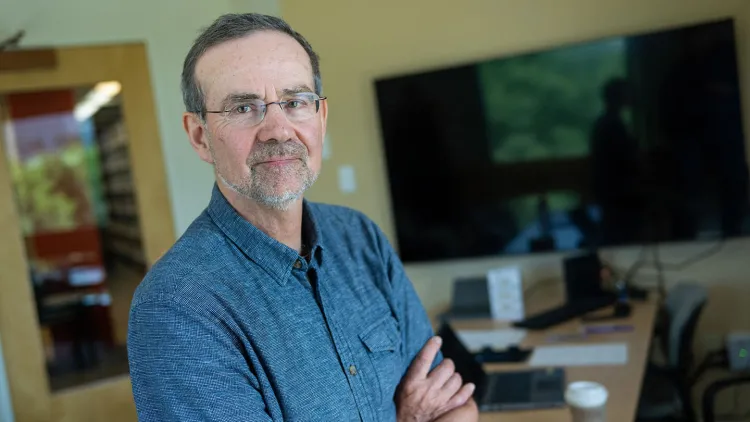
Richard Watts can often be found padding around the second floor of the Howe Memorial Library in his socks between meetings. But don’t be fooled by the rimless glasses and soothing voice—Watts is a fire starter.
Since founding the Center for Community News (CCN) in 2022, he and a team of professional journalists have built a network of more than 200 universities, assigning student reporters to the places they are needed most—off their campuses and into regions where traditional news coverage has dwindled. The concept, funded in part by a $5 million grant from John S. and James L. Knight Foundation, flips the model of teaching journalism. Instead of handing in assignments that remain buried in the hard drives of their computers, students report on the people and events outside the campus community for local news outlets. It’s a model that benefits not only the student journalists learning on the job, but also the resource-strapped media organizations that publish their work.
“They are getting content to their standards, at no cost, from somebody they trust,” explains Watts, a senior lecturer in geography at the UVM. “Because common across all these programs–it is a former journalist is teaching the class or editing the content.”
In the first year of the effort, Watts traveled to dozens of colleges across the country, training faculty members to build sustainable news partnerships and sharing everything from fundraising strategies to sample course syllabi. By 2026, there were over 9,000 students enrolled in classes overseen by professional journalists and nearly 20 percent program growth since 2024. Watts has no plans to slow down.
“Only about 200 universities participate, but there are at least 4,000 who could,” he says one June morning, brown eyes flashing. “The potential is huge.”
Tapping it may help stem the attrition of local news from underserved communities. Since 2002, over 70 percent of local newspaper jobs have vanished, particularly in rural regions where small papers are often the first to fold. This does not go unnoticed. When local news disappears from a community, the erosion of social capital may follow as voter turnout dips, political partisanship increases, and property crimes and corruption rise. What happens when media is added back to a community is unknown. But Watts, a former journalist and community organizer, is not trying to rebuild the press corps of the past.
“It has never been about saving what once was,” he says. “But building what is next.”
Admittedly, the University of Vermont is an odd place to launch a movement to bring local news to far-flung regions of the country without it. The university does not offer a formal journalism major. And yet, UVM does produce students who get good jobs in journalism and can be a model for other institutions that lack traditional programs but want to teach journalism, Watts explains.
“It has never been about saving what once was, but building what is next.” - Richard Watts
He honestly didn’t set out to patch the holes left behind by a changing media landscape. The effort stems from another project he was tackling—how to expand and improve student internships. He realized that hiring interns, and bringing them up to speed, was often too much work for struggling news organizations; everyone would be better served if professional oversight was managed in-house. Watts started offering courses such as environmental reporting that teach students the tenets of journalism and create stories ready for publication. And that’s how the Community News Service at UVM was born.
Bursting the campus bubble
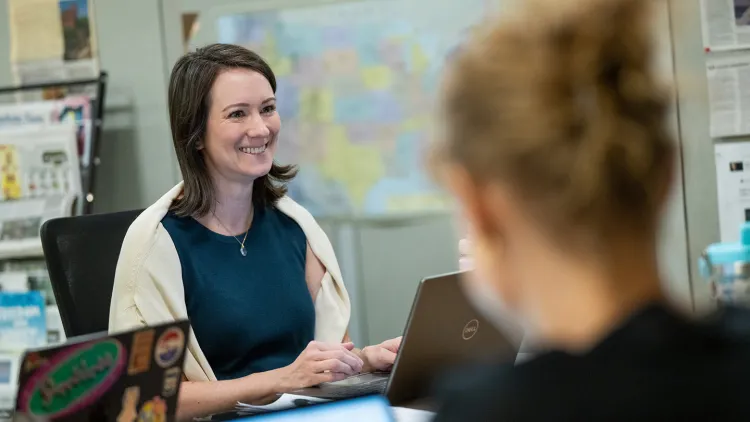
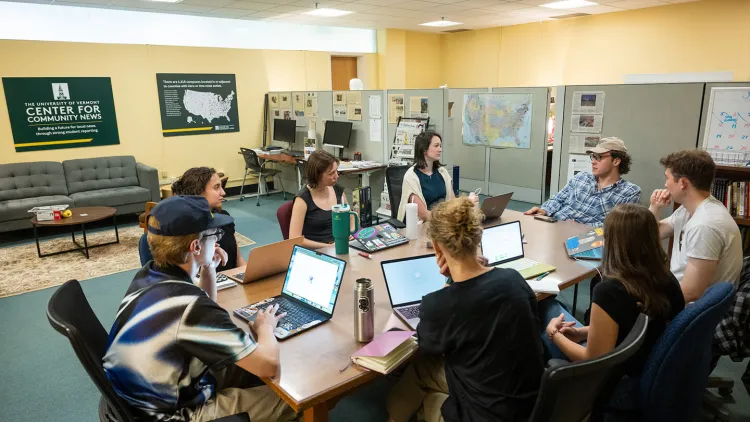
One June morning, Courtney Lamdin fiddles with her laptop before the weekly editorial meeting at the center, flanked by cubicle walls decorated with yellowing news pages inked by student journalists.
As editor for UVM’s Community News Service, Lamdin, a former reporter for Seven Days, the Vermont weekly, oversees the work of student interns who trickle in holding thermoses of coffee. The interns sit around a conference table refining their pitches before floating stories about the invasive emerald ash borer, profiles of quirky business owners, and historical pieces on patches of forest rumored to be haunted. Lamdin greenlights the forest piece and gently flags a potential conflict of interest of a student wanting to feature a place where he works. This is what professional editors do.
Lamdin has loved journalism since high school when she first read Carl Bernstein and Bob Woodward’s All the President’s Men.
“That just did it for me—hold powerful people accountable,” Lamdin says.
And yet, the aim of the CNS program isn’t necessarily to save journalism or even to produce more journalists. When students cover local elections or interview residents about a proposed ordinance, they learn how to engage in their own communities.
A lot of times they are the only people covering these towns and they develop a sense of responsibility for them, too, Lamdin explains.
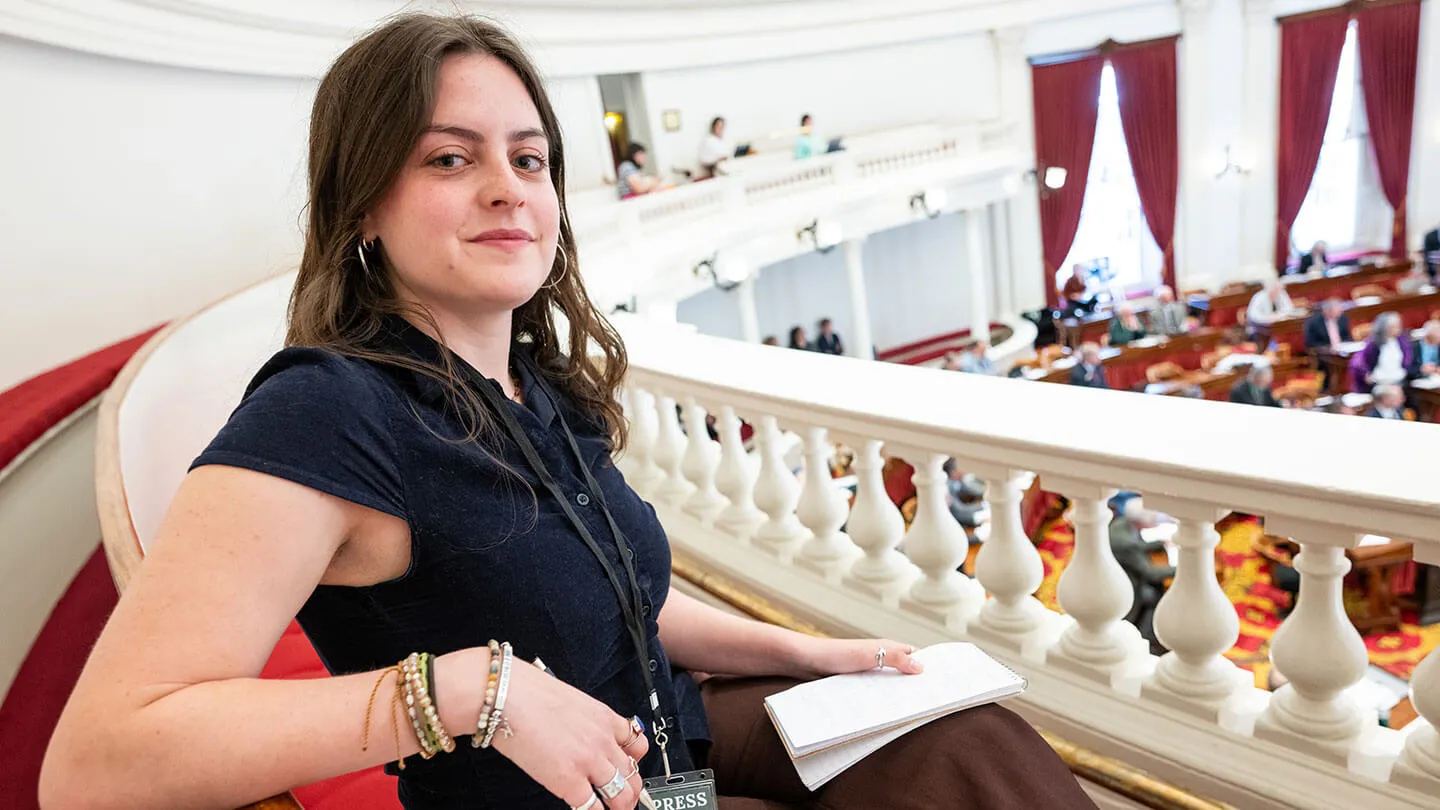
That is what happened to Elise Coyle ’26 when she covered Bradford, Vt., a town along the border with New Hampshire, about as far from Burlington as she could get. Coyle, a California native, values the time she spent away from the campus beat.
“I really loved that as someone from out of state,” she says. “People mentioned that ‘Burlington bubble.’ And that burst that for me.”
Driving two hours across Vermont you start “putting faces to issues,” Coyle says.
She knows that mistakes can be made in reporting because she has made them. And she has witnessed sources provide inaccurate information they thought was true. It may seem like a harmless mistake, but it can erode public trust. Now, Coyle better understands how journalism works and what is at stake.
“I am aware of the little things that can fall through and how it can happen,” she says. “I feel a great responsibility, especially when I am going into rural communities, if I provide wrong information.”
“I feel a great responsibility, especially when I am going into rural communities, if I provide wrong information.” - Elise Coyle
And like many students, the experience forced her to wrestle with discomfort. Like picking up the phone. For a generation more comfortable communicating by text, dialing a stranger and asking them to explain zoning codes can feel immense.
“I was super, super shy when I started,” Coyle says. “I am much less afraid to engage with people. … I feel like I have had a lot of great conversations with people I wouldn’t have had.”
This is the type of personal and professional transformation CNS editors see over the course of a semester.
“This is a very accelerated program, and they do it,” Lamdin explains. “They rise to the occasion.”
Curiosity that pays
Most CNS students will not seek careers in journalism. But some, like Kate Kampner ’26, catch the reporting bug.
Kampner knew she would pursue a career in writing but wasn’t sure how to put it into practice until she took Watts’ environmental reporting class. Despite never writing an article before, she quickly learned how to craft publishable pieces and spent the next two years taking more CNS classes and working as an intern, putting professional standards into practice as a Vermont State House reporter. Kampner banked her story clippings, and spun them into her first job at Colorado’s Vail Daily upon graduation. She credits CNS mentors for helping her develop the skills needed to jump start her career.
“My first ever call was with a legislator,” Kampner recalls with a smile. “And, oh my gosh, I remember being so nervous. … It took me awhile to get really comfortable with questions. But I realized how much learning I was doing when I started to respond rather than read my list of questions. Active listening is a skill I had to learn over time with reporting.”
Meeting Kampner, one would never guess she ever felt intimidated talking with strangers. During her last week as an intern, she walked into the State House knowing exactly where to go and who to talk to before filing her final story. Kampner looked like she belonged in the room. She felt like it, too.
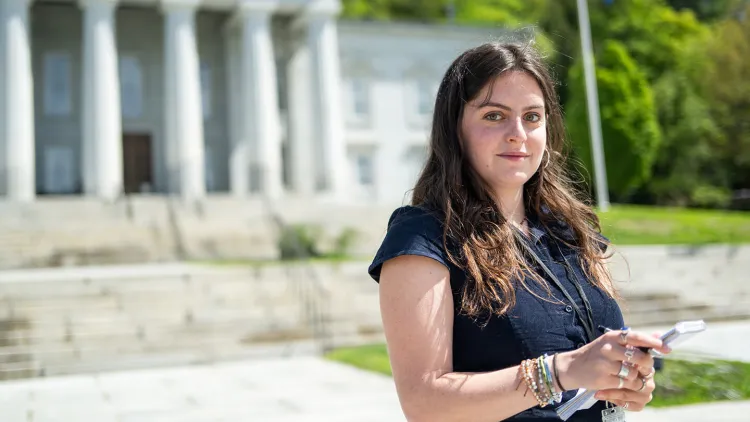
“That was the important piece,” she says. “I had to recognize for myself that ‘You are a real reporter.’ You have to be the one to recognize that you are allowed to be there. And you have put yourself in this room.”
Kampner’s time at the State House showed her how local news and policy affects people. Legislators have told her about the public responses they received to her stories, Kampner says, and she recalled an instance when another CNS reporter’s source was recently invited to testify.
Your journalistic decisions matter and can impact people, she explains. “… You want to get things right. You want to get the right things out. You learn the importance of that and holding yourself accountable while holding others accountable.”
That is why gaining trust with sources is so important to Kampner. She wonders if building trust with the public could prompt more people to appreciate the news and read it again. “One step at a time.”
"You want to get things right. You want to get the right things out. You learn the importance of that and holding yourself accountable while holding others accountable.” - Kate Kampner
The same could be said for Watts’ approach to expanding the Center for Community News: one institution at a time. Making the case, and lifting up UVM as proof-of-concept. Perhaps by asking colleges to look out rather than in, higher education can help plug the holes left behind when local news fails. They also might have some fun while doing it.
“Not many jobs you can say your goal is the best version of the truth,” Watts says. “And be paid for being curious.”
An appetite for real news
Christopher Drew was an early adopter of the CNS approach. He is a former New York Times investigative journalist and a professor at Louisiana State University who runs the school’s statehouse bureau and teaches a popular cold case course focused on crimes during the Civil Rights era.
In 2016, when LSU started its statehouse reporting, only a handful of big journalism schools had bureaus, Drew explains.
Richard Watts wanted to change that. He convened a meeting between schools with bureaus and those who wanted one to learn best practices. Afterward he asked Drew to host a workshop for schools in the Gulf region to build a statewide network.
“I call him the Johnny Appleseed of community journalism because he bops around the country planting seeds,” Drew says.
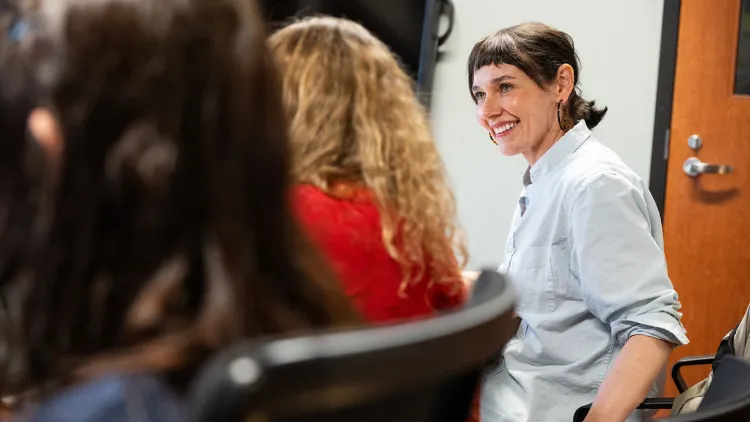
The idea of universities partnering with local media may seem obvious in retrospect. But it wasn’t until the mainstream media struggled to maintain profits and staffing dwindled that they saw a reason to showcase student work, Drew explains. “In the old days when newspapers were fat and happy they wouldn’t have bothered to want to run student stories—they didn’t need them.”
Now, they do.
A 2025 report on the state of journalism in the United States by Muckrack and Rebuild Local News found about a 75 percent drop in the local reporting workforce since 2002, and that more than a third of counties have fewer than one full-time local journalist covering the region. Students could close these gaps.
The work is different for the professors who teach CCN courses, too—it’s harder.
“It would be nothing easier than to sit back and teach two courses where nobody ever sees what the students produce,” Drew says. “… It’s another thing to have to work with [students] to turn the stories into publishable form. It’s a whole other level of rigor. So, I am always telling students we are two big mistakes away from being the end of any of these programs.”
Each school in the CNS network is a testbed for innovation. For instance, Drew recently hired a student to develop TikTok reels for cold case stories. One of the first posts—just 32 seconds of video and still pictures from 1964—earned over 1.8 million views, 400,000 likes, and a thousand comments.
“There is an appetite among young people for real news if you put it in the right channels for them.” - Christopher Drew
“Most of [the comments were] by young people saying that they had no idea that as recently as their grandmother’s lifetime there was this type of brutality and stuff happening,” Drew says. “There is an appetite among young people for real news if you put it in the right channels for them.”
Drew’s goal is to harness the students’ instincts for new media and place them in the role of news influencers at outlets where they use the principles of journalism to build readership. It may also be necessary.
“My fear is, and I mentioned this to Richard,” Drew says, “is that we do all this wonderful stuff to help news sites by providing more information, we help readers, we help the universities do a public service, the students get clips, and all that, and we give the sites stories, but if the sites still go under anyway then the whole thing kind of collapses.”
Building what comes next
Scott Finn knows how tenuous the career of a journalist can be. He spent two decades in public broadcasting as a reporter and news director before serving as CEO and president of Vermont Public. Over the years he witnessed government officials in West Virginia try to eliminate state funding for local NPR and PBS stations, and in 2025, Congress rescinded $1.1 billion in federal funding for the Corporation for Public Broadcasting.
“The loss of funding has been hard, especially on rural stations or low-income states,” he says, adding that while some outlets have received additional support from listeners, others are rethinking their role and doubling down on community service.
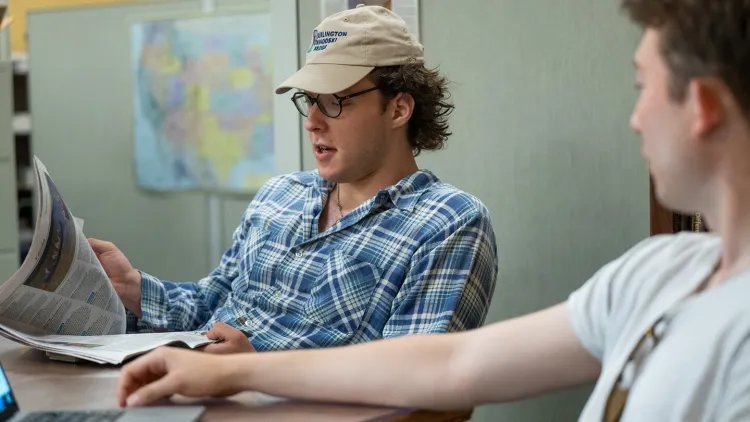
Finn argues more stations should dial up their involvement with area colleges. In 2024, he joined CCN to help manage statewide operations and lead a yearlong mentoring and training program for faculty members. Finn recently examined how public media stations across the country engage students, cataloging if they worked with students and the extent of their involvement. The numbers show room to grow. While 88 percent of public media stations have some student reporters, only 59 percent have a sustained internship program, and fewer than 15 percent include educating students as a core function.
“One way to survive is, you need to lean even harder into your student mission, Finn says. “One thing you can do is become a teaching hospital for students.”
For UVM, this fits with its land-grant mission, and Community News Service editors ensure students cover communities outside Chittenden County. For public media, the decision may be about economics since half are licensed to colleges or universities.
“You can do a lot more together. To do that, public radio and TV stations need to open their airwaves to student voices." - Scott Finn
“You can do a lot more together,” Finn says. “To do that, public radio and TV stations need to open their airwaves to student voices. Some of them have been reluctant to do so because of concerns about quality. … But I think they need to overcome these fears, because public media started as an experimental media organization, usually on college campuses, before CPB funding, and it needs to go back to some of those roots and be community based.”
He suspects the future of community news will be smaller and scrappier than today, but hopefully involving students who’ve been taught the core values of journalism: truth, accuracy, fairness, and balance.
“I think it’s going to look like what it did before the rise of professional news 150 years ago,” Finn says. “My job is to help the people that wind up in that kind of system do it better, fairer. ... That is how I sleep at night. And I still hope that something resembling traditional journalism will make it through.”
Perhaps with more students like Otis Roessler, this may come to pass.
Roessler, a senior political science major, came to UVM because he was inspired by alumni Ryan Rusillo’s sportswriting career for ESPN. While familiar with the highs of journalism, Roessler also knows the lows: His dad was once the managing editor for a community newspaper, “which barely exists anymore in my hometown,” Roessler says.
He aims to have a career adjacent to politics and public policy where he can advocate for the working class. As a CNS reporter last spring he covered municipal government in the town of Winooski, learning about town budgets and reporting on things like the refurbishment of the police station.
“I don’t mind getting into the minutiae of how that stuff works and put it in simple terms for the reader,” Roessler says.
"We live in such tumultuous, crazy times. There will always be people willing to report on it and do their best to tell the truth." - Otis Roessler
In July, he broke a story on the slow repair of elevators in Waterbury apartment buildings that affected disabled and vulnerable residents. Roessler has honed the hard skills of journalism—writing swiftly on deadline—and the soft ones—preparation, time management, and persistence–which is often "how to be a little annoying.”
“Journalism is not the most promising financial endeavor,” Roessler admits.
But he insists it’s important, nonetheless. “We live in such tumultuous, crazy times. There will always be people willing to report on it and do their best to tell the truth. It is really a godsend—the Community News Service—it was for me.”