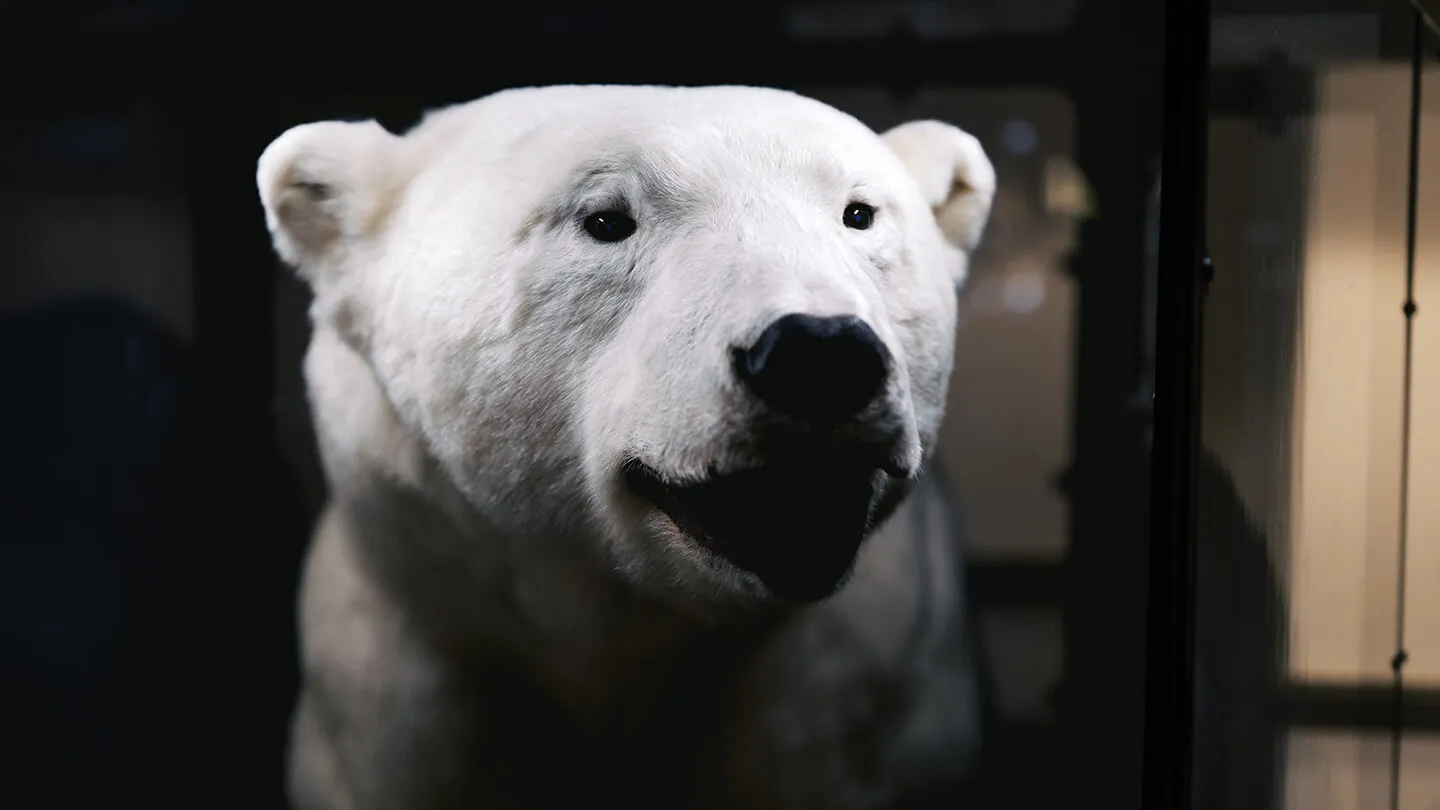
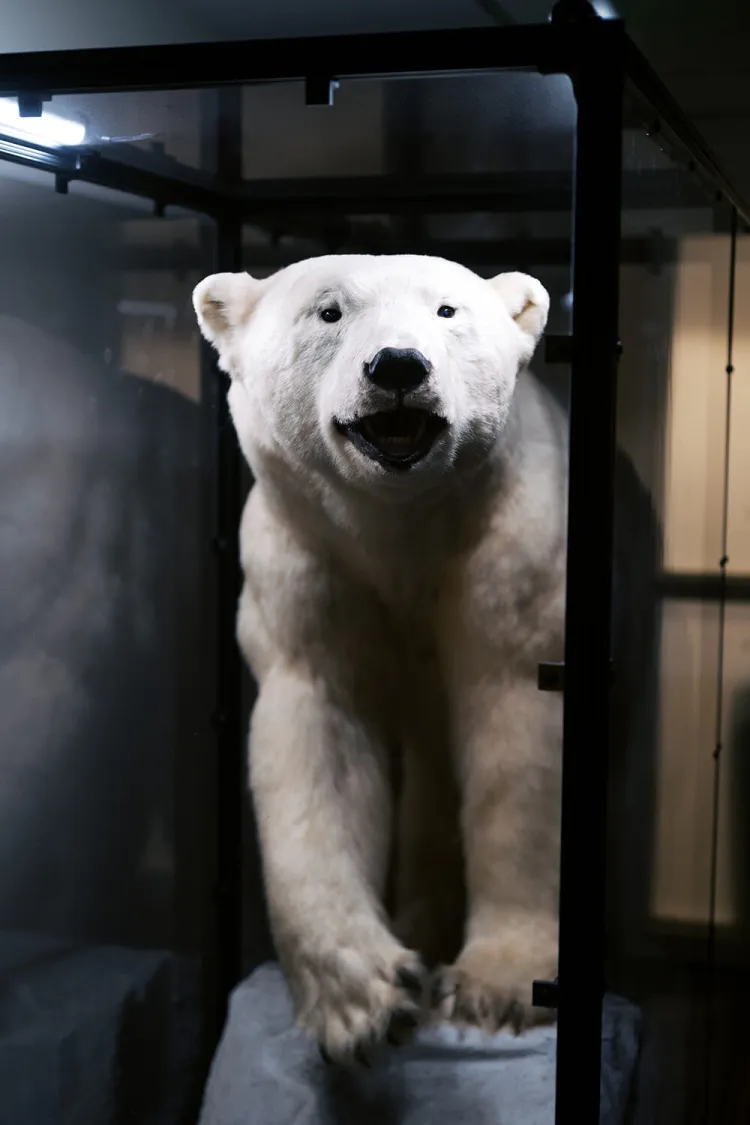
In the 1980s, UVM’s polar bear languished in storage long enough for mice to chew the fur off his ankles. By the time I first laid eyes on him, he had been standing on his artificial iceberg in the lobby of the Marsh Science building for decades, in the company of dozens of other taxidermied birds and mammals. Along with his ankle fur and several front claws, his story was almost lost to history—until Dave Moroney G’24 and I set out to learn how UVM had acquired this bear in the first place.
I put Dave in touch with a woman named Carol whom I’d recently met at an open house for the zoological collections. She’d told me that as a UVM student in the 1970s, she’d helped catalog vertebrates. I asked for her email address, since I’m perpetually on the hunt for anyone who might have some knowledge of our extensive but poorly documented taxidermy collection. (It makes up only a tiny fraction of our 150,000-specimen research collection, which is 90 percent insects.) Dave reached out to her, hoping she might recall some details of the bear’s arrival at UVM in 1975.
Carol’s tale surpassed our wildest expectations. She recounted to Dave the lore she remembered from her student days, when campus was abuzz with the story: during a sting by the U.S. Fish and Wildlife Service (USFWS) targeting a massive poaching ring, the polar bear had been killed in Alaska by a special agent who feared that his cover would be blown and his life endangered. Dave and I were de-lighted but skeptical. We hadn’t yet learned the craziest part of the story: it was true.
We obtained a scan of the case file from the USFWS Office of Law Enforcement in Anchorage, Alaska, detailing the undercover opera-tion with photographs, letters, permit records (or verified lack thereof), and a typewritten account of the case. The file is over 80 pages and contains such juicy lines as “[He] took a 12-gauge automatic shotgun from his plane…telling Agent Parker that this was the per-suader.” In one photo, a mustached accomplice, leering from beneath a thickly furred hood, looks more diabolical than any Disney villain.
The case history describes how, in early 1972, USFWS Deputy Game Warden Paul Bagalio and Agent Bruce Parker, both of Montpelier, Vt., approached a Seattle taxidermist in the guise of unscrupulous trophy hunters looking to bag a polar bear. A scribbled note with a phone number and a hefty dollar figure told them who to call to make this illegal hunt happen. Bagalio and Parker then traveled to Barrow (now called Utqiagvik) on Alaska’s northern coast, accompanied by guides in league with the taxidermist-ringleader. On March 8, as part of the carefully planned sting, Bagalio shot a male polar bear on the pack ice approximately 100 miles north of Point Barrow (now Nuvuk). He had no legal permit to do so, and the bear, along with another one killed by Agent Parker, served as hard evidence of the poaching ring’s profiteering crimes. Back in Fairbanks, a USFWS agent marked Bagalio’s bear for future identification by ripping the keratin sheath from one of its front claws and smearing fluorescent dye around its nose.
Dave and I wasted no time in shining a blacklight on the bear’s snout to see if the dye was still visible. It wasn’t, but we already had proof that the bear was Bagalio’s: a taxidermy conservator who’d repaired the mouse damage the year before had discovered that one of the missing front claws was actually still there, just lacking its dark keratin sheath. Fifty years later, the marker originally meant for law enforcement told us we had our bear.
Bagalio and Parker carried out several similar undercover operations to catch other poachers in the western United States. Bagalio later told the Bennington Banner, “My guide made it perfectly clear that he would leave me dead in the mountains if he thought I was an investigator.” Fortunately, that never happened: after helping to bring the ringleaders to justice, Bagalio lived out the rest of his life in Vermont, passing away at age 90 in December 2022, sadly just a few months before I first opened the case file that revealed the story of his daring mission.
Incidentally, it was David Rippeto ’91, now a USFWS special agent based in Anchorage, who, at my request, gamely combed through a mountain of old case files stashed temporarily in cardboard boxes and found the right one. You never know when a Catamount will step up to help you find the missing piece.