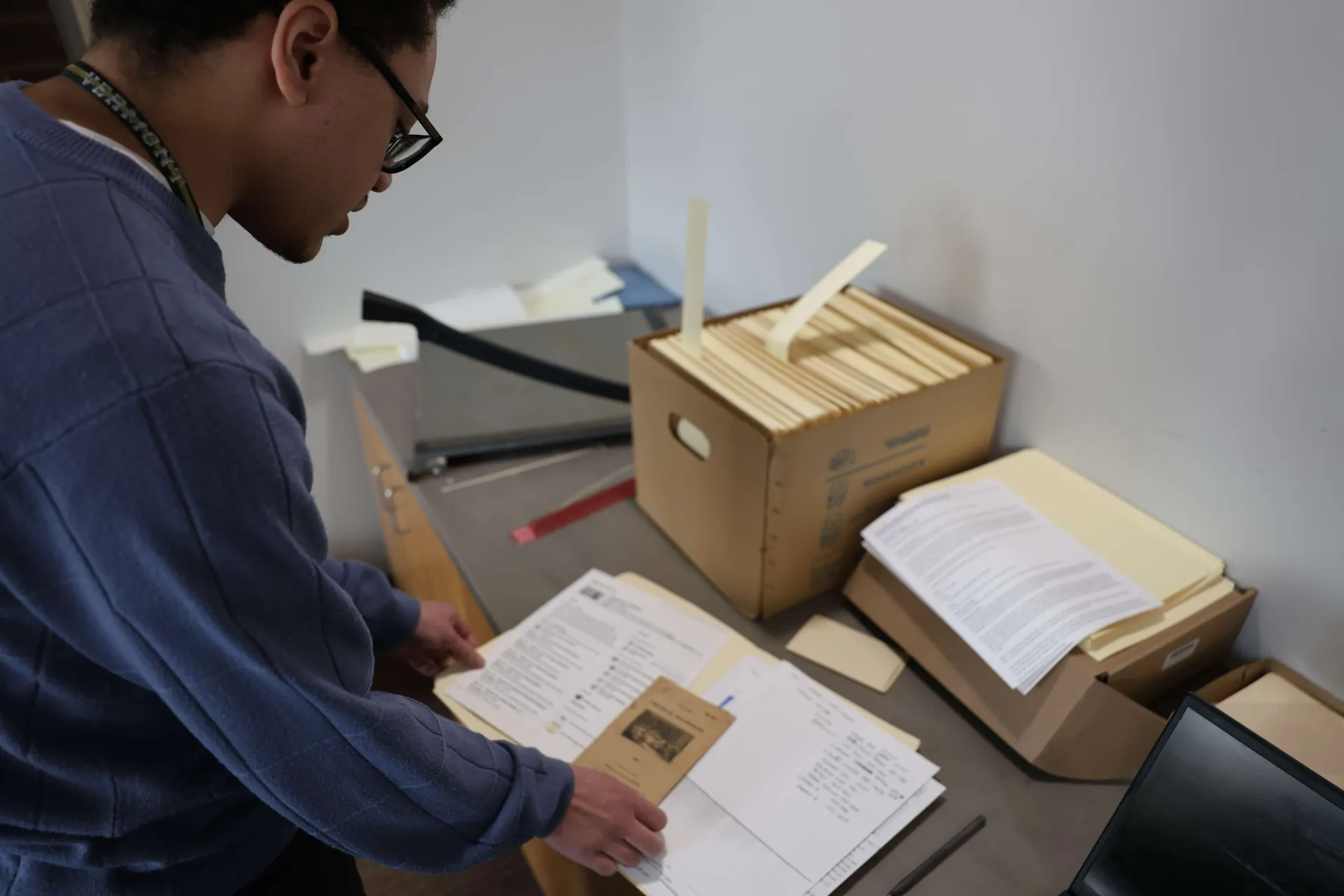
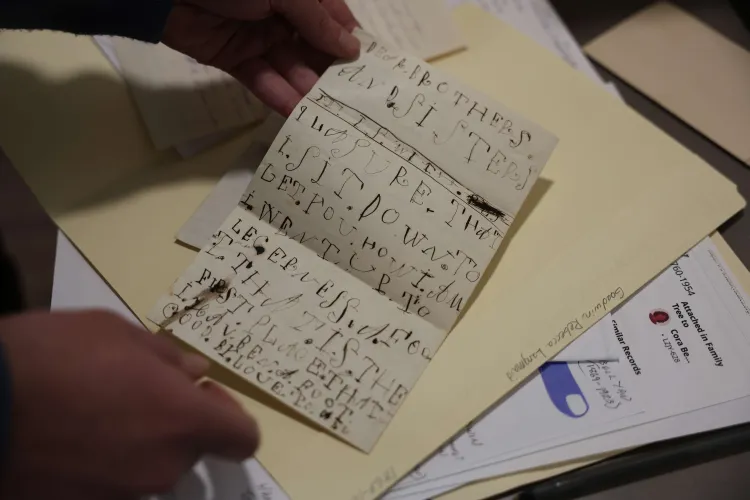
When junior anthropology major Marcellus Walker began exploring a collection of 19th-century family letters in UVM’s Silver Special Collections Library (SSC), he was curious to discover something that felt strikingly relatable: a doodle- and ink splotch-covered letter written by children teasing their mother.
How did Walker come upon such an interesting item? He enrolled in an experiential learning course, Cultural Heritage Community of Practice (CAS 2920F), that placed him as an intern in SSC. One of many offered under the Office of Experiential Learning and Discovery’s Communities of Practice Program, the three-credit course is designed to pair students with internships at museums, archives, libraries and other cultural heritage organizations where they complete 100 hours of work.
Led by UVM Libraries’ Congressional Papers Archivist Erica Donnis, the course provides students with an understanding of the cultural heritage field at large while they simultaneously gain hands-on experience in a specific occupation.
Students from Donnis’s class are placed at one of ten sites in Chittenden and Franklin counties, including right here at UVM. Alongside Walker, sophomore political science major Holly Richardson is working in SSC with a team of congressional papers archivists (including Donnis) organizing Senator Patrick Leahy’s papers.
In addition to working in Special Collections, students are interning for the Community News Services and the Vermont Monuments Project on campus, the Vermont Historical Society, Shelburne Museum, Birds of Vermont Museum, Roman Catholic Diocese of Burlington, Saint Albans Museum, Vermont Arts Council and the Heritage Winooski Mill Museum.
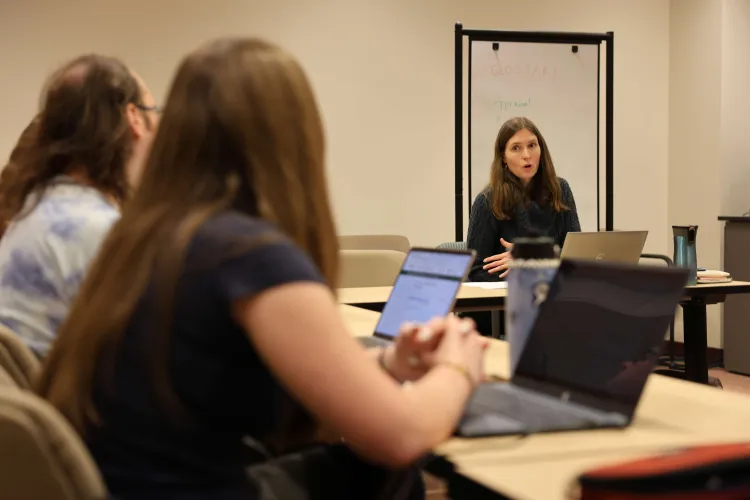
"This course is a great opportunity for undergraduate students to explore their career interests, gain some valuable experience, and build their resumes,” said Donnis. “In class, we discuss some of the big-picture themes and issues impacting the cultural heritage sector at large. In their internships, students complete research, education, cataloging, preservation, and communications projects of real benefit to local partners.”
Archiving Vermont’s history
While flipping through a box stuffed with documents from the Langmaid Family Papers, a collection containing around 100- 200 letters passed between the Vermont-native Langmaid family during the 19th century, Walker paused to consult his inventory of the collection before pulling a small piece of yellowed paper out of the box.
Walker explained that the letter, filled with large looping handwriting, was written by unidentified children who were mocking a note their mother wrote to them. The near-identical language in both letters is what drew Walker to this conclusion. The mother’s letter said, “Dear children, it is with pleasure that I myself seat to pen a few lines to let you know that we are well...” and the children responded: “Dear brothers and sisters, it is with [...]-sure that I sit down to let you know how I am...”
At his internship, Walker uses clues to investigate the structure of the family such as signatures, how the letters are addressed, and mentions of relationships. Using these observations alongside resources available to him through the Libraries, such as Ancestry.com, Walker has been building a Langmaid family tree.
“The majority of people in history are not born into royalty, so this collection is a look into the average, everyday life of Vermonters at this time,” he said. Pointing to ink splotches at the bottom of the children’s letter, Walker added, “that’s human; it’s relatable.”
As he continues his internship this semester, Walker’s understanding of the cultural heritage field continues to grow and contextualize his work. Weekly class discussions center around issues faced in the field such as accessibility, preservation best practices, funding, artificial intelligence and more.
Sophia Trigg, director of the Office of Experiential Learning and Discovery, said that experiential learning opportunities like Walker’s are crucial for gaining hands-on experience with the support of a professor and peers.
“A student’s major does not equal their career; they are a portfolio of skills and experiences,” she added. “We are interested in providing students with various broad experiences that help them collect skills while at UVM so they have a range of career paths to choose from after graduation.”
Ultimately, Walker’s work will contribute to what is known in the archival world as a “finding aid” or a webpage where patrons can explore all that a collection has to offer. Until then, Walker continues to develop the far-reaching Langmaid family tree, which includes individuals from Cabot, Peacham, Plainfield, Marshfield and more, while diving deep into Vermont’s rich history.