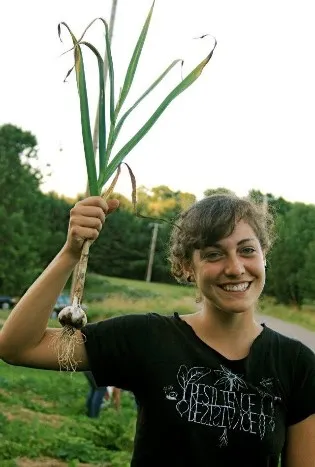
Hometown: Mendon, MA
Educational Background: BS in Global Studies with a minor in Food Systems from UVM
How did you learn about the Food Systems program and what made you interested in applying? I met my current advisor, Dr Teresa Mares while in my undergrad at UVM. She supervised an independent study where I worked with migrant farm workers on dairy farms, facilitating the planting of kitchen gardens. I spent one semester in the independent study, but I was immediately hooked. It has now been four years that I have co-coordinated the project, now known as Huertas. I applied for the masters program to gain a new understanding and depth into the dynamics that I was seeing through Huertas and to continue working with Dr Mares.
Tell us more about your educational background and your interests. My undergraduate program, Global Studies, was interdisciplinary, allowing me to take courses across departments and schools at UVM. This holistic approach to comprehension and problem solving resonated with me. While I was studying rather large, abstract concepts, a minor in Food Systems, the fledgling program that began around the same time as this masters program, allowed me to ground these concepts in something a bit more tangible- food. As my passion for learning, asking better questions, and listening developed through my studies, I found that I was the most fulfilled when my studies were balanced with hands-on projects. Over the past four years, those have mostly taken place in community-based garden projects.
How has your educational background and experience prepared you for studying food systems? I think that the Master’s program is a fluid continuation of the concepts and things I was seeing in my undergrad at UVM. The master’s program is transdisciplinary, which I feel my interdisciplinary background prepared me for. The self-motivation and direction in my undergrad were helpful in preparing me for this Food Systems program.
Many people ask about the master’s program and if I have any recommendations about looking for a good program. The two things that I always say are (1) that I am so glad that I took time between my undergraduate and my graduate and (2) find an advisor who you want to work with. I think that, for me, to get the most out of this program, having spent two years in hands-on projects was really important. It humbled me and gave me a perspective that I could not have gained from academia, and which enriched the experience of returning to school.
What are your future career goals?
I would like to see two garden projects that I am working on in Vermont take root and continue autonomously. I am trying to set them up now so that they will be able to function and continue if I am no longer involved.
I am interested in going to Mexico to do research on the other end of circular migration. Through Huertas I have met a lot of farm workers from Mexico, and I would be very interested to go and meet their families and better understand the reasons that people leave there communities to seek work in Vermont and the US.
Ultimately, I am interested in education and teaching a balanced hands-on and theoretical food systems curriculum, either at the high school or college level.
Have you learned anything in particular, since entering the program that has surprised you?
I have been most surprised by how much time it takes to create, conduct and write up a research project. I thought that it would be easier because I was coming into this program with a pretty good sense of what I wanted to do. However, the process of developing a project and grasping the research methods, particularly in a transdisciplinary program, is a bit overwhelming and humbling. I have grown to deeply appreciate the academic process and the university as a space for creating knowledge in a way that I did not fully grasp as an undergraduate.
Please leave us with a fun fact about yourself.
My middle name is Brianne which is a combination of my mother and father’s names, Anne & Brian.