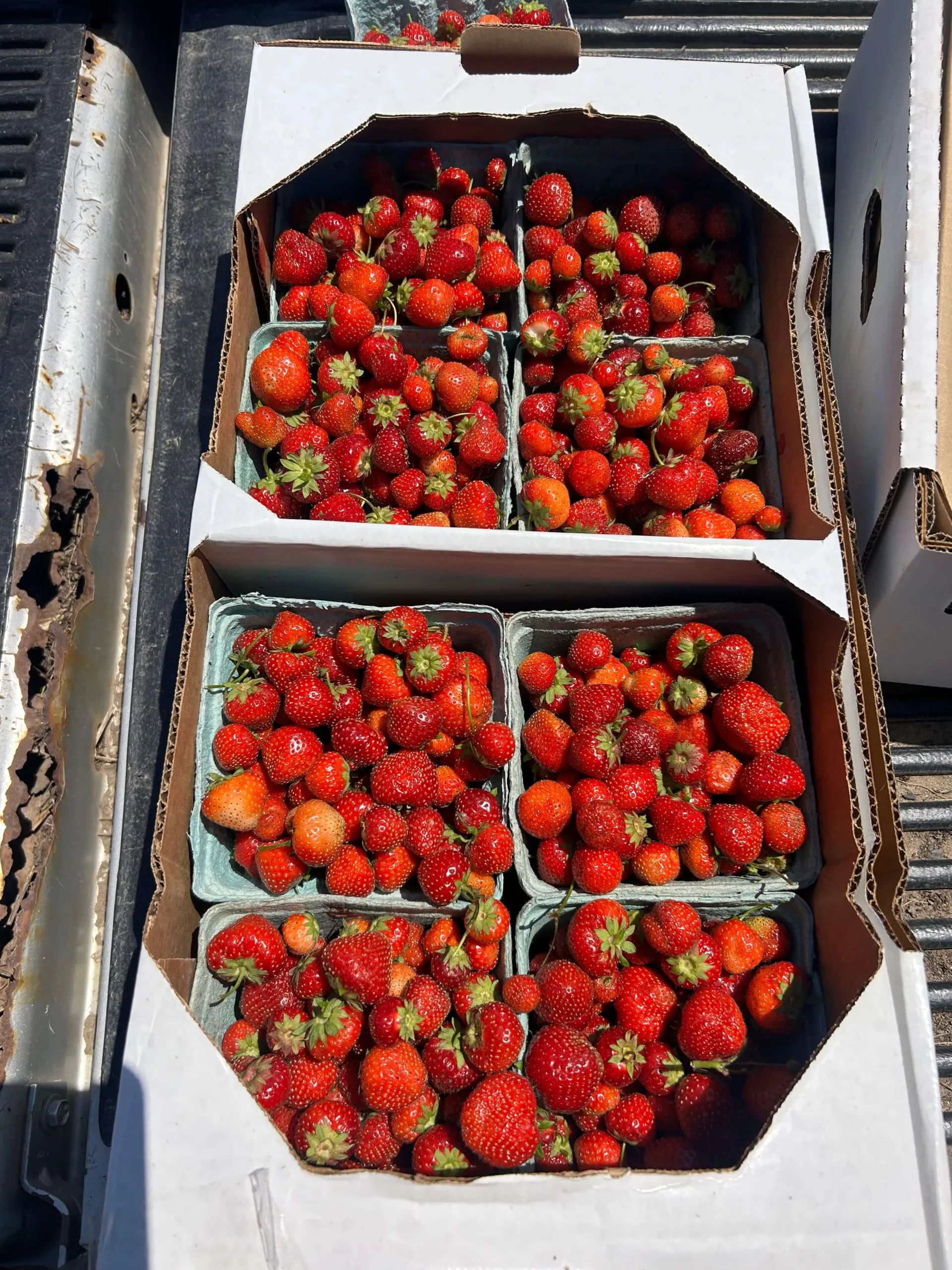
In 2025, the UVM Extension Northwest Crops & Soils program began conducting the Managing Disease in Organic Strawberry Production project supported by the Vermont Agency of Agriculture, Food and Markets, Specialty Crop Block Grant Program, project award no. 02200-SCBGP-21-02. Throughout the 2025 growing season, nine strawberry fields across Vermont and New Hampshire were assessed for crown/root, foliar, and fruit diseases.
Two strawberry varieties were evaluated by a member of the UVM Extension Northwest Crops and Soils Program (NWCS) at each farm. A total of eight varieties were evaluated; “Jewel” was assessed at six of the nine farms (Table 1). Fields varied in management practices (see full report for more details).
Assessments were conducted twice throughout the season, once in May (prior to fruit set) and once in June or July (during harvest).
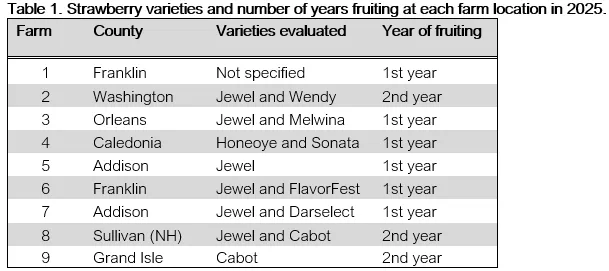
In May, the incidence (presence or absence) of foliar disease was recorded on 100 plants per variety. A total of 1,700 plants were evaluated for foliar fungal pathogens including “Angular Leaf Spot” (Xanthamonas spp.), “Powdery Mildew” (Sphaerotheca spp.), “Leaf Spots” (Mycosphaerella spp.), “Leaf Scorch” (Diplocarpon spp.), “Leaf Blight” (Phomopsis spp.), and abiotic symptoms (i.e. nutrient deficiencies, frost or wind damage, etc.).
At this time 1-5 whole plant samples were collected from each variety to assess the incidence of crown/root disease and winter injury. Sixty-five plants were tested for crown/root diseases including “Black Root Rot Complex”, (Pythium, Rhizoctonia, and Idriella spp.), “Red Stele Root & Crown Rot” (Phytophthora spp.), “Anthracnose Crown Rot” (Colletotrichum spp.), and winter injury. All samples were assessed at the University of Vermont Plant Diagnostic Clinic.
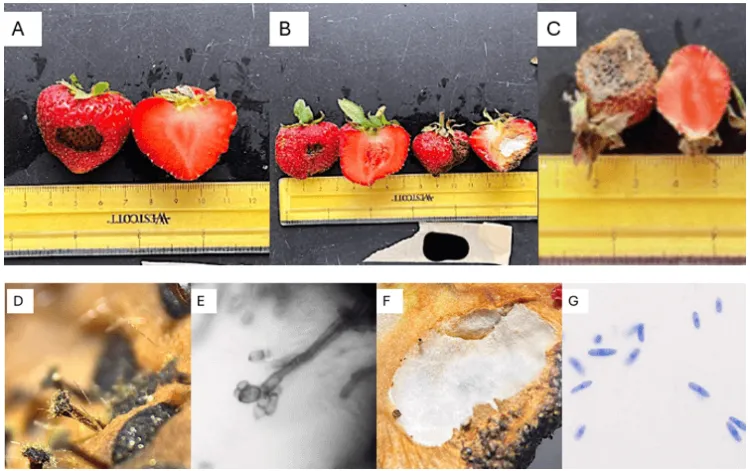
In June and July, fruit assessments were conducted on 100 berries per variety per farm. A total of 1,700 berries were assessed. The fruit assessment evaluated fungal pathogens, insect damage, and abiotic damage (i.e. excess water, hollow centers, and ripeness). The fungal pathogens included “Anthracnose” (Colletotrichum spp.), Botrytis cinerea, and “Leather Rot” (Phytophthora cactorum) (Image 1).
All surveyed farms had multiple foliar and fruit pathogens present in the field. Leaf spot was the most prevalent foliar pathogen observed during scouting with 29.2% of all plants observed showing signs of the pathogen, followed by leaf blight at 2.35%. Botrytis was the most prevalent fruit pathogen, with 4.35% of all berries observed showing symptoms, followed by Anthracnose at 2.94%. Of the 65 strawberry plants examined at the PDC two crown and root diseases stood out. Red Stele Root & Crown Rot was the most prevalent found at 88% of the with farms with 41.5% of the plant samples showing signs. Black Root Rot Complex was found at 77% of the farms with 33.8% of the plant samples showing signs (Table 3).
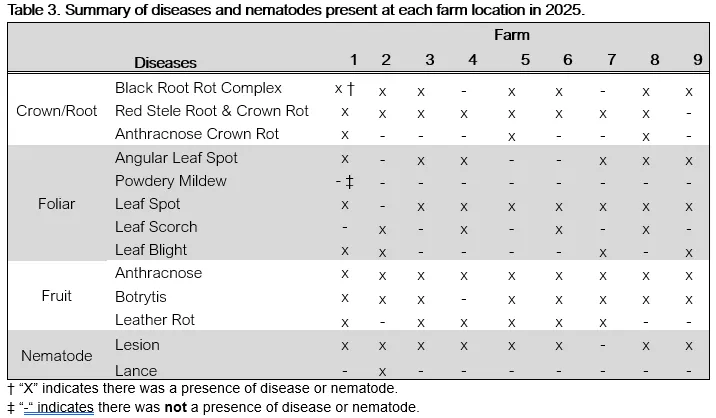
During the June/July scouting date, soil samples were taken from each strawberry field to evaluate the presence of plant-pathogenic nematodes. Twenty, 1x8-inch soil cores were taken around the field near plant roots and sent to the University of Arkansas Nematode Diagnostic Lab for diagnostics. Soil samples were assessed for fifteen different nematode species, but only two species were found, “Lesion” (Pratylenchus spp.) and “Lance” (Hoplolaimus spp.) nematodes. Lesion nematodes were the most common, present on 88% of the farms with an average of 12.3 nematodes per 100 cm3 of soil. Lance nematodes were also present on 11% of the farms with an average of 0.4 nematodes per 100 cm3 of soil. Nematode feeding can make roots vulnerable to pathogenic fungi and bacteria. Studies have found Lesion nematode to be associated with black root rot disease. Currently, management options for nematodes and black root rot are limited. Implementing a 3-5 year crop rotation using cover crops and cash crops, but avoiding crucifers and legumes, could limit pathogen buildup.
For more details, please read the full 2025 On-farm Strawberry Pest and Disease Survey Report.