
Teaching Minute: A SoTL Story
January 23, 2026
This semester, many of our Teaching Minutes will focus on the Scholarship of Teaching and Learning (SoTL) at UVM. In each mailing, we'll highlight a faculty member who presented at the SoTL Symposium—now hosted every spring by the CTL and sponsored by the Office of the Provost—to share their teaching experiments or innovations and what they've learned along the way. Topics will range from our colleagues’ incremental teaching improvements to more formally researched teaching interventions.
At the May 2025 SoTL Symposium, Keith Epstein gave a lightning talk describing a creative and practical approach to managing group work in Capstone Design I and II, a course that spans the year for senior Electrical and Mechanical Engineering majors. With roughly 100 students enrolled, the course is organized around teams of four, with about 25 teams each working on distinct engineering projects across the fall and spring semesters.
While most class time is devoted to team work in various locations, there's a short, all-class meeting each week. Because it’s brief, attendance has historically been—let's just say—a challenge. So, Keith designed a strategy that not only gets students to attend, but also builds in accountability and strengthens the community.
Each week, at the beginning of the all-class gathering, he shares a slide listing five randomly-chosen teams to come to the front of the class that day with each team member responding to one of the prompts shown in this example slide:
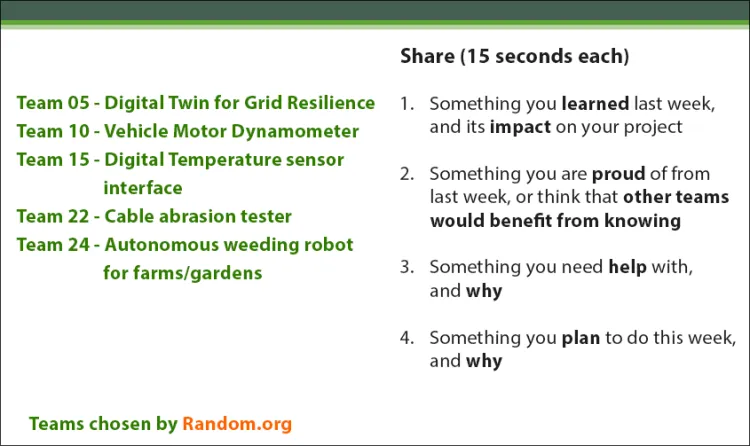
Five randomly selected teams and the prompts they're asked to respond to.
The key is that the teams don’t know in advance whether they’ll be called to present their team updates that day, and this randomness incentivizes students to arrive both on time and prepared. After each team presents, they take up to three questions from their peers.
Beyond the initial purpose of boosting attendance, Keith notes other benefits:
- Students develop a metacognitive awareness of their team's process—what's working, what they're learning from, and where they need support
- There's a new component of peer-to-peer learning through questions and explanation of their problems and solutions
- Students learn about all the team projects, rather than having a laser focus only on their own
- Students get regular public speaking practice within a supportive environment
- It helps everyone learn each other’s names, strengthening the class community
You can learn more about the Scholarship of Teaching and Learning on our website, including info on our Spring '26 SoTL working group.
Warmly,
The Center for Teaching & Learning
www.uvm.edu/ctl
ctl@uvm.edu