|
 |
|
|
INTERDISCIPLINARY SEMINAR: MODERNISM IN AMERICAN ARCHITECTURAL HISTORY; HISTORIC CULTURAL LANDSCAPES;
& ADVOCACY THROUGH COMMUNITY PRESERVATION PROJECTS
SYLLABUS AND PR0JECT GUIDELINES COURSE DESCRIPTION.
This third-semester course is designed to encourage students to become advocates for historic preservation and to be cognizant of the need for an interdisciplinary approach to that advocacy. It follows, in logical sequence, courses offered during the first and second semesters. Introductory courses, History on the Land, History of American Architecture, Historic Preservation Law, and Researching Historic Structures and Sites, were intended to provide a broad view. Those courses, in turn, were followed by seminars that offered much closer inspection of preservation tools and best practices (Contemporary Preservation Policy and Planning, Historic Preservation Practice Methods, and Architectural Conservation. Advocacy is the fundamental activity that separates our discipline from that of general history. In addition to being historians of the built and cultural environments, we are advocates for the preservation of historic resources. We speak for these resources and engage the public in conservation efforts. Thus, the course's principal project assignment will involve the development of community preservation projects for non-profit and public-sector organizations or agencies, serving as advocates for the resources in question and in some way benefiting such organizations and agencies. At the same time, preservation advocacy cannot function in isolation of other worthy concerns, and the need for an interdisciplinary, humanistic approach to the conservation of resources, natural as well as cultural, is becoming critically important. Thus, classes will advance that interdisciplinary approach. All the while, the course’s substantive content continues to evolve in order to expand the graduate program’s curriculum in essential ways.
The first initiative will emphasize Modernism in American architectural history, with special focus on Mid-Century Modern (MCM) residential architecture, supplementing the topic of “Surveys of Historic Sites and Structures offered in the spring seminar, Historic Preservation Practice Methods. We will begin with a discussion of International architecture as it developed first in Europe and then in America, followed by the introduction of trends in commercial and residential architecture both prior to and after World War II. Knowledge of those trends is already essential in the context of regulatory review under Section 106, and is a crucial component of practice skills. In addition, Vermont’s State Historic Preservation Office has begun to consider individual and district nominations to the National Register of Historic Places for MCM buildings and neighborhoods. We will be relying heavily on Virginia McAlester’s most recent edition of A Field Guide to American Houses, and will point to stylistic trends that continue into the 21st century. Readings from a second source, Ranch House, by Alan Hess and Noah Sheldon also will be used.
The second segment will reinforce an interdisciplinary approach to preservation advocacy, and will continue to emphasize the reading of history on the land begun in HP201, but will do so in greater depth with focus on historic cultural landscapes. Toward that end, we will investigate two seemingly opposing aspects of land shape: forested landscapes and heavy industry. Having anchored those two poles in an environmental spectrum, we will explore middle ground in the hope of spanning the considerable divide between cultural and natural resource protection in this country. At key junctures, we will again underscore to the important relationship between history and art in the interpretation of landscapes, and will also point to the Society for Industrial Archeology, the country's principal organization devoted to understanding and preserving the nation's industrial heritage.
The recent flooding in Montpelier and Barre has also offered opportunities to study best practices for responding to natural disasters in the context of historic buildings, downtowns, neighborhoods, and village centers. We will spend one class session in Montpelier, survey one or more historic buildings damaged by the flood, tour the downtown area, and meet with local and state officials.
READINGS. With such goals in mind, the following required readings have been selected. The books by Garn, Hess, Stilgoe, and Wessels should be available from the internet but also will be on Wheeler House reserve. Copies of the Cronon and Sauer articles, National Register Bulletin 18, National Register Bulletin 30; Guidelines for Treatment of Cultural Landscapes, and other National Park Service publications will be distributed. I have also added a short book, Stations. An Imagined Journey, by artist and writer Michael Flanagan, which will reinforce the important relationships between cultural landscape history and landscape art. That book is available through the internet but is optional. If you have not already purchased the revised edition of A Field Guide to American Houses, please do so.
PROJECT BIBLIOGRAPHY. In addition to the assigned readings, students will be asked to select two primary or secondary sources related to their individual projects and should include summaries of those sources in final presentations.
1. Ames, David L., and Linda Flint McClelland, “House and Yard,” in Historic Residential Suburbs: Guidelines for Evaluation and Documentation for the National Register of Historic Places. Washington, D.C.: U.S. Department of the Interior, National Park Service, 2002. National Register Bulletin
2. Cronon, William. "The Trouble with Wilderness, or Getting Back to the Wrong Nature." Environmental History 1 (January, 1996). Handout
3. Garn, Andrew. Bethlehem Steel. New York: Princeton Architectural Press, 1999.
4. McAlester, Virginia Savage. A Field Guide to American Houses, revised ed. (2013), New York: Alfred A. Knopf, 2013.
5. Sauer, Carl. “Morphology of Landscape,” in University of California Publications in Geography, Vol. 2, No. 2. Berkley, CA: University of California Press, 1925. Handout
6. Stilgoe, John. What is Landscape? Cambridge: MIT Press, 2015
7. Wessels, Tom. Reading the Forested Landscape: A Natural History of New England. Woodstock, Vermont: Countryman Press, 1997.
8. U.S. Department of Interior, National Park Service. "How to Evaluate and Nominate Historic Designed Landscapes." National Register Bulletin 18.
9. U.S. Department of Interior, National Park Service. "Guidelines for Evaluating and Documenting Rural Historic Landscapes." National Register Bulletin 30.
10. U.S. Department of Interior, National Park Service. "Guidelines for Identifying, and Registering Historic Mining Properties.” National Register Bulletin 42.
11. U.S. Department of Interior, National Park Service. The Secretary of the Interior's Standards for the Treatment of Historic Properties with Guidelines for the Treatment of Cultural Landscapes. Charles Birnbaum and Christine Peters, eds. Washington, G.P.O., 1996.
12. U.S. Department of the Interior, National Park Service. Preservation Brief 36: Protecting Cultural Landscapes: Planning, Treatment and Management of Historic Landscapes.
13. U.S. Department of the Interior, National Park Service, National Register of Historic Places Multiple Property Documentation: Historic Resources of the Mad River Valley.
SUPPLEMENTAL READINGS
1. Hess, Alan, and Noah Sheldon, Ranch House. New York: H. N. Abrams, 2004.
2. Michael Flanagan. Stations. An Imagined Journey. New York: Pantheon Book, 1994.
3. Theodore H. M. Prudon, Preservation of Modern Architecture (Hoboken, NJ: John Wiley & Sons, Inc., 2008).
SCHEDULE OF CLASS MEETINGS.
Class meetings are assigned to a three-hour segment on Mondays between 12:00 and 3:00 P.M. Class sessions will be conducted in Wheeler 101, but we will also meet in Montpelier, walk through neighborhoods dominated by MCM architecture, and will also hold one class session at UVM’s Jericho Research Forest, possibly with Cecilia Danks or Walter Poleman from the Rubenstein School of Environment and Natural Resources.
PROJECTS. In addition to class presentations, the course is designed to give students sufficient freedom to develop individual or team projects. A portfolio of potential projects will be distributed, and students are free to choose any project, either individually or working as a team. Students may also develop their own projects, subject to approval. Students will be expected to coordinate activities with sponsoring agencies or organizations, conduct research, and engage in field study.
Part 1: Architectural Modernism
1. Monday, August 28th.
12:00 to 1:30. Class Introduction. Course summary and description of project portfolio. Review of National Register Nomination for Lincoln Hall. Project selection.
1:45 to 3:00. International Style. The development of European modernism, and the contributions of Peter Behrens, Walter Gropius, Adolf Meyer, Le Corbusier, Ludwig Mies van der Rohe, and Gerrit Reitveld.
Readings: McAlester, 616-627.
2. Friday, September 2nd. Project Selection. Everyone should have selected topics by this date and should provide confirmation of that selection to me by e-mail.
3. Monday, September 4th. Labor Day. No Class
4. Monday, September 11th. Travel to Montpelier to inspect flood damage, discuss best practices for remediating flood damage in historic buildings, flood-proofing mechanical systems, crafting building regulations.
5. Monday, September 18th.
12:00 to 12:30. Project Review. Provide brief sketches of your projects, discussing methodology, research, development of project statements, selection of bibliography, and resolution of any concerns.
12:30 to 1:30. Mid-Century Modern Architecture: Evolution of the Tall Building; and
the creative synthesis of Louis Kahn.
1:45 to 3:00. Mid-Century Modern Residential Architecture: Banker’s Modern: Minimal Traditional (1935 – 1950s); Banker’s Modern: Ranch (1935 – 1975); Banker’s Modern: Split-Level (1935 – 1975). Mainstream Modern: International (1925 – Present); Mainstream Modern: Contemporary (1945 – 1990).
Readings: McAlester, 586-594; 595-611; 612-615; 628-647.
6. Monday, September 25th.
1:15 to 2:30. Residential Architecture: Mainstream Modern: Shed (1965 – 1990); Mainstream Modern: Other 20th- Century Modern: Organic (1950s – Present); A-Frame (1950s – 1970s); New Formalism (1950s - 1970s); Brutalism (1950s – 1970s); Post-Modern (1960 – Present); Deconstructivism (1980s – Present); 21st-Century Modern.
2:45 to 4:15. Mid-Century Modern Architecture: Historic Sites and Structures Surveys. Surveys of Burlington mid-century modern neighborhoods.
Readings: McAlester, 648-772. David L. Ames and Linda Flint McClelland, “House and Yard,” in Historic Residential Suburbs: Guidelines for Evaluation and Documentation for the National Register of Historic Places. Washington, D.C.: U.S. Department of the Interior, National Park Service, 2002. National Register Bulletin. Hess and Sheldon, Ranch House, read for reference.
Part 2: Interdisciplinary Study of Historic Cultural Landscapes
7. Monday, October 2nd 12:00 to 3:00. Field Study: Jericho Research Forest, Jericho VT. Class discussion will focus on the documentation and interpretation of cultural and natural resources in UVM's research forest, formerly an early 19th century farmstead. We'll have a chance to read the forested landscape first hand and will be joined by from the Rubenstein School of Environment and Natural Resources. Readings: Wessels, Reading the Forested Landscape, Chapters 1-8; and National Park Service: National Register Bulletin 30. Stilgoe, What Is Landscape?, Preface, Introduction, and Chapter 1.
8. Monday, October 9th.
12:00 to 1:30: Mid-term project presentations.
1:45 to 3:00: A Trail Head to Interdisciplinary Landscape Study. Presentation will focus on the fifty-year friendship of conservationist Benton MacKaye and architect Clarence Stein, America's 21st century kindred spirits in environmental humanism. Their model sets the stage for using landscapes as meeting grounds where a broad range of human concerns such as housing, urban blight, population, transportation, community, ecology and environmental justice can be confronted through local and regional planning.
Readings: Project bibliography. Cronon, "The Trouble with Wilderness;” Sauer, “The Morphology of Landscape.”
9. Monday, October 16th 12:00 to 1:30 and 1:45 to 3:00. Cultural Landscapes. Discussion will focus on the structure and criteria developed by the National Park Service to evaluate historic cultural landscapes, representing four distinct types: historic sites, historic designed landscapes, historic rural or vernacular landscapes, and ethnographic landscapes. This structure will provide a benchmark for consideration of many of the landscapes to be considered throughout the course. Readings: Stilgoe, What Is Landscape?, Chapters 2-5; National Park Service, National Register Bulletin 30; National Park Service: Guidelines for the Treatment of Cultural Landscapes, 1-54; National Park Service, National Register of Historic Places Multiple Property Documentation: Historic Resources of the Mad River Valley; National Park Service, Preservation Brief 36.
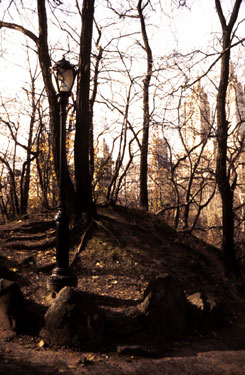
10. Monday, October 23rd. Management of Historic Designed Landscapes. Discussion will focus on the 1982 Restoration and Management Plan for New York City’s Central Park, a model plan for the survey, assessment, and interpretation of one of the country’s most important designed landscapes. The discussion will also provide a detailed analysis of the park’s historic and existing landscape features. Readings: National Park Service: Guidelines for the Treatment of Cultural Landscapes, 55-148; National Park Service, National Register Bulletin 18. Stilgoe, What Is Landscape, Chapters 6-9.
11. Monday, October 30th. 12:00 to 1:30 and 1:45 to 3:00. Vermont's Historic Bridge Program. Topics will include a history of the program, the preservation plans that have been developed for bridge types, including metal truss bridges and covered bridges, and case studies of successful (or not so successful) projects, all in the context of bridges as important features of our cultural landscapes, as revealed by artists, photographers, and historians. Readings: Preservation plans for timber framed, metal truss, reinforced concrete arch, and masonry arch bridges, developed by the Vermont Historic Bridge Program, will be distributed.
12. Monday, November 6th. 12:00 to 1:30 and 1:45 to 3:00. Steel Manufacturing in America. Part 1 and Part 2. Part 1 presentation will focus on two aspects of steel manufacturing: (1) converting pig iron into steel through the Bessemer, open hearth, crucible, electric furnace, and basic oxygen methods; and (2) the evolving technology of blast furnaces and steel manufacturing. Part 2 will focus on the numerous features of the built environment requisite to the vertically integrated manufacture of steel, including transport and movement of ores and coal; ore beneficiation; by-product coking plants; blooming and various rolling mills, and the evolving technology associated with these mills and their rolling machines; treatment of finished products such as porcelain enameled steel and galvanized steel; seamless tubing; forging; power systems; blowing engines; dry air blast; steel monopoly; and company towns. Time permitting. Readings: Garn, Bethlehem Steel, pages 3-47; 1-107.
13. Monday, November 13th. 12:00 to 1:30. Project Presentations 1:45 to 3:00. Refining Fossil Fuels. The Influence of the Oil Industry on America’s Cultural Landscapes – Part 1. Presentation will continue the focus on heavy industry but will shift to the mining and refining of fossil fuels, and the subsidiary industries that have developed in relation to this aspect of American manufacturing.
14. Monday, November 20th. Thanksgiving Recess – No Class
15. Monday, December 4th.
12:00 to 1:30 and 1:45 to 3:00. Gas Stations. The Influence of the Oil Industry on America’s Roadside Cultural Landscapes. Presentation will focus on the very visible part of the roadside built environment related to motorized transportation dependent on fossil fuels, e.g. the automobile. The history and evolution of American gas stations as a unique architectural type will be considered, as will the numerous contributions of this building form to other aspects of roadside commerce.
16. Monday, December 11th. Final Presentations. 10:30 to 1:15
(Subject to alternate date and time).
COURSE STRUCTURE CLASS PRESENTATIONS. Final class presentations will be scheduled in lieu of a final examination, and students are encouraged to consider these as rehearsals for presentations to be given to project sponsors, if possible. The materials you discuss should be organized into thirty-minute segments, including ten minutes allotted for questions and discussion.
COMMUNITY PRESERVATION PROJECT ASSIGNMENT. Students will be asked to select an area of special interest and apply appropriate preservation tools and policies toward completion of a project that advances the cause of historic preservation for a non-profit organization or public agency, or in some way advances the cause of community preservation. Five principles are fundamental to the structure of this course. 1. Students should be given an opportunity to explore areas of individual interest in great depth. Select projects that interest you or involve subjects that you hope to pursue in your preservation career. 2. Students should try, in some respect, to incorporate public advocacy for preservation into each project. 3. Students will work directly with non-profit or public agency sponsors to define and execute these projects. Your role is as a private consultant engaged by that organization, and the project is to be defined by mutual agreement. The form of the final product must satisfy your professional standards as well as those of your sponsor 4. Completed projects should be substantial enough to add to student portfolios. 5. Finally, students may develop these projects individually or in small teams. Projects will be evaluated by sponsors and by course instructors and will be measured against criteria that expand these fundamental principles.
PROJECT GUIDELINES. Students will be responsible for all aspects of project development, and the following guidelines should be observed. Project Selection. Projects may be selected from the attached list, and students should consider projects that can be linked to their desired areas of practice. Students should also consider the nature or mission of the sponsoring organization, again as a way to explore in greater depth the type of work conducted by that organization. One of the course's goals is to assist students faced with making career choices. Using a template provided, students should prepare written proposals for desired projects and meet with the course instructors to confirm any selection. Students may also develop their own project or projects, subject to approval from the course instructor. Bibliography. Each student, working with course instructors, will develop a bibliography of readings for their respective projects. Readings should be selected to expand students' knowledge in areas of practice relevant to the project. Comprehensive summaries of at least two readings must be included in the final class presentations, a means to share that knowledge with the entire class. Individual or Team Projects. Students should weigh the respective merits and hardships of individual and team projects. Generally, the scope of team projects will be larger or more complex, and the final product may have more far-reaching influence. In addition, the experience gained from working as part of a team can be valuable. However, students who select team projects will be collectively (jointly and severally) responsible for all aspects of the work. Evaluations by the course instructors and project sponsors will focus on the product itself, not the separate contributions of individual students. A single grade will be given for the project, and that same grade will be given to each participating student, regardless of the quality or extent of work performed by individual students. Be forewarned. This rule can create inequitable results. Thus, it is important for students to form partnerships with colleagues whose skills, work habits, and interests are compatible. Once a partner has been selected and a project started, it may not be possible to change to another project and meet the required deadlines. Team projects also require additional time for planning and coordinating work assignments. Individual projects, although usually narrower in scope, nevertheless provide students with an opportunity to select topics that are of particular interest and to explore those topics in greater depth. Students may also have the opportunity to work more closely with project sponsors. Finally, students may be better able to organize their time to fit complicated work schedules. Project Statement. Once a project has been selected, students may develop a simple project statement that describes the final product, explains the expected work performance of each participating party (including project sponsors), assigns responsibility for specific tasks, and includes a schedule for project completion. That schedule should incorporate the deadlines identified by these guidelines. The project statement should be signed by each student and by the project sponsor. Copies of that signed project statement should be submitted to project sponsors and to the course instructors. The project statement should also identify the expected costs, if any, and explain the method of reimbursement. Public Advocacy and Presentations. One of the course's fundamental principles is that the project must in some manner advance the cause of historic preservation. Put another way, students must add to public awareness about the contributions of historic preservation. Different projects can accomplish this in different ways, and students should work with sponsors and the course instructors to create an appropriate strategy. If possible, students are encouraged to devise a public presentation and will be given extra credit for that effort. Class Presentations. Each student will be asked, individually or as part of a team, to present his or her project to the entire class. Presentations will outline project participants, content, direction, and objectives and will identify the key readings selected and will be an opportunity to rehearse for public presentations. In addition, a more detailed summary of readings will be required. Travel. Some of the projects offered will require travel, and students should consider the complexities of transportation when making a selection. Travel will increase the overall time required to complete a project, and coordination with project-sponsors may be more difficult as well. Anticipating and planning for work to be accomplished at a distant site may also be troublesome. Nevertheless, a course with a broad geographical reach will expose students to a greater variety of topics, which in turn will offer more opportunities for individual exploration. Moreover, students will be given a better understanding of the many regional organizations that are working in the field of historic preservation. The projects, too, may serve as very personal introductions to specific areas of practice and become part of student portfolios. In addition, many of the projects have been designed to allow students to complete work it convenient locations. Project Sponsors. Project sponsors will serve as students' clients and will be responsible for defining and evaluating projects. An evaluation form will be distributed to all sponsors, and that form will provide guidelines for review. Criteria include (but are not limited to) accuracy of content, writing, organization or format, quality of visual materials, communication skills, and presentation style. Course instructors will rely heavily on these evaluations in assigning project grades. It is crucial for students to establish clear communication with project sponsors at the outset and to define very precisely the sponsor's expectations. These should be incorporated into the written project statement. If miscommunication occurs or if questions develop, stop work immediately and resolve those questions. Delay can be costly. Course Instructors. In most cases, the content of projects will be determined by project sponsors, and the course instructor may have only limited discretion to revise that content. In addition, the breadth (or narrowness) of certain topics may make review difficult for the course instructor. In such instances, students must again rely on project sponsors for essential critique. However, the course instructors will be available for general guidance and will evaluate projects using the same criteria given to project sponsors Written Materials. Students are solely responsible for producing clearly written, well organized, and carefully edited documents. Poorly written or poorly edited materials will be returned to students without comment and without extension of any deadlines. Careful editing requires time, and students should complete documents well in advance of deadlines in order to devote several days to the editing process. If you lack confidence in your writing skills, it is your responsibility to seek assistance from course instructors or a professional editor early in the semester. Final review of documents by course instructors and project sponsors should focus on substantive content, and this is very difficult to do if documents are poorly written. If documents are to be placed in public circulation, students should schedule additional time for copy-editing, a normal part of the publication process.
PROJECT DEADLINES. Students will be responsible for meeting the course deadlines. If deadlines are missed, it may not be possible for project sponsors and course instructors to complete their reviews in time for students to graduate.
Friday, September 1st. Projects should be selected and draft project statements should be ready for signature by project sponsors. A copy of the executed project statement should then be submitted to the course instructor.
Monday, October 2nd. Seventy-five percent of project research should be completed.
Monday, October 23rd. All project research should be completed and fifty-percent of written components should be completed.
Friday, November 17th. Projects are due for submission to course instructor. Any written materials to be included as part of any project must be fully edited for content, grammar, and syntax. Poorly edited documents will be returned for resubmission, but project schedules will not be extended. Projects will be reviewed and returned for necessary corrections.
Friday, December 8th. Revised documents should be resubmitted to project sponsors and the course instructor.