| • DISCUSS: Indicators are short term measures of
achievement with respect to specific Outcomes.
Indicators for the examples given in the previous
exercise are as follows:
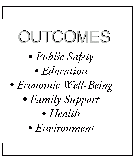
(1) Public Safety - lower index in crime rate and
increased youth participation in out-of-school
programs.
(2) Education - an increase in student skill levels
and literacy rates.
(3) Economic Well-being - an increase in personal
income, employment rate increases and contained
costs.
(4) Family Support - civic and occupational partici-pation,
family participation in intergenerational support.
(5) Health - improved live birth rates, lower alcohol
and drug rates, and numbers of people receiving
prenatal care.
(6) Environment - air quality, land use policy,
transportation services and available housing.
• DISCUSS: "Benchmarks" is a term being used widely
these days regarding standards for measuring
progress and performance in areas such as economic
development, school dropout rates, crime, teen
pregnancy, adult literacy, children living above the
poverty line, and air quality standards. States as
diverse as Mississippi, Texas and Oregon are em-bracing
the idea of benchmarks to help shift away
from the old-style line-item budgeting measuring
inputs or what the state is currently spending on
programs, to a budgeting system that measure
outcomes or the effect of their spending.
Benchmarks focus on results and as such are getting
a lot of attention. The idea is catching on at the
local level, too. Municipal governments, private
business, and non-profit agencies see benchmarking
as a way of measuring whether or not they're
reaching their goals.
Remember there are risks, which we discussed in
the last section, Developing Outcome Indiators:
some activities defy precise gauging and may be
long-term in nature. Oftentimes we don't know the
precise relationship between our intervention
strategies and what is actually going on in the "real"
world (We know how to boost childhood immunization
rates, but the connection between our activities
and child abuse prevention is not nearly as
clear.) Any system based on statistical accountability
tempts agency heads to skew their numbers or pick
those numbers which are most flattering.
Given these caveats, "benchmarks" are here to stay,
and are tied intrinsically to any discussion surrounding
outcomes. Try to check the availability of data
sources for the area in which your collaboration
training is taking place, so that you have some
specific examples of easily obtained measurable
standards to help steer the collaboration as it develops
Outcome Indicators.
• ACTIVITY: (1) Break into small groups as the group
did for Identifying Outcomes, (2) Incorporate the
identification of Indicators with Identifying Outcomes
and have the group work on them at the
same time, (3) Have participants individually
develop indicators for one or more outcomes, write
them on colored sticky notes and place them on the
flip charts of prioritized Outcomes.
|