Training Manual Menu |  | Main Menu |
Training Manual Menu | | Main Menu |
| understanding collaborations |  173 KB |
|
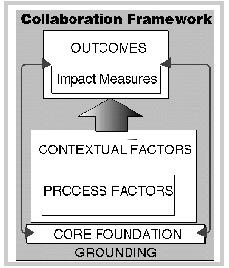
Unit 1 focus an overview of all 5 elements in the Collaboration Framework: grounding, core foundation, process factors, contextual factors, and outcomes |
|
 |
• What Collaboration Means. |
| • How Collaborations Fit Within Changing Community Conditions. | |
| • Planning For Change. | |
| • How Change Comes About. | |
| • Beliefs About Change. | |
| • Using The Framework for Collaborative Efforts. | |
| • Understanding Collaborative Goals. | |
Time: |
45 minutes to 4 hours depending upon the number of people, the level of current knowledge, and the manner of facilitation. |
Audience: |
10-50 interested people. |
Equipment: |
Overhead projector, paper, pencils, flip chart, felt pens, tape, push pins, sticky dots. |
| • ACTIVITY: Divide into small groups (or not). Ask participants to share their experiences in response to the above discussion points. |
 |
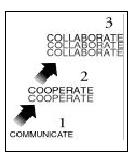
• EXAMPLE: In the case scenario, three people began communicating over coffee about issues that disturbed them. Their behavior changed from communication to cooperation around the time they could say a group had formed to study the issue. By the time 11 agencies delineated portions of their budgets for teen pregnancy programming, they had effectively collaborated. |
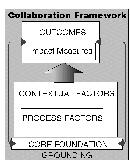 |
• DISCUSS: Time and the Framework. The time involved in successful collaborations and the role of the Framework in helping collaborative efforts. Successful collaborations may take years, perhaps decades. Time is a critical element needed to build the relationships necessary for all partners to come to a shared vision. Further time is also essential in defining tasks, developing roles and responsibilities, clarifying work plans, evaluating outcomes, and establishing patterns of communication that are positive and respectful. The Framework helps guide collaborative efforts, because it offers a pathway for groups to focus their efforts. It also provides a purpose for interested collaborators to move toward a foundation on which community collaborations can build and experiment. |
| • EXAMPLE: It took three people, in our case scenario, two years to cooperate and another two years to finally collaborate. Collaborations take a tremendous amount of time and energy. |
| • OUTCOMES: To assist the group in identifying current community conditions that enhance or inhibit collaborative efforts. |
| 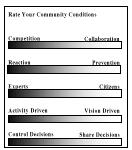 |
• DISCUSS: Changing community conditions. Collaborative efforts are part of new, emerging community conditions. Ideas and values are beginning to shift in communities, sometimes faster in certain areas, sometimes slower. We are seeing conditions move from competition to collaboration, from reaction to prevention, from outside experts to local citizens, from activity driven to vision driven and from controlled decisions to shared decisions. You can see this trend as Congress discusses block grants and thinks about shifting resources from a central federal authority to states and on to local communities. |
| • EXAMPLE: Twenty to thirty years ago Larkin County had a number of mills working at full capacity, with high paying jobs that didn't require a high school diploma. It was commonplace within the community for kids to drop out of school, marry young, and have their own children at early age because there were local jobs to support them. As times and economic factors changed, perceptions and behaviors didn't – mills closed and family wage jobs became scarce. Yet, young people were still dropping out of school and getting pregnant. |
| • ACTIVITY: Participants rate their communities, and discuss their responses. The purpose of this exercise is to help participants get to know their community better, and for them to start thinking realistically about how things currently operate in their community. (1) Have participants individually fill out the handout and pass it in. Before the next session transcribe the responses and present them back to the group, or (2) Divide participants into small groups and have them individually fill out the handout, discuss among themselves and then report back to the group, or (3) Make a large flip chart poster for the wall which accommodates everyone’s response in order to visualize the group overview. Participants may put sticky dots or X's on the chart anonymously, or (4) Develop overheads for individual responses which can be overlaid upon one another to form the group’s response. |
 | • OUTCOMES: To have participants better understand how to plan for change in a community. |
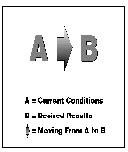 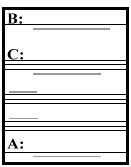 |
• DISCUSS: The idea of change as exemplified by the A-B-C model – (A) Current Conditions, (B) Future Conditions, and (C) Figuring Out How to Get From (A) to (B). Planned change leads to a new condition without the problems or issues of the current condition. There are three basic questions to ask. These need to be discussed at the beginning of the effort to assure successful results: (1 - Condition A): "Where are you now?", (2 - Condition B): "Where do you want to be?", and (3 - Moving from A to B): "How will you get there?" The description of A must be clear so people will understand what is to be changed. Likewise, the description of B must be specific so people will know their goal(s), outcome, or what they are to accomplish. |
| • EXAMPLE: In the case scenario are three phases of change, with the second coming two years after the first, and the third change occurring in the fifth year. Each phase can be broken down using the A-B-C Model. In the first phase A is a widely accepted community norm that girls would have babies before age 17 (research revealed 80% of those girls with children were 2nd generation teen moms). B is to create an understanding and awareness of the impact and responsibility of parenting at an early age (not only to the individual, but to the community - young men and womenwere having babies and interrupting their educations). C targets natural community touch points to raise the issue. In the second phase, in A community agencies and organizations are concerned how to address teen pregnancy, but there is no pattern, history or tradition within existing systems. B equals a change in people's attitudes and behaviors regarding teen pregnancy. And C is a community action plan workshop, formalizing the cooperation and providing a range of services to impact the issue. In the third phase, A assure specific programs and services are in place to support teen moms and dads, and prevention education is provided through traditional schools and related organizations. B is to assure young people will make conscious decisions to postpone parenting until they are self-sufficient, productive, and contributing members of the community. C is parenting education, establishing group norms and behaviors in an open manner, and a range of organizations and individuals defining positive expectations for their young people throughout the community. |
Training Manual Menu | | Main Menu |