Training Manual Menu |  | Main Menu |
how change comes about: (from the "Community Leader's Guide")
 |
• OUTCOMES: To impart an awareness of the five stages in which people adopt new ideas, and the five classifications for how rapidly people move through the process of change. |
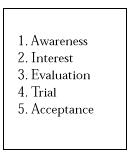 |
• DISCUSS: Change comes about as a result of individuals and groups communicating their ideas to others and coming to agreement that the change is indeed needed. Research by social scientists suggests that new ideas are diffused and adopted through a somewhat orderly process of five stages. (1) Awareness, or when people first hear of the new idea. (2) Interest, the earliest step in accepting the new idea. This happens when someone starts to think about what they heard or read and ask themselves, "how will it affect me?" (3) Evaluation, when a person considers accepting the idea and perhaps thinks of alternative actions. (4) Trial, when the individual or group researches how others have dealt with the problem before and begins involving others. (5) Acceptance, when the new idea is accepted and new behavior occurs. |
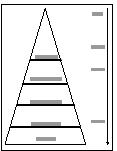 |
Not everyone moves through the process of change at the same rate. Research has also shown there are five different classifications for how rapidly persons move through the change process: Innovators, Early Adopters, Early Majority, Late Majority and Lag-gards. |
| An INNOVATOR (2.5% of the population & venturesome) is the first individual to accept a new idea, and the highest risk taker of the five groups. Generally, this person(s) takes too great a risk to be
locally accepted. They are generally highly educated, may be younger than the rest of the group, and usually participate more widely in organized groups. EARLY ADOPTER (13.5% of the population & respected) also are generally younger people or newer groups with more formal education than the remaining three groups. They tend to "reason out" which alternative new idea is best. Even at this stage, the risk may be too great for early adopters to be locally accepted. This group often has democratic leadership, and is active in community affairs. The EARLY MAJORITY (34% of the population & deliberate) consists of individuals who follow the early adopters, and often looked to as the real leaders. Education and the socioeconomic level tends to be somewhat less, and the average age is somewhat older. They rarely participate at state or national levels. LATE MAJORITY (34% of the population & skeptical) individuals wait until almost all the risk is eliminated before trying a new idea. There is less participation for this group in community affairs and therefore their exposure to new ideas is less. This is the largest grouping in terms of numbers except for the laggards. LAGGARDS (16% of the population & traditional) strongly resist change, generally has the lowest formal educational and socioeconomic levels of all groups, are usually the oldest. This group reminds us that there are some people who will always oppose change. Never expect full support in your community. • EXAMPLE: In Larkin County the Innovators were the three people having coffee who first discussed the issue. Early Adopters were the first folks who listened to them and together with the Early Majority formed the first group to actually study the problem. This took two years. The Late Majority came on board about the time that community action planning formed large public forums and Laggards adopted the change after the issue had become commonplace within the community and the collaboration had already developed many positive success stories. • ACTIVITY: After discussing these ideas, ask partici-pants to discuss where they see themselves as a group right now. Where do you fit? Does your fit depend on the issues at hand? Where does your group fit? What individuals and groups in your community belong in which category? Whose support do you need to seek during the first year? Second year? |
beliefs about change: (from the "Community Leader's Guide")
| • OUTCOMES: To assist the group in identifying how they feel about change by thinking about their beliefs. |
 |
• ACTIVITY: Have participants begin to understand how they feel about change by filling out a rating sheet and discussing their responses. "This exercise will get you thinking about how you feel about change and your role in instigating and implementing change. Take five minutes or so to complete this questionnaire.” |
| • DISCUSS: After participants complete the rating sheet have them discuss their attitudes about change within a small group. Afterwards you can elaborate: “If you answered ‘true’ to questions 2, 4, and 6, it may indicate a need to be a little more realistic. If you answered ‘true’ to questions 7 and 9, this may indicate a pessimistic attitude that may make it hard for you to work energetically for change. If you answered ‘true’ to questions 1, 3, and 5, it indicates a recognition of the real problems involved in change.” • OPTIONS: Check to see if there are other beliefs about change not on this list that anyone would like to add and discuss. |
| • OUTCOMES: To assist the group to understand the five elements of the Collaboration Framework. |
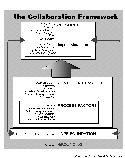 |
• DISCUSS: Grounding, Core Foundations, Outcomes, Process and Contextual Factors. (1) Grounding is the bedrock for successful collaborative efforts. It entails honoring the diversity—the unique gifts and talents—of each person, group and organization within the collaboration, and striving to include all relevant parties in the collaboration. (2) The Core Foundation represents the common ground of understanding and purpose inspiring your collaborative group. This is on-going and a process where you will continually refine and articulate your vision, mission, values and principles. Process and Contextual Factors represent those things that can either help or hinder your collaboration. (3) Process Factors include specific tools to build effective working relationships. (4) Contextual Factors are conditions either existing or lacking within your environment which may enhance or inhibit your efforts. (5) Outcomes are the desired future conditions for your community, such as increased livable wage jobs for families, or decreased vandalism and increased public safety. |
| • EXAMPLE: In our case scenario Grounding consisted of taking a community-based approach, integrating diversity with stakeholders from three distinct cultural communities, a broad range of socio-economic levels, and having both old and young people participate during all developmental phases. The Core Foundation developed a vision to insure young people became contributing, productive community citizens. Process Factors utilized a community action planning approach that engaged a wide cross-section of people, identified underlying root causes, and developed specific courses of action. Contextual Factors included a history of community groups working together. Historically, people did not perceive the issue as a problem. Examples of Outcomes included three areas: (1) Education - people will be prepared for the 1990's knowing that 90% of the jobs by the year 2000 will require post-secondary education; (2) Health -people will become parents when they can support their family economically with good parenting skills, and also be contributing community members; and (3) Economic - to have a quality community workforce for jobs for young people needing to have at least a high school education. |
| • OUTCOMES: To assist participants in identifying their collaborative goals. • DISCUSS: General Goals for Collaboration are: (1) Build community capacity, (2) Promote the well-being of children, youth and families, and (3) Solve existing and emerging problems. |
|
 |
Specific goals for your collaboration may be: (1) About the well-being of your community - all community members will be committed to creating a positive environment; (2) Healthy life-styles - all community members will have the resources to reach their full physical, mental, emotional and spiritual capacity; or (3) Safety - community neighborhoods will be safe and secure. • ACTIVITY: Have participants describe their goals for collaboration and discuss their responses. Analyze themes with the group. Have the group prioritize their goals. • OPTIONS: (1) Have participants write down their goals on the worksheet and discuss it in small groups, or (2) After individuals have filled out the worksheet, have them transcribe their top two goals onto colored sticky notes. Have all participants put their sticky notes on a wall or flip chart page and then group them categorically. |
Training Manual Menu | | Main Menu |