Summer on the Lake: Cyanobacteria Education
By Jessie Curl, Communications Lead & Program Specialist, Lake Champlain Sea Grant
Cyanobacteria blooms have led to frequent beach closures in Burlington and across Lake Champlain this summer. While a closed beach may seem like an inconvenience on a hot day, these closures are necessary because cyanobacteria can pose serious risks to people and pets. Knowing how to recognize a bloom and understanding what steps to take when one is present can help keep you, your family, and your pets safe. Lake Champlain Sea Grant is working to increase public awareness of cyanobacteria and improve access to information about bloom activity and beach conditions. This summer, we have hosted media tours, engaged with elected officials, and supported efforts to make beach closure signage more accessible and informative.
Science Writers Explore Cyanobacteria Blooms in Lake Champlain
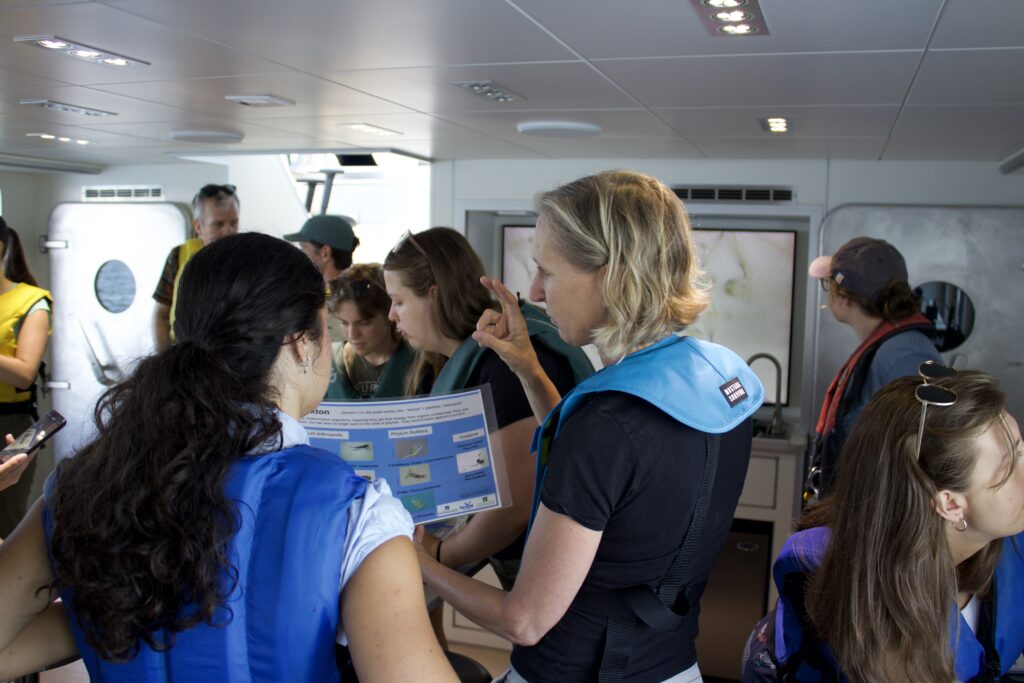
This July, Lake Champlain Sea Grant (LCSG) welcomed science writers and members of the media aboard the R/V Marcelle Melosira for a hands-on look at cyanobacteria blooms in Lake Champlain. Participants joined scientists in collecting and analyzing water samples for cyanobacteria, while learning about ongoing research, the current state of the lake, and volunteer water quality monitoring programs. This annual trip aboard the research vessel helps equip media professionals with the knowledge needed to inform the public about water quality issues and share actions we can all take to protect Lake Champlain. This year, the focus was on reducing phosphorus pollution in the lake, a key contributor to cyanobacteria blooms.
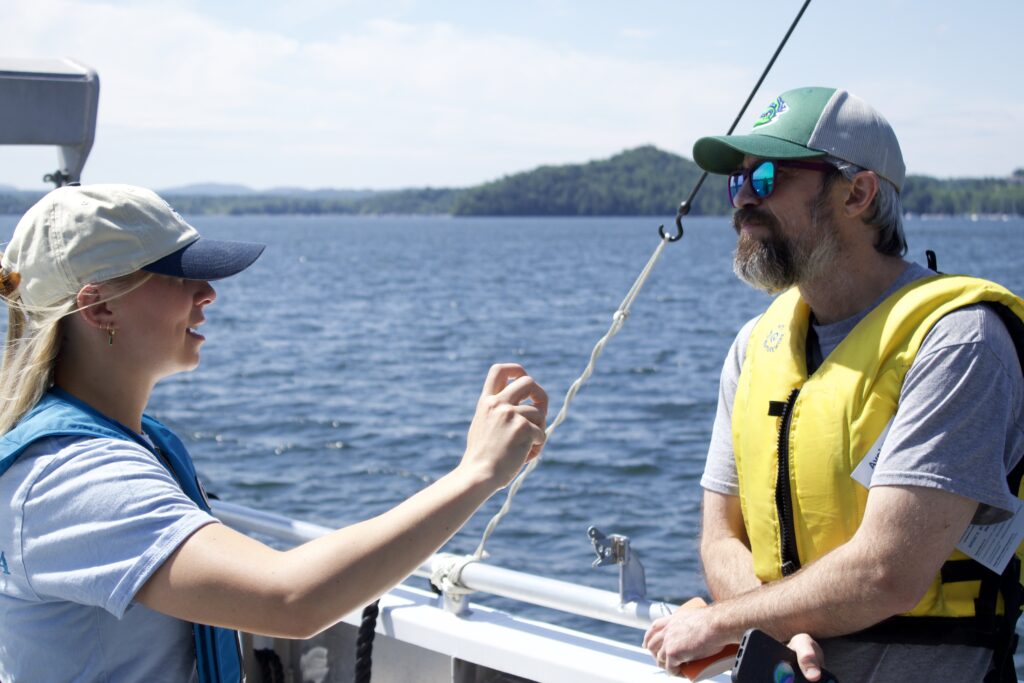
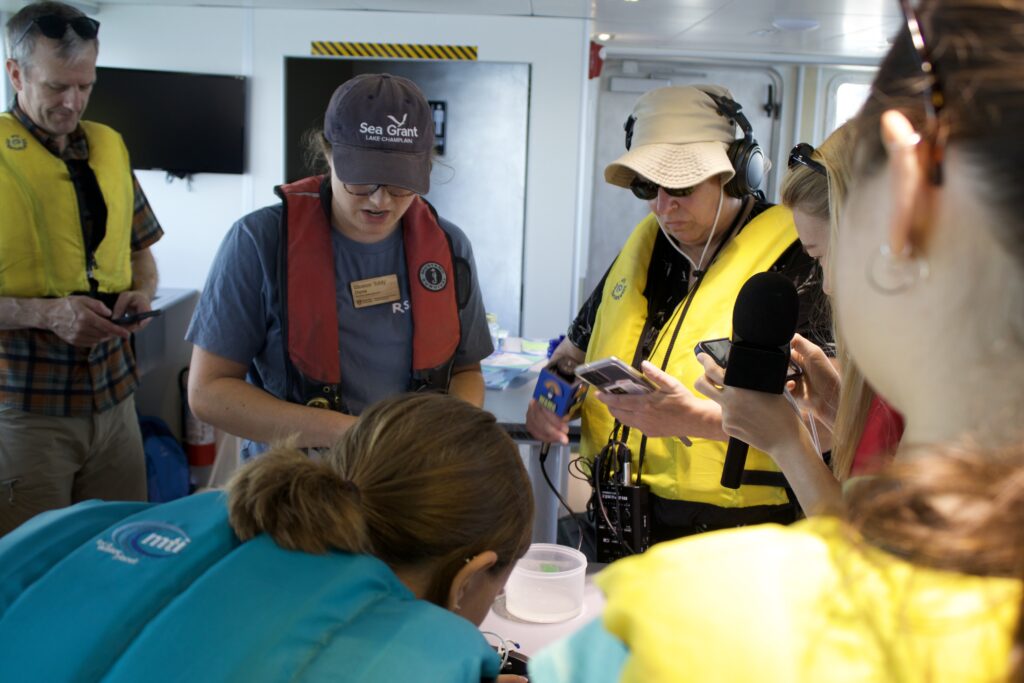
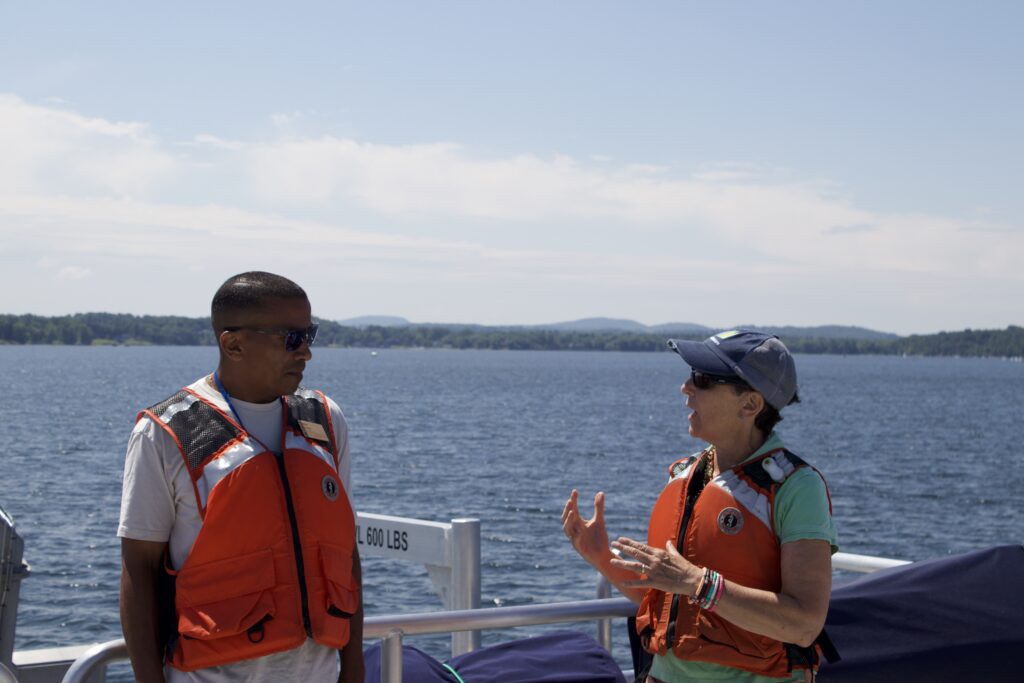
The trip began with a “Cyanobacteria 101” lesson from Lake Champlain Basin Program Chief Scientist Dr. Matthew Vaughan, who provided an overview of cyanobacteria and the environmental conditions that may contribute to bloom formation. “Cyanobacteria blooms can come and go very quickly,” Vaughan explained. “These hot, dry days are when you should be thinking about it and looking out for it.”
Continued monitoring and testing of water quality play an important role in protecting human health. Dr. Lindsey Cookson of the Lake Champlain Committee highlighted the organization’s cyanobacteria monitoring program, which has trained and supported volunteers to survey bloom conditions and report findings since 2004.
The severity and existence of cyanobacteria blooms can vary from lake to lake and hour to hour. Vermont Department of Environmental Conservation State Limnologist Peter Isles emphasized the importance of awareness and education about the topic so that beach visitors can recognize blooms and recreate safely. “The nice thing about cyanobacteria in relation to some other water quality contaminants is that when they’re present, you can see them. And if there’s enough to be dangerous, you can definitely see them,” said Isles. “So, once you learn to educate yourself and to recognize them, then you can enjoy our water safely.” Cyanobacteria blooms can look like spilled paint, foam, or scum on the water’s surface. Blooms can be green, red, brown, or blue. Sometimes they hide below the water’s surface and are not highly visible.
Reducing phosphorus pollution is one way that everyone can play a role in improving water quality. “Whatever you can do on your property to minimize the water running off that property or erosion coming off the property is going to help the lake and help to minimize cyanobacteria,” shared Dr. Kris Stepenuck, Extension Leader and Associate Director of Lake Champlain Sea Grant. This includes reducing the application of phosphorus fertilizers to lawns (which, by law, should only be applied if a soil test indicates phosphorus is needed or when establishing a new lawn), picking up pet waste, and limiting impervious surfaces on your property.
Participants also learned about ongoing research at the University of Vermont, Vermont Limnology Laboratory. Research Scientist Dr. Katelyn Warner discussed how the limnology lab studies phytoplankton community composition and how environmental drivers may be influencing them.
“We’re curious about the entire phytoplankton community as a whole. So, the Vermont Limnology Lab is looking at phytoplankton community composition, what environmental drivers are changing these communities, and how they shift over time in response to changes in weather patterns and nutrient cycling and all of that. We really are interested in who’s all here and exists together and how those patterns might change over time,” shared Warner.
A special thank you to our partners at the Vermont Department of Environmental Conservation, University of Vermont, R/V Marcelle Melosira, Lake Champlain Basin Program, and the Lake Champlain Committee for helping make this educational experience possible.
This trip resulted in media coverage from four outlets:
WCAX: Scientists aboard UVM research vessel study algae blooms on Lake Champlain
ABC22/FOX44: What to do about blue-green algae in Lake Champlain
NBC5: Vermont scientists use Lake Champlain boat ride to study cyanobacteria blooms
WAMC: Lake Champlain researchers highlight research into cyanobacteria blooms
Capital for a Day Event Highlights Lake Carmi Restoration Efforts
Lake Champlain Sea Grant Lake Monitoring and Community Outreach Coordinator Mark Mitchell had the opportunity to speak with Governor Phil Scott, Vermont Agency of Natural Resources Secretary Julie Moore, and Vermont Agency of Agriculture Food and Markets Secretary Anson Tebbetts during a “Capital for a Day” event in Franklin County, Vermont. During the event, Mark shared water quality samples collected from Lake Carmi through Vermont’s Lay Monitoring Program, highlighting the important role of community-based monitoring in lake restoration efforts.
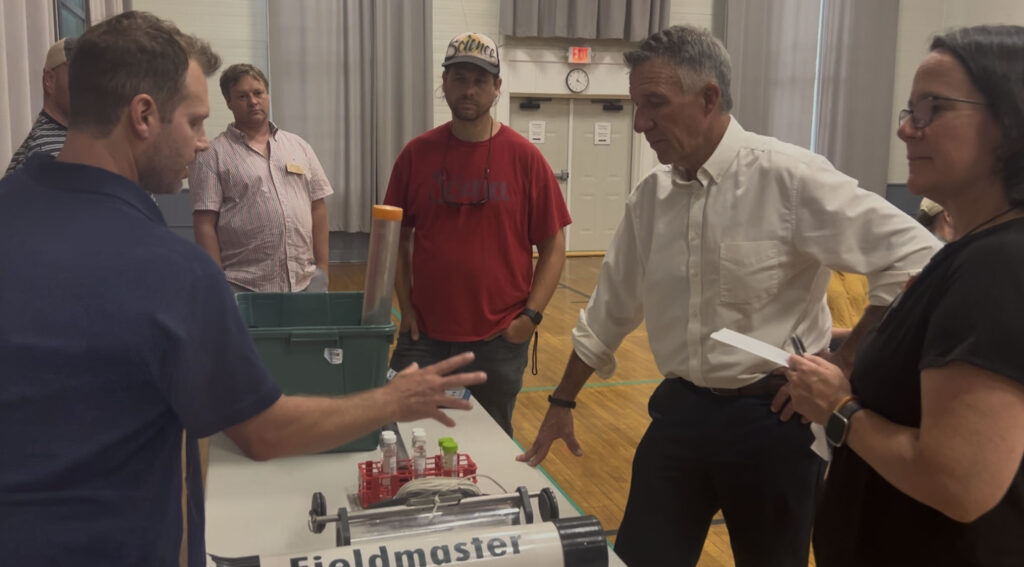
Lake Carmi, a 1,375-acre lake in the northwest corner of Vermont, has experienced recurring cyanobacteria blooms for decades. These blooms can reduce water clarity, emit a foul odor, and produce toxins that lead to beach closures and swimming advisories. Cyanobacteria blooms have had a significant impact on the local Lake Carmi community and economy. In 2008, the VT Department of Environmental Conservation listed Lake Carmi as “impaired” for phosphorus, meaning that it did not meet Vermont Water Quality Standards. This designation prompted a restoration plan to address the amount of phosphorus entering the lake.
A major milestone occurred last fall, when the lake underwent an aluminum sulfate (alum) treatment to address persistent internal phosphorus loading, which fueled repeated cyanobacteria blooms. Alum treatments have been used successfully in lakes for decades, including twice in Lake Morey in Vermont, where water quality has significantly improved after treatments in 1986 and 2024. The goal of the Lake Carmi alum treatment project is to address legacy phosphorus stored in the lake and its sediments. The treatment, which can be effective for 10 to 15 years, is expected to contribute to improved water quality in the lake, particularly in reducing cyanobacteria blooms during the summer months and improving water clarity. The treatment appears promising, as Mitchell noted that “the Secchi disk depth was 4 meters, which is nearly double compared to previous years,” indicating measurable improvement.
The Capital for a Day event showcased the power of collaboration and the impact of sustained restoration work. Through persistence, partnership, and a commitment to learning, significant progress has been made toward improving the health of Lake Carmi. As many attendees noted, the accomplishments of the past five years serve as a strong example of what can be achieved when communities, organizations, and agencies work together toward a common goal.
Thank you to Governor Phil Scott; the Vermont Agency of Natural Resources/Department of Environmental Conservation/Department of Forests, Parks, and Recreation; the Vermont Agency of Agriculture; the Lake Carmi Campers Association; the Town of Franklin; the Franklin NRCD; the NRPC; University of Vermont; LCSG; Lake Champlain Basin Program; and the many others who contributed both to this event and to the continued protection of Lake Carmi.
Multilingual Cyanobacteria Warning Signs Available
“Danger! Swimming Area Closed”
Unfortunately, this message has become more common during Vermont summers as warmer conditions create favorable environments for cyanobacteria blooms. While many beaches already have warning signage available, some lack prominent signs or signs that aid beachgoers in understanding what blooms look like to inform their decision of whether to swim or recreate in the water. Also, most beach warning signs surrounding Lake Champlain are only available in English. To address this need, Lake Champlain Sea Grant worked with beach managers, nonprofit organizations, and Vermont and New York health department staff to develop cyanobacteria warning and swimming area closed signs in eight different languages.
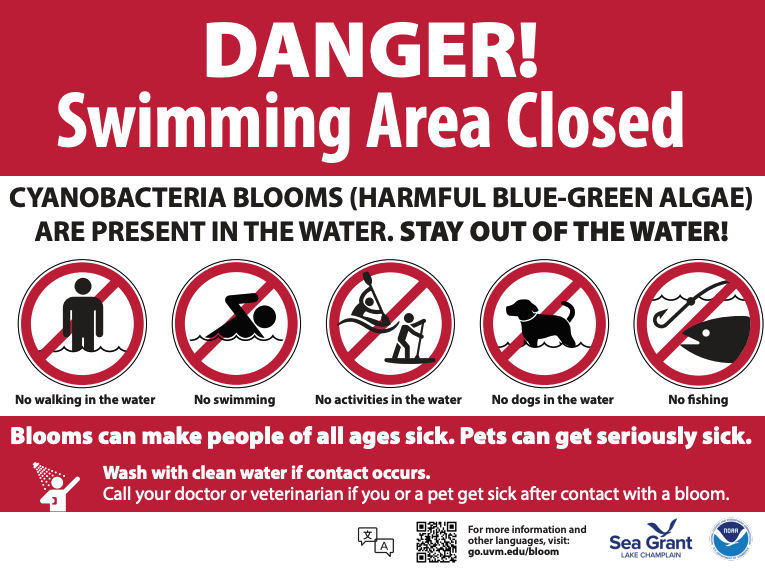
LCSG has English-language election-style signs available to distribute to local beach managers. These signs contain a QR code link to online versions of the signs in the other languages. The signs are also available for download and printing at go.uvm.edu/bloom. LCSG is willing to share the design files for beach managers who would like to personalize contact information at the bottom of the signs. Contact Kris Stepenuck to inquire (kstepenu@uvm.edu).
By making these resources available to beach managers, watershed organizations, and community leaders, LCSG hopes to improve public awareness and ensure more people have access to information about cyanobacteria blooms and beach conditions.