Lake Champlain Sea Grant Announces 2026 Funded Research Projects
By Jessie Curl
Lake Champlain Sea Grant (LCSG) is excited to share the research projects selected for funding in 2026. These awards support priorities outlined in the 2024–2028 LCSG Strategic Plan, shaped through extensive input from partners, community members, and organizations across the Lake Champlain basin. Through this work, LCSG continues to advance its role as a basin-wide leader in science-informed education, outreach, and research that strengthens ecosystem health and resilience.
Education remains central to our mission. LCSG is committed to engaging a wide range of audiences, including basin residents, land managers, and students at the K–12, undergraduate, and graduate levels. Each funded project integrates meaningful outreach components such as public events, community engagement, peer-reviewed publications, and partnerships within the basin, and provides hands-on learning opportunities for undergraduate and graduate students in Vermont and New York.
Following a competitive and rigorous review process, five proposals were selected for funding. The 2026 awards support research teams from the University of Vermont, SUNY–Brockport, SUNY College of Environmental Science and Forestry, and the Ausable Freshwater Center.
Dr. Matthew Futia of SUNY Brockport will evaluate the severity of Thiamine Deficiency Complex (TDC) in both stocked and wild lake trout populations in Lake Champlain. This research will help fisheries managers better understand the extent of thiamine deficiency in the lake trout population and assess the degree to which it may be limiting natural recruitment. The project will provide a new perspective on the extent of TDC in Lake Champlain, which can be used to inform future lake trout monitoring and management.
Drs. Richard Shaker and Eddie Bevilacqua of SUNY ESF will evaluate whether passive environmental DNA (eDNA) improves the sensitivity and operational efficiency of aquatic invasive species detection compared to conventional eDNA and traditional field studies. This project will also develop and validate lake-landscape models to assess and map aquatic invasive species (AIS) risk across the Lake Champlain Basin, supporting earlier detection and more targeted, cost-effective management.
Carrianne Pershyn and Gary Henry of Ausable Freshwater Center will combine predictive landscape analysis, ground-truthing, and drone-based thermal imagery to identify and assess thermal refuge zones in the East and West Branches of the Ausable River. This project will provide critical new data to inform fisheries management, riparian restoration, and aquatic organism passage planning. The outcomes will support climate resilience, sustain sportfishing economies, and enhance long-term survival prospects for coldwater fish populations in the Adirondack rivers of the Lake Champlain Basin.
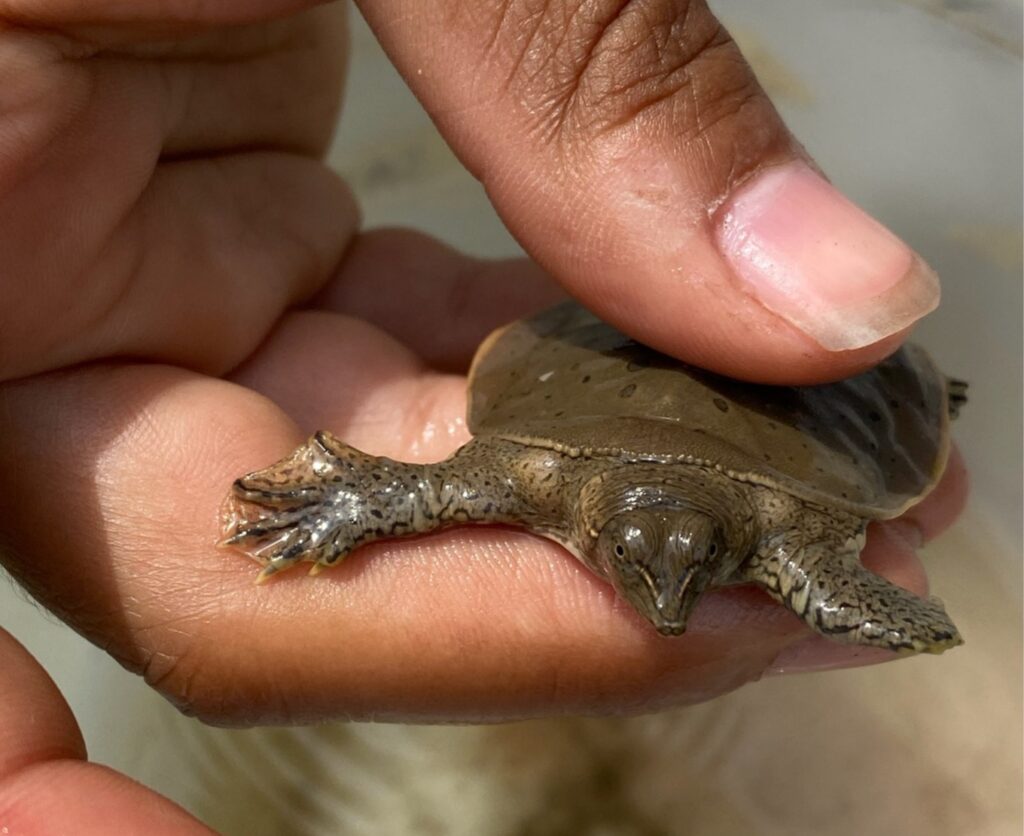
Dr. Brittany Mosher of the University of Vermont will use acoustic telemetry to track the movements of spiny softshell turtles (Apalone spinifera) across Lake Champlain and its tributaries to determine population connectivity, movement corridors, and whether the species has recolonized the Winooski River. The project will also engage K–12 students and regional partners through hands‑on education and outreach, supporting conservation of this state‑threatened species and informing long‑term recovery planning.
Drs. Helena Jolly and Bindu Panikkar of the University of Vermont will explore how winter environmental relationalities affect the economic opportunities, recreational activities, social interaction, and health and well-being among winter novices in the Lake Champlain region. Findings will inform policy, public health strategies, and community-based interventions that enhance resilience and equity in the region.
These two-year research projects will begin this field season, and Lake Champlain Sea Grant will communicate findings throughout the projects. If you’re interested in learning more about these projects, sign up for our newsletter to get updated when we announce our fall Research Webinar Series. If you’re interested in receiving Sea Grant funding, check out the resources on our request for proposals page.