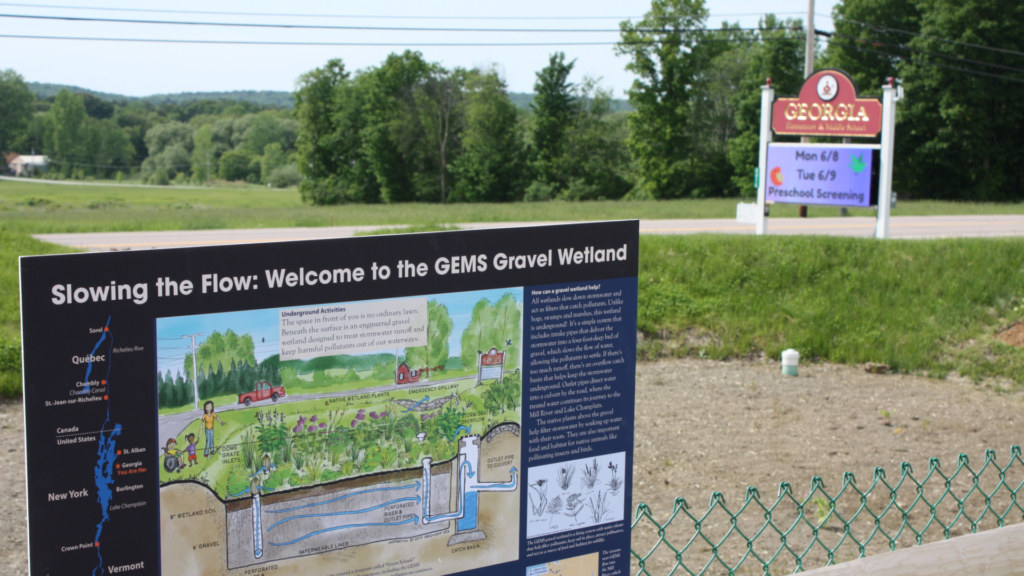
The Vermont Green Schools Initiative: Slowing the Flow
By Ashley Eaton, Watershed Education Coordinator
Supporting K-12 Schools to meet stormwater requirements and engage in stormwater education
Since 2020, Lake Champlain Sea Grant (LCSG) has been partnering with the Vermont Department of Environmental Conservation (VTDEC) and Greenprint Partners on the Vermont Green Schools Initiative. This initiative is part of a larger watershed effort to reduce stormwater runoff in the Lake Champlain and Lake Memphremagog watersheds to help both bodies of water meet their phosphorus total maximum daily load (TMDL) limits, or the maximum amount of a pollutant permitted to enter a waterbody.
Stormwater is water from rainfall, melting snow, or ice that moves over the land and collects pollutants as it makes its way to lakes, ponds, streams, and other surface waters. Because urban areas typically have more impervious surfaces (where water cannot infiltrate into the ground), stormwater may reach these waterbodies more quickly and in higher volumes following a rainfall event than it would in a natural area. Alternatively, in natural areas, stormwater can more easily soak into the ground and eventually recharge surface waters. The health of Lake Champlain and other waterbodies in the basin (which lies within portions of Vermont, New York, and Quebec) is impacted by nonpoint sources of pollution (not from a single source), which can carry phosphorus, nitrogen, sediments, chloride, and bacteria through stormwater runoff.
In 2020, the State of Vermont released a new stormwater permitting regulation, General Permit 3-9050 (commonly referred to as the “Three-Acre General Permit”). Under this new regulation, sites with impervious surfaces over 3-acres, which includes many K-12 schools and state college campuses, would be required to manage their stormwater on-site. This means implementing stormwater management retrofit practices that capture, slow, and sink stormwater into the ground. To address concerns over how K-12 schools would meet this new permitting requirement, the Vermont Green Schools Initiative was launched!
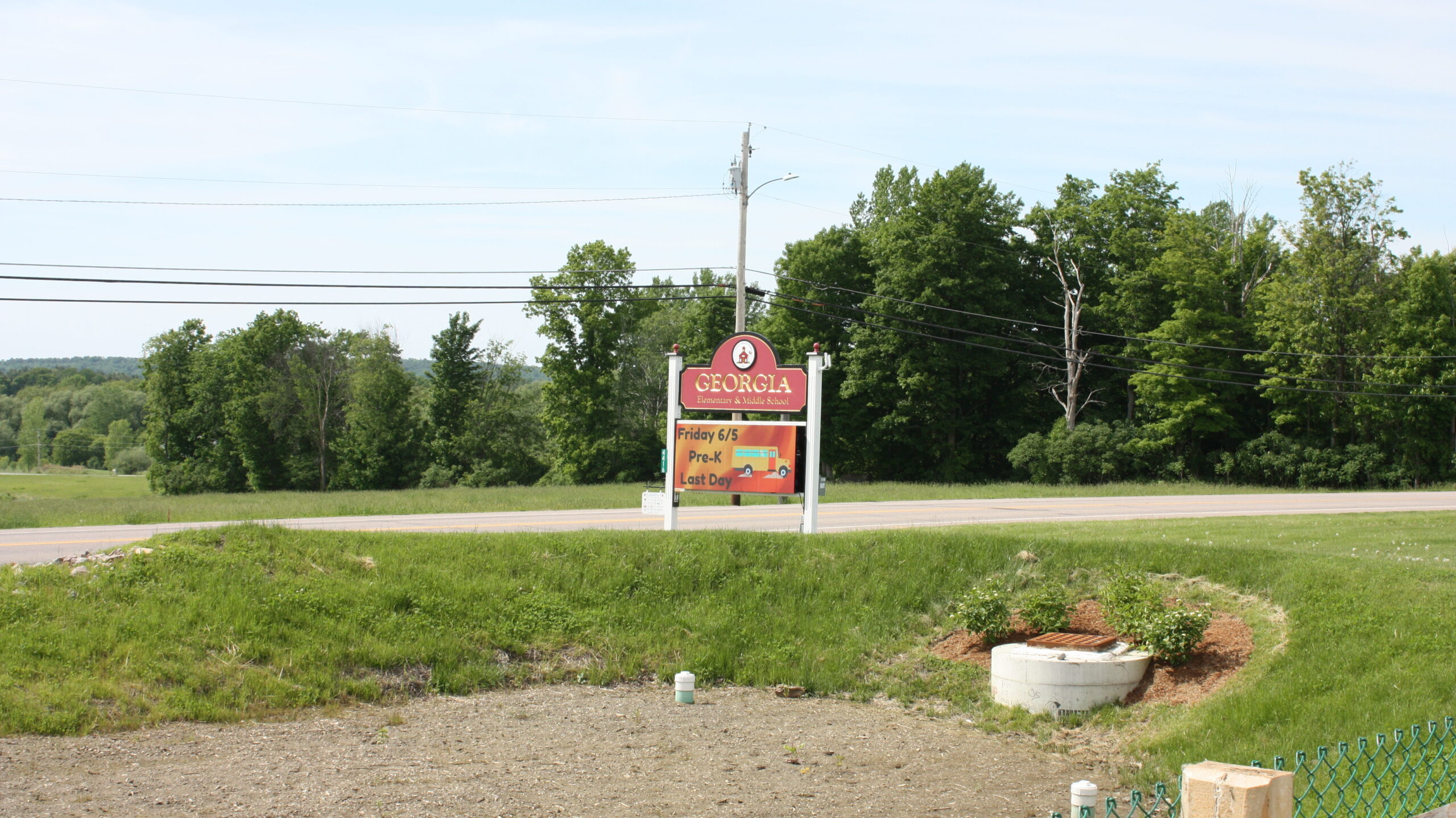
The program offers funding and technical assistance to assist public schools and state colleges in complying with the General Permit 3-9050. Because several schools fall within the permit’s requirements, this program presents a great opportunity to collaborate and support schools in navigating the regulation.
Currently, 65 schools have permitted designs, and 35 schools have completed stormwater projects. Installed stormwater management practices include gravel wetlands—subsurface gravel/stone layers that lie beneath a wetland soil surface—as well as the installation of subsurface storage chambers. In 2026, construction is anticipated at nine additional schools, with two projects expected to be completed in 2027.
LCSG’s role in the project has been to provide stormwater education and outreach to school communities, with our Soaking up Stormwater in the Lake Champlain Basin and Beyond curricula at the forefront of this work. Over the past five years, LCSG Watershed Education Coordinator Ashley Eaton has trained more than 40 K-12 teachers and informal educators, along with 10 watershed organizations, on how to utilize the curriculum for place-based learning on school campuses. This work includes a course offered through the University of Vermont (UVM), Stormwater Education Methods, that was co-taught with Kris Stepneuck, LCSG Associate Director.
Additionally, LCSG has helped schools identify ways to maximize the added benefits of green stormwater projects, such as creating pollinator habitat and outdoor classrooms. One standout example is the work happening at Georgia Elementary and Middle School (GEMS), where the GEMS Middle School Cultivating Pathways to Sustainability Youth Leadership Team spent this school year becoming stormwater stewards by installing a gravel wetland at the school’s main entrance. Cultivating Pathways is a Shelburne Farms program that empowers youth to make meaningful change in their schools and communities.
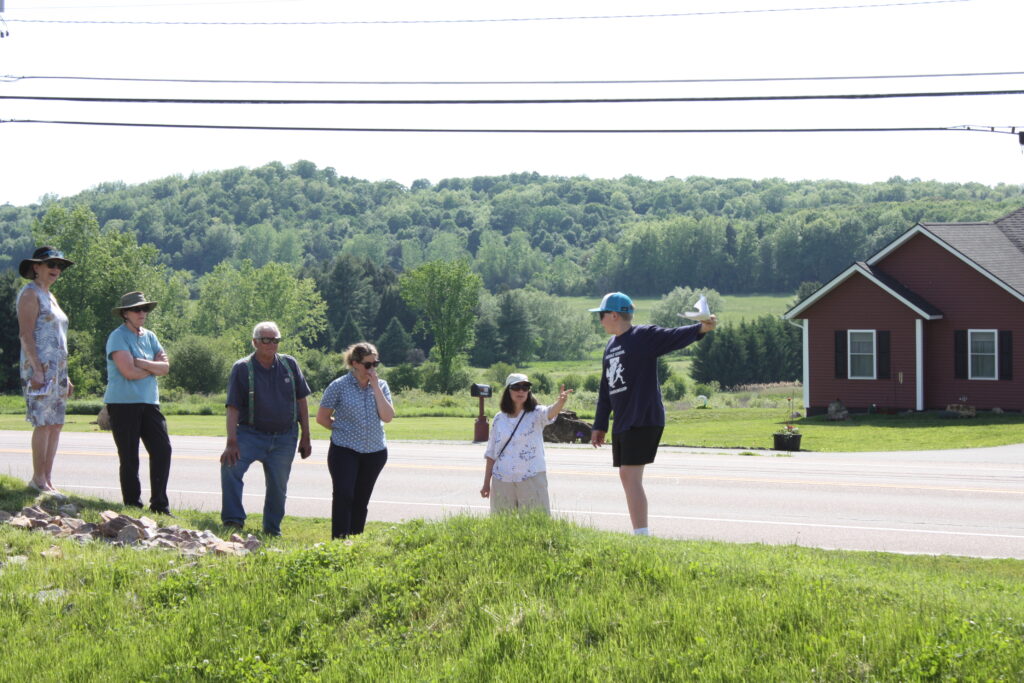
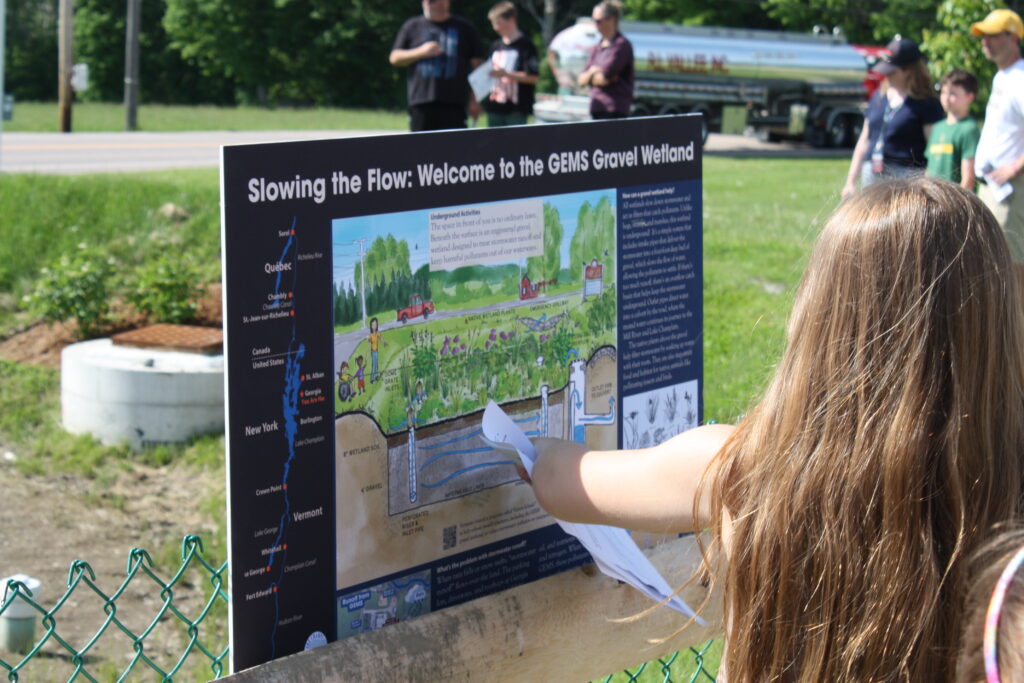
Through additional funding from the Lake Champlain Basin Program, the GEMs leadership team worked with the Lake Champlain Committee this year to learn about what stormwater is and how it impacts water quality. Through this effort, students also engaged in the design and planting of several native species to increase pollinator habitat around the gravel wetland. A goal of the leadership team was to communicate the importance of the new gravel wetland to fellow classmates and members of the community–and they spent the last six months putting this into practice! Students taught a “slow the flow” activity to the third and fourth-grade classes at GEMS to increase the understanding of stormwater across the student body, helping build connections to the new gravel wetland installed in front of the school campus. The team didn’t stop there–in January, they had the opportunity to share their stormwater knowledge at the Lake Champlain Research Conference and even presented at the Vermont State House. The culmination of this project happened just this month, when GEMS students guided over 35 community members on a tour of the gravel wetland and native plants.
Lake Champlain Sea Grant is so grateful to our partners at the Lake Champlain Basin Program, the Lake Champlain Committee, and the amazing school community at the Georgia Elementary and Middle School for being a leader and advocate for the Vermont Green Schools Program.
To learn more about the Green Schools Initiative, click here.